
Top 10 Aluminum High Bay Lights for Warehouses?

Time:2026-11-09 Author:Liam
0%

A warehouse needs more than bright fixtures. It needs light that reaches aisles, racks, loading zones, and work surfaces with useful consistency. This guide to the Top 10 Aluminum High Bay Lights for Warehouses compares practical features, including output, beam distribution, glare control, dimming options, and housing design. An Aluminum High Bay Light may suit a tall ceiling, but the right choice still depends on mounting height, aisle width, and the tasks below. Small details matter. A narrow beam can leave dark gaps between shelves; poor glare control can make a long shift harder on workers’ eyes.

Lighting researcher Dr. Ian Ashdown is known for his work on lighting measurement and visual performance. As a paraphrase of a measurement-focused principle: “Check the light at the work surface, not just the fixture label.” That is a useful test when comparing product claims with actual warehouse needs. The list considers construction and heat management, too, since aluminum housings can help transfer heat away from LEDs. Still, materials alone do not guarantee long service life; installation, operating temperature, and product quality matter. No shortlist is perfect. Specifications can look convincing on a page, while real performance depends on the space. Use these picks as a starting point, then verify photometric data and confirm that the beam pattern fits your layout before choosing.
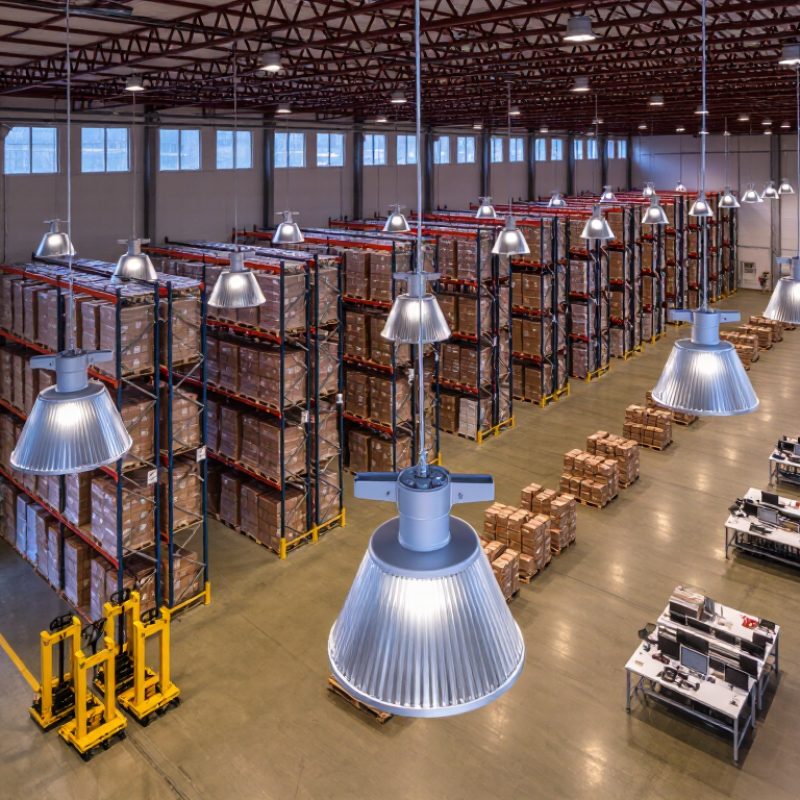
Top 10 Aluminum High Bay Lights for Warehouses?

What Aluminum High Bay Lights Are and How They Work

An aluminum high bay light is a ceiling-mounted fixture designed for large, tall spaces such as warehouses. Its aluminum housing supports the LED board and helps move heat away from sensitive components. Heat matters. Excess heat can shorten LED life and reduce light output over time.

Inside, a driver converts incoming electricity into the controlled current LEDs need. The LEDs create light, while a reflector or lens directs it toward aisles, racks, and work areas. The housing also acts as a heat sink, releasing warmth into the surrounding air. In practice, mounting height and beam angle affect whether light reaches the floor or leaves dark patches between shelves. Aluminum helps manage heat, but it cannot fix poor optics or a badly planned layout.

The U.S. Department of Energy’s 2022 Energy Savings Forecast of Solid-State Lighting projects that widespread LED adoption could save about 569 terawatt-hours of electricity annually by 2035. That estimate covers lighting across the country, not warehouse high bays alone. Actual savings depend on the old fixtures, operating hours, controls, and installation quality. A sensor may reduce use in quiet aisles, but only when its settings suit real work patterns. Sometimes the details are less tidy than a product specification suggests.

Key Features Used to Compare Warehouse High Bay Lights

Warehouse high-bay comparisons should start with delivered light, not advertised wattage. Check lumens per watt, tested output, beam angle, and mounting height. A narrow optic can leave dark aisles, even when the lumen figure looks impressive. Compare lighting plans with aisle width and rack height, not just fixture count. Color rendering, glare control, and flicker also matter when staff read labels or operate forklifts.

Energy use deserves equal scrutiny. The International Energy Agency’s Energy Efficiency 2023 report estimates that lighting accounts for about 15% of global electricity consumption. Compare efficacy using LM-79 test reports, then check driver warranty, thermal design, dimming range, and sensor compatibility. High ceilings complicate maintenance; a small efficacy gain may not offset frequent lift rentals. A polished specification can still hide poor aisle uniformity.

Tips: Request a photometric layout based on your actual rack plan. Verify that controls dim smoothly, and inspect sample output on site. Small details matter. Recheck after installation; real layouts rarely match drawings perfectly.

Top 10 Aluminum High Bay Lights for Warehouses

A practical top ten of aluminum high bay lights should compare designs, not just advertised wattage. A die-cast UFO model suits open warehouse floors, while a linear aluminum fixture can spread light along long aisles. Adjustable-wattage models help match output to ceiling height. Selectable color temperature offers flexibility, though consistency matters when replacing fixtures in the same zone. Sensor-ready models can reduce energy use in areas with changing occupancy. Check the details.

For narrow shelving, aisle-focused optics direct light onto rack faces and floor paths. Wide-beam versions work better across open loading spaces. Sealed housings can help limit dust entering the fixture, but inspect the stated protection rating and installation conditions. Emergency-backup models provide another option where continued illumination is needed during an outage. Dimmable fixtures suit spaces with compatible controls and wiring. Aluminum helps move heat away from LED components, yet housing shape and thermal design matter too. Ten options, then; no single winner. Before choosing, compare mounting height, beam angle, measured light output, and color consistency. A fixture that looks bright on a datasheet may leave dark patches between tall racks. That is easy to overlook.

How the Top Models Differ in Performance and Applications

Aluminum high bay lights differ in more than wattage. Compare delivered lumens, efficacy, beam angle, glare control, and thermal design. A narrow optic can reach tall pallet aisles with less spill; a wide distribution suits lower racks and open packing zones. Aluminum housings help move heat away from LED boards, but poor fin design or dust buildup can still shorten service life. Small details matter.

For a practical comparison, check photometric files and mounting height, then match light levels to the actual task. A 30-foot ceiling above forklift aisles needs different optics from a 20-foot picking area. Motion sensors and dimming can reduce energy use in lightly occupied zones, though controls need careful commissioning. The U.S. Department of Energy’s 2019 Energy Savings Forecast of Solid-State Lighting projected up to 569 terawatt-hours of annual electricity savings by 2035 across general lighting applications; that is a sector-wide forecast, not a warehouse guarantee. Treat it as context, not a promise.

The top models may also diverge in ingress protection, surge tolerance, and warranty terms. Check whether the rating fits damp, dusty, or temperature-variable spaces. A higher lumen figure is not always better. Uneven aisles still happen. One overlooked issue is glare from polished floors or reflective pallet wrap; a site mock-up can reveal it before full installation.

Top 10 Aluminum High Bay Lights for Warehouses? — How the Top Models Differ in Performance and Applications

Representative, brand-neutral product profiles for comparison—not specific commercial products. Figures are typical specification targets; actual performance varies by design, optics, driver, and operating conditions. Ranking is editorial, not a certified market ranking.

Rank Generic Model Profile Housing Input Power Typical Light Output System Efficacy Color Options Optics Ingress Rating Typical Application Key Performance Difference
1 Compact Linear High Bay Extruded aluminum body with heat-dissipating fins 100 W 15,000 lm 150 lm/W 4000 K or 5000 K; CRI ≥ 80 120° wide distribution IP40 Small warehouses, packing areas, and lower mounting heights Low power draw and broad coverage for modest ceiling heights
2 Standard Linear High Bay Extruded aluminum housing 120 W 18,000 lm 150 lm/W 4000 K or 5000 K; CRI ≥ 80 90° or 120° IP40 General-purpose warehouse aisles and open storage areas Balanced output and coverage for everyday warehouse lighting
3 Efficient Mid-Power High Bay Die-cast aluminum heat sink and frame 150 W 24,000 lm 160 lm/W 4000 K or 5000 K; CRI ≥ 80 90° IP40 Medium-height storage zones and distribution centers Higher efficacy helps reduce energy use where long operating hours are common
4 Wide-Beam Mid-Power High Bay Die-cast aluminum housing 150 W 21,000 lm 140 lm/W 4000 K or 5000 K; CRI ≥ 80 120° wide distribution IP54 Open floor areas where broad, relatively even illumination is needed Wider beam and added dust protection; lower efficacy than the high-efficiency profile
5 Heavy-Duty 200 W High Bay Rugged die-cast aluminum housing 200 W 30,000 lm 150 lm/W 4000 K or 5000 K; CRI ≥ 80 60° or 90° IP65 High-bay warehouses with dust exposure or routine washdown requirements Sealed construction suits harsher environments; verify the fixture’s approved cleaning conditions
6 High-Efficacy 200 W High Bay Aluminum heat-sink housing 200 W 34,000 lm 170 lm/W 4000 K or 5000 K; CRI ≥ 80 90° IP40 Large facilities prioritizing energy savings and high light output High lumen output per watt; best suited to clean, dry indoor locations
7 High-Output 240 W High Bay Die-cast aluminum body with thermal fins 240 W 36,000 lm 150 lm/W 4000 K or 5000 K; CRI ≥ 80 60° or 90° IP65 Tall storage racks, industrial aisles, and dusty work areas Combines substantial output with a sealed enclosure for demanding settings
8 Precision-Aisle 240 W High Bay Aluminum housing with aisle-focused optical lens 240 W 38,400 lm 160 lm/W 4000 K or 5000 K; CRI ≥ 80 30° × 70° aisle distribution IP40 Narrow warehouse aisles with tall pallet racking Shapes light along the aisle to improve useful illumination and limit spill onto adjacent racks
9 High-Output 300 W High Bay Heavy-duty die-cast aluminum housing 300 W 45,000 lm 150 lm/W 4000 K or 5000 K; CRI ≥ 80 60° or 90° IP65 Very high ceilings, large industrial spaces, and high-bay storage High delivered lumens can reduce fixture count, subject to a photometric layout
10 Premium-Efficacy 300 W High Bay Aluminum heat sink and sealed fixture body 300 W 51,000 lm 170 lm/W 4000 K or 5000 K; CRI ≥ 80 60° or 90° IP65 Very tall warehouses and facilities with demanding energy targets Highest output and efficacy in this comparison; check temperature ratings and glare control for the installation

How to Choose a Light for Your Warehouse Conditions

Choosing an aluminum high bay light starts with the warehouse, not the fixture list. Measure ceiling height, aisle width, and the distance between beams or racks. A narrow aisle may need a focused beam, while open storage often benefits from wider coverage. Check the lighting layout on a floor plan before ordering. Looks bright on paper is not always bright on the floor.

Dust, moisture, heat, and cleaning routines matter too. In a dusty packing area, inspect how the fixture sheds heat and how easily its lens can be cleaned. For damp locations, confirm the protection rating suits the actual exposure; do not assume aluminum alone makes a light weatherproof. Review the operating temperature range and mounting method, especially near loading doors where conditions can change quickly. Small details count.

Match output to the work. Picking labels and checking inventory need clear, even light, not just a high lumen number. Ask for a photometric layout, then check for dark gaps, glare, and shadows cast by tall racks. Dimming or occupancy controls may help in low-traffic zones, but test sensor placement around moving equipment. A tidy calculation can still miss real workflow. Leave room for adjustment after installation, and compare measured light levels with the tasks and applicable guidance.

FAQS

What should I compare when choosing warehouse high-bay lights?

Compare measured light output, efficacy, beam angle, mounting height, and glare control. Advertised wattage alone can mislead.

How does warehouse layout affect light selection?

Measure ceiling height, aisle width, and rack spacing. Narrow aisles may need focused beams; open areas often suit wider coverage. Check the floor plan.

Why request a photometric layout?

It shows how light may reach aisles, rack faces, and work areas. Ask for one based on your actual rack plan. Drawings can still miss things.

What should I check beyond brightness?

Check color rendering, flicker, and glare. Staff need to read labels clearly. A bright spot is not enough.

Do aluminum housings guarantee good heat management?

No. Housing shape and thermal design also matter. Check the operating temperature range and driver warranty.

Which features can help reduce energy use?

Dimming and occupancy sensors may help in low-traffic zones. Confirm control compatibility and test sensor placement around moving equipment.

How should I choose lights for dusty or damp areas?

Check the stated protection rating, cleaning needs, and exposure conditions. Aluminum alone does not make a fixture weatherproof. Keep it practical.

What should I inspect after installation?

Look for dark gaps, glare, and shadows between tall racks. Compare measured light levels with the work being done. Real layouts rarely match perfectly.

Conclusion

This article explains what an Aluminum High Bay Light is and how it delivers focused illumination from ceilings in large warehouse spaces. It outlines the main features used to compare high bay lights, including brightness, energy use, beam distribution, durability, installation requirements, and suitability for different ceiling heights and working conditions.

A comparison of ten types of aluminum high bay lights highlights how their performance and applications can vary, from general storage areas to spaces that need brighter, more evenly distributed lighting. The article also offers practical guidance for choosing a fixture based on warehouse layout, operating environment, lighting needs, and maintenance considerations, helping readers identify an option that supports safe, efficient, and comfortable daily operations.

Liam

Liam

Liam is a dedicated marketing professional with a profound expertise in the industry, where he excels at highlighting the unique advantages of our core products. With a keen understanding of market trends and consumer needs, Liam frequently updates our company’s professional blog, providing......