
Featured Industrial High Bay & Heavy-Duty Lighting Products
Engineered by leading OEM/ODM factories for extreme environments, heavy manufacturing, logistics hubs, and hazardous facilities.
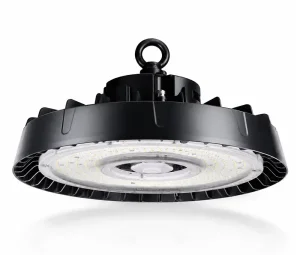
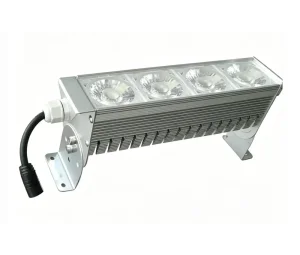
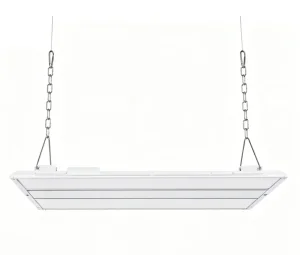
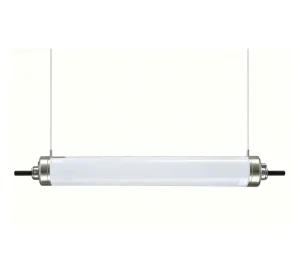
Global High Bay Light Industrial Status & Market Dynamics
Understanding how modern manufacturing ecosystems, carbon neutrality mandates, and energy costs shape industrial lighting procurement.
The global market for industrial high bay lighting is undergoing a structural transformation. Driven by stringent decarbonization targets, accelerating automation in logistics, and escalating industrial electricity tariffs, enterprises worldwide are replacing legacy High-Intensity Discharge (HID), Metal Halide (MH), and High-Pressure Sodium (HPS) systems with advanced solid-state LED high bay architectures. High bay light factories—particularly advanced manufacturing hubs in Shenzhen and Greater Guangdong—have evolved from simple assembly workshops into sophisticated OEM/ODM engineering facilities capable of optical design, thermal modeling, and smart IoT control integration.
Industry Insight: Transitioning from 400W Metal Halide fixtures to high-efficacy 150W-200W LED high bay systems yields immediate energy savings of 60% to 75%. When integrated with DALI-2 daylight harvesting and motion occupancy sensors, net energy reduction regularly exceeds 85% in automated fulfillment centers.
Deep-Dive High Bay Light Engineering & Component Standards
A rigorous examination of optics, thermal dissipation physics, driver topology, and semiconductor reliability.
High bay luminaires operate under harsh industrial stresses—ranging from severe voltage surges and electromagnetic interference (EMI) to high ambient temperatures, oil mist, airborne dust, and high ceiling vibration. A true industrial-grade fixture relies on four interconnected engineering pillars:
| Engineering Subsystem | Technical Specification & Materials | Industrial Performance Impact | Factory Testing Standard |
|---|---|---|---|
| Thermal Management | ADC12 Cold-Forged Aluminum / Copper Heat-Pipe Phase-Change Systems | Keeps $T_j < 80^\circ\text{C}$ under $50^\circ\text{C}$ ambient; prevents thermal throttling. | Thermal Shock (-40°C to +80°C), FLIR Thermography |
| LED Driver Topology | Class I / Class II Isolated Driver, PFC > 0.97, THD < 10%, 6kV–10kV Surge Protection | Suppresses grid voltage spikes, protects against lightning strikes and heavy machinery inductive load switching. | IEEE C62.41.2 Surge Test, EMC CISPR 15 |
| Optical Engine | High-Transmittance Optical PC / Tempered Glass Lens (60°, 90°, 120°, Asymmetric) | Controls UGR (Unified Glare Rating) < 19; optimizes horizontal and vertical lux distribution. | IES LM-79-08, Type-C Goniophotometer Photometrics |
| LED Emitter Array | SMD2835 / SMD3030 / COB Chips (Lumileds, OSRAM, Bridgelux), Ra > 80 / 90 | Delivers system efficacy up to 190–210 lm/W with MacAdam 3-Step Ellipse color consistency. | IES LM-80 / TM-21 Lifetime Projection (>100,000 Hrs) |
1. Advanced Thermal Dissipation Physics
Heat is the primary adversary of semiconductor solid-state lighting. When an LED junction operates above its rated temperature, internal quantum efficiency drops (thermal droop), phosphor degradation accelerates, and epoxy encapsulation yellowing causes color temperature drift. Leading high bay light factories utilize 3D cold-forging die-cast aluminum heat sinks featuring pin-fin ventilation channels. This design harnesses natural chimney convection to draw cool air upward through thermal chimneys, discharging heat away from the LED engine and driver compartment.
2. Precision Photometric Design & Glare Control
In high ceiling industrial spaces (ranging from 6 meters to over 20 meters), unshielded light sources create blinding glare that jeopardizes forklift operators and overhead crane mechanics. Professional linear and UFO high bay luminaires incorporate micro-prismatic optics and anti-glare louvers. By directing beam spreads precisely into working aisles—rather than wasting light on upper wall structures—factories boost Target Lux Efficacy while maintaining UGR < 19 standards compliant with ISO 8995-1 / EN 12464-1 workplace visual comfort codes.
High Bay Light Factory Production Capabilities
Empirical performance benchmarks establishing factory reliability, capacity, and quality verification.
Industrial Application Scenarios & Sector Solutions
Tailored illumination strategies for diverse industrial environments and facility requirements.
1. Logistics & High-Bay Warehousing
Narrow rack aisles up to 15 meters tall require specialized narrow beam optical distributions (30° × 90° or 60° × 120° linear optics). This ensures deep vertical illuminance on barcode labels from floor to top pallet while preventing blinding glare down long aisles.
2. Heavy Manufacturing & Foundries
Foundries, steel mills, and glass processing facilities feature ambient temperatures exceeding 60°C–80°C. High bay factories supply high-temperature rated luminaires with remote-mounted driver enclosures and silicon seals capable of withstanding extreme thermal exposure.
3. Food Processing & Chemical Plants
Washdown environments demand smooth, non-porous housing designs that eliminate bacterial traps. IP69K-rated tri-proof and high bay lights endure 100-bar high-pressure hot water washdowns and corrosive chemical sanitizers without moisture ingress.
Future Trends: Smart Lighting & Industry 4.0 Integration
How next-generation high bay light factories are converging solid-state lighting with industrial IoT ecosystems.
1. DALI-2, Zigbee 3.0 & Wireless Mesh Control
Modern high bay lights are evolving from static illumination points into active IoT nodes. Integrated microwave radar motion sensors and daylight sensors communicate across wireless mesh networks, dynamically lowering lumen output based on real-time occupancy and incoming daylight.
2. Predictive Digital Twin Analytics
By embedding smart drivers equipped with black-box energy metering and operating temperature telemetry, facility managers can monitor driver health in real time. Systems trigger automated maintenance alerts prior to lumen degradation or component failure.
3. Modular Circular Design Architecture
To meet global ESG commitments, top high bay factories are engineering tool-free module replacement systems. Facility operators can replace driver modules or optical arrays independently without discarding the heavy aluminum heatsink assembly.
How to Audit and Select a Qualified High Bay Light Factory
Key verification metrics for global EPC contractors, industrial distributors, and OEM buyers.
Selecting the right factory vendor requires thorough technical due diligence beyond surface-level pricing. Enterprise buyers should evaluate high bay light manufacturers using the following five-stage verification protocol:
Factory Checklist: Ensure the factory maintains in-house SMT lines, automated optical goniophotometers, integrating spheres (minimum 1.5m/2.0m diameter), IPX6/IPX8/IPX9K waterproof testing tanks, and dedicated burn-in aging rooms operating under elevated thermal load.
| Audit Category | Key Factory Deliverables | Compliance Standards to Request |
|---|---|---|
| Quality Management Systems | Traceability of raw materials, inbound component inspection (IQC), in-process quality control (IPQC), final shipping verification (OQC). | ISO 9001:2015, ISO 14001:2015, ISO 45001 |
| Global Safety Certifications | Independent third-party laboratory test reports for specific regional markets. | UL 1598 / CSA C22.2 (USA/Canada), CE-LVD / CE-EMC / ENEC (Europe), CB, RoHS, SAA |
| Optical & Photometric Data | Raw IES / EULUMDAT files generated from calibrated Type-C Goniophotometers for Dialux EVO lighting simulation. | IESNA LM-79-08, IESNA LM-80-08, IES TM-21-11 |
| Environmental Resistance | Ingress protection, mechanical impact resistance, salt spray anti-corrosion rating, and vibration stress resilience. | IP65 / IP66 / IP67 / IP69K, IK08 / IK10, ASTM B117 Salt Spray (500-1000 Hours) |
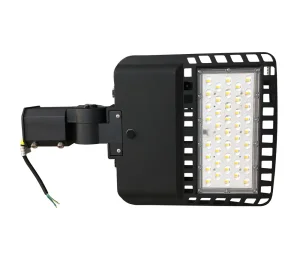
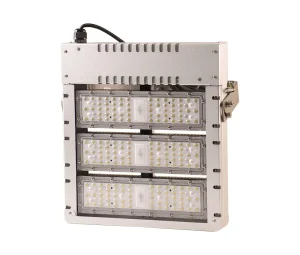
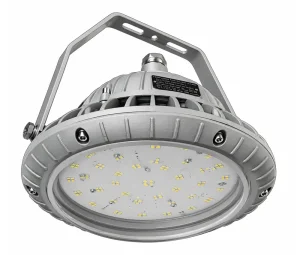
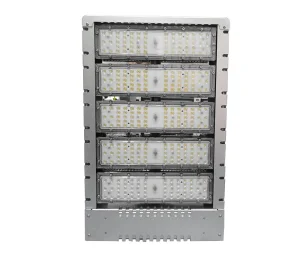
Specialized Industrial & Harsh-Environment Lighting Series
Explore specialized high bay, street, stadium, and explosion-proof luminaires engineered for challenging industrial sites.
High Bay Light Procurement & Engineering FAQ
Expert answers to critical technical questions regarding high bay light factory sourcing, installation, and performance maintenance.
What is the key difference between UFO High Bay and Linear High Bay lights?
UFO High Bay lights feature a compact, circular die-cast design ideal for open space illumination such as manufacturing floors, auto repair shops, and open warehouses. Linear High Bay lights feature a rectangular form factor designed specifically for warehouse aisles, pallet racking, and assembly lines, projecting a rectangular beam spread that minimizes light waste on rack tops while maximizing lux along floor aisles.
How do high bay light factories ensure L70 lifespan over 100,000 hours?
Factories achieve L70 > 100,000 hours by controlling junction temperature ($T_j$) through high thermal conductivity copper heat-pipes or 3D cold-forged aluminum heatsinks ($k > 200\text{ W/m}\cdot\text{K}$), using tier-1 LED chips (Lumileds, OSRAM, Nichia) with LM-80 validation data, and pairing them with high-reliability drivers featuring Japanese 105°C long-life electrolytic capacitors.
What beam angle should I select for a 10-meter to 15-meter mounting height?
For mounting heights between 10m and 15m, a 60° or 90° narrow-to-medium beam optical lens is recommended. Wide 120° optics at heights above 10m cause excessive light scatter in the upper air space, reducing ground illuminance. Narrow optics concentrate foot-candles directly onto work surfaces.
Why is 10kV surge protection essential for industrial high bay luminaires?
Industrial power grids suffer from frequent switching transients caused by heavy electrical loads like electric arc furnaces, large motors, and compressors, as well as atmospheric lightning strikes. Integrated 10kV SPD (Surge Protection Device) modules prevent input voltage spikes from destroying sensitive driver components and LED arrays.
Can OEM high bay light factories customize voltage inputs for 347V/480V industrial grids?
Yes. Leading OEM/ODM factories engineer custom high-voltage high bay luminaires supporting 277V-480V AC (North America) and 347V AC (Canada) inputs alongside standard 100V-277V AC models, eliminating the need for bulky step-down transformers.