
Flagship High-Heat & Critical Duty Fixtures
Explore our foundational range of heavy-duty luminaires designed specifically to solve rapid lumen depreciation, driver thermal cut-off, and enclosure breakdown under blistering operating temperatures.
Engineering the 150℃ Barrier: The Physics of Thermal Survivability
Why standard industrial LED luminaires experience catastrophic component failure within 300 operating hours at elevated ambient temperatures, and how our thermal isolation architecture delivers L70 > 65,000 hours.
The Arrhenius Degradation Dilemma in High-Bay Industrial Lighting
In standard commercial LED high bays, electronic components and semiconductor p-n junctions are calculated based on a maximum ambient temperature of 40°C to 50°C. In steel mills, blast furnaces, annealing furnaces, and boiler facilities, ceiling-level thermal stratifications regularly breach 90°C to 150°C. According to the Arrhenius reaction rate equation, every 10°C rise in the internal junction temperature ($T_j$) doubles the rate of chemical and mechanical failure within traditional electrolyte-filled capacitors, silicone encapsulate bonds, and copper trace paths.
When junction temperatures exceed critical thresholds, light-emitting diodes undergo immediate blue spectral shift, micro-cracking across solder joints, silicone yellowing, and optical lens warping. As a professional high-temperature LED light manufacturer, our engineering framework resolves this challenge not through superficial passive heatsinks, but via an absolute decoupling of thermal pathways.
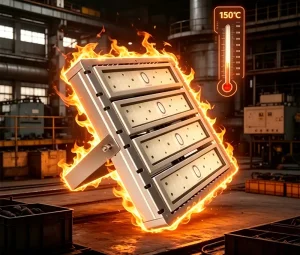
Core Thermal Law: Our 150°C architecture guarantees that even when the exterior ambient air sustains an unyielding 150°C (302°F), the internal LED junction temperature ($T_j$) maintains a steady operating delta ($ΔT < 18^\circ\text{C}$), completely preventing thermal runaway.
Structural Isolation Topology
Our 150°C luminaires utilize a dual-chamber split architectural chassis composed of ADC12 cold-forged aluminum alloy paired with high-purity AL6063 aerospace-grade extruded dissipation fins.
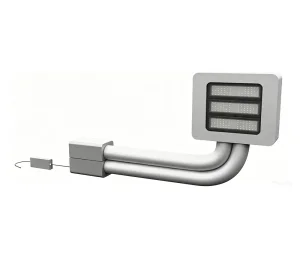
- Remote Driver Enclosure: Galvanically decoupled housing isolating control gear up to 50 meters away from radiant furnace ceilings.
- Sintered Silver Die Attach (TIM >60 W/m·K): Replacing organic epoxy resins to eliminate thermal impedance between chips and substrate.
- Fused Silica Borosilicate Glass Optics: Completely impervious to yellowing, warping, and optical degradation up to 550°C.
- Fluorocarbon (Viton) Gaskets: Continuous hermetic IP68 rating resilient to high-heat expansion, ozone, and sulfurous mill gas.
Engineering Classification: Standard vs. Extreme Thermal Luminaires
Direct comparison of critical bill-of-materials and thermal performance metrics between commercial high bays and specialized 150℃ continuous-rated industrial luminaires.
| Performance Dimension | Commercial Industrial Bay | Heavy Industrial Spec (80℃) | Lsledsus Extreme 150℃ Engineering |
|---|---|---|---|
| Maximum Rated Ambient ($T_a$) | 40°C to 50°C (122°F) | 80°C (176°F) | 150°C (302°F) Continuous |
| Driver & Power Architecture | Integrated Standard SMPS (Electrolytic) | Extended High-Temp Driver Compartment | Galvanic Remote Control Gear / Solid-State Driver |
| Optical Refraction Material | Polymethyl Methacrylate (PMMA) / PC | Tempered Glass or Heat-Stabilized PC | Non-Degrading Borosilicate Glass 3.3 Optics |
| Thermal Interface Material (TIM) | Standard Silicone Grease (<1.5 W/m·K) | Phase Change Material (3.0 W/m·K) | Sintered Nano-Silver / Pyrolytic Graphite (>60 W/m·K) |
| Substrate & Trace Soldering | Standard FR4 or Aluminum MCPCB | High Thermal Conductivity Aluminum Board | Direct Plated Copper (DPC) Ceramic Substrate (AlN) |
| Lumen Maintenance (L70 @ Max $T_a$) | <1,500 Hours (Sudden Blackout) | 25,000 Hours | >65,000 Hours (Zero Catastrophic Failure) |
| Ingress & Environmental Seals | EPDM Rubber (Hardens at 70°C) | Silicone Gasket (Degrades at 110°C) | Fluoropolymer FKM (Viton) Hermetic Dynamic Seal |
Engineered for High-Radiance, Corrosive & Extreme Heat Workplaces
Tailored lighting strategies deployed globally across intensive manufacturing sectors where standard illumination compromises plant safety and demands weekly maintenance.
Steel Mills & Continuous Casting Bays
Above ladles, tundishes, and rolling lines, radiant infrared emissions drive ceiling ambient temperatures well past 130°C. Our 150°C luminaires cut through thick slag dust, resist extreme structural crane vibration, and maintain critical lux levels for overhead crane operators without thermal tripping.
Glass Annealing & Bottle Forming Lehrs
Continuous molten glass processing generates localized ambient temperatures fluctuating between 110°C and 145°C, laden with airborne mold lubricants. Pure borosilicate optics prevent surface chemical etching, ensuring pristine color rendering for inline quality inspections.
Automotive Paint Curing & E-Coat Ovens
Baking ovens and paint drying tunnels demand sustained 140°C–150°C endurance alongside absolute silicone-free construction to eliminate cratering defects in wet coats. Our fixtures conform strictly to automotive cleanroom and anti-static safety requirements.
Pulp Digesters & Chemical Kilns
Combining saturated thermal humidity, sulfur dioxide emissions, and caustic vapors, pulp mills cause rapid corrosion in ordinary die-cast housings. Marine-grade powder coatings and Viton sealing protect internal circuits against extreme thermal-chemical destruction.
Chinese Supply Chain Resilience, Vertical Integration & Cost Efficiency
How our Shenzhen manufacturing complex delivers unmatched prototype agility, rigorous environmental screening, and industrial supply assurance for Tier-1 engineering contractors worldwide.
The Greater Bay Area Industrial Advantage
Located in Shenzhen’s premier high-tech manufacturing corridor, our factory leverages a localized ecosystem that collapses component lead times from months to days. From localized high-purity aluminum extrusion casting to specialized surface anodization and automated SMT placement utilizing high-melting-point gold-tin and lead-free silver alloy pastes, every link in the supply chain operates under synchronized quality control protocols.
Unlike assembly-only competitors who re-badge stock industrial high bays, our facility maintains in-house CNC milling, optical ray-tracing software calibration, and automated high-pressure helium leak detection for IP68 verification. This vertical depth allows us to adapt optics, custom brackets, and remote driver lengths to project-specific constraints in under two weeks.
Zero-Defect Thermal Screening Protocol
Before leaving our Shenzhen facility, every single 150°C production unit undergoes an uncompromising quality verification cycle:
Global Industrial Standards & Hazardous Environment Compliance
Navigating stringent international regulatory mandates across Europe, North America, the Middle East, and Asia-Pacific to safeguard heavy industrial infrastructure investments.
ATEX & IECEx Hazardous Locations
Certified for Zone 1/21 and Zone 2/22 explosive atmospheres where flammable dust (grain, coal, sulfur) or explosive vapors coexist with extreme process heat. Precision T-class temperature ratings prevent surface auto-ignition.
UL 844 & North American Codes
Engineered to comply with Class I, Division 2, Groups A, B, C, D and Class II, Division 1 requirements. Standard high-bay fixtures violate NEC standards when thermal radiation creates unmanaged housing hotspots.
CE, RoHS & European Directives
Complies fully with EMC Directive 2014/30/EU and Low Voltage Directive 2014/35/EU, featuring ultra-low Total Harmonic Distortion (THD < 10%) to prevent electrical feedback into delicate manufacturing plant PLCs.
Dialux Photometric Validation
Every industrial project receives certified Dialux photometric calculations before procurement. We calculate direct horizontal illuminance, vertical facial recognition lux, and Unified Glare Ratings (UGR < 19) for crane gantries.
The Future of Ultra-High Temperature Solid-State Photonics
Pioneering advancements in wide-bandgap semiconductors, solid-state phase change materials, and autonomous edge telemetry engineered to push operating limits to 350℃.
Wide-Bandgap Gallium Nitride (GaN) Driver Topology
While silicon-based power electronics degrade precipitously above 105°C, wide-bandgap semiconductors such as Gallium Nitride (GaN) and Silicon Carbide (SiC) offer electronic bandgaps three times wider than silicon. Our R&D laboratory is commercializing the next evolutionary phase of high-ambient LED drivers: GaN-driven switching regulators capable of sustained operation at 175°C without requiring external cooling or electrolytic smoothing stages.
By eliminating liquid-electrolyte capacitors and substituting multilayer high-temp ceramic capacitors (MLCC), the mean time between failures (MTBF) extends beyond 120,000 continuous hours in ambient conditions that would vaporize traditional power boards.
AI-Enabled Thermal Telemetry & Predictive Maintenance
Future iterations of our extreme-temperature fixtures incorporate embedded silicon temperature probes and edge microcontrollers. Utilizing encrypted RS485 or wireless industrial mesh protocols, the fixtures dynamically communicate junction temperatures, input voltage spikes, and operating hours directly to plant SCADA systems.
If an unpredicted blast furnace surge breaches safe operating thresholds (e.g. ambient spikes to 200°C), the fixture automatically executes a micro-dimming cycle to lower internal heat generation, preserving critical visibility while safeguarding physical components from thermal shock.
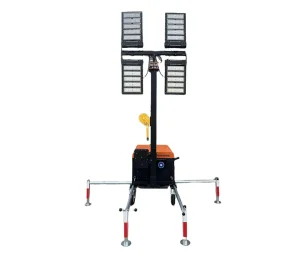
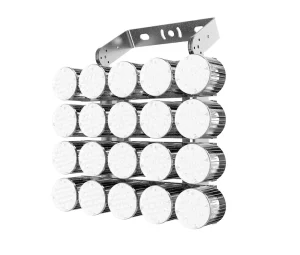
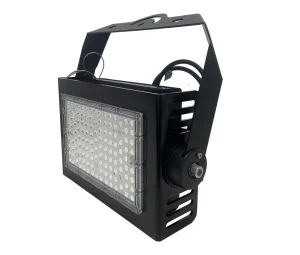
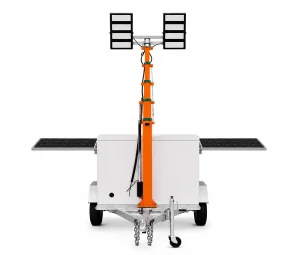
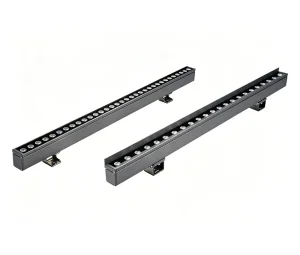
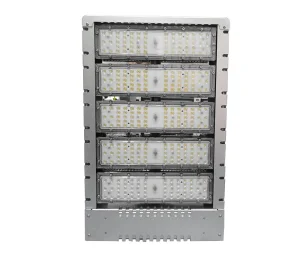
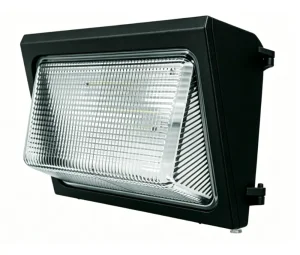
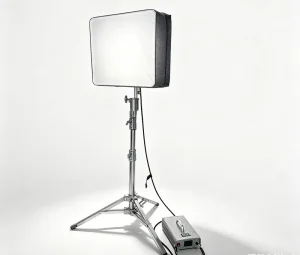
Specialized Heavy Industrial & Infrastructure Solutions
Browse our complementary industrial families engineered to endure relentless mechanical shocks, severe saline corrosion, wide-area high-wattage requirements, and mobile operational setups.
Frequently Asked Questions on 150℃ High Temperature LED Lighting
Authoritative technical answers direct from our chief thermal and optical engineers to guide project specifications, retrofits, and life-cycle cost analysis.
Why do standard "high-temperature" fixtures rated for 65°C fail in 100°C–150°C applications?
Most commercial suppliers market standard high bays with larger passive fin sinks as "high temperature" rated for 65°C. At 100°C–150°C, traditional electrolytic capacitors dry out rapidly, solder joints undergo thermal creep, and polycarbonate lenses turn brittle and yellow. Our 150°C fixtures utilize remote solid-state drivers, gold-wire bonded flip chips, and fused borosilicate glass, maintaining continuous operation without thermal shock failure.
How does remote driver mounting impact fixture performance and electrical safety?
Mounting the LED driver 10 to 50 meters away in an ambient environment below 50°C completely removes the most heat-sensitive link from extreme ceiling zones. We engineer low-impedance high-temp silicone cable harnesses that eliminate DC line voltage drop while maintaining clean, flicker-free power deliverability without high-frequency harmonic distortion.
Can your high-temperature LED lights directly retrofit legacy 400W–1000W High Pressure Sodium (HPS) or Metal Halide (HID) fixtures?
Yes. Our modular mounting systems include 360-degree adjustable stainless steel brackets, pendant eye-bolts, and universal conduit adapters designed for 1:1 drop-in replacement of inefficient HPS, metal halide, and mercury vapor lamps, reducing electrical energy consumption by up to 72% while doubling lux levels.
What is the expected lumen maintenance (L70) at a continuous 150°C ambient exposure?
Through our direct-bonded aluminum-nitride ceramic substrates and sintered nano-silver thermal interfaces, junction temperatures remain below 105°C during continuous 150°C ambient exposure. Certified IES LM-80 test reports and TM-21 extrapolations confirm an L70 life expectancy exceeding 65,000 continuous hours.
How do you guarantee hermetic sealing against corrosive sulfur, acids, and blast furnace fumes?
Standard rubber gaskets degrade and harden when exposed to extreme thermal cycling, allowing acidic fumes to corrode internal chip phosphor coatings. We exclusively employ genuine Viton (FKM) fluoropolymer elastomeric O-rings combined with high-precision CNC-machined gasket grooves, guaranteeing continuous IP68 ingress protection.
How can an engineering contractor request photometric Dialux layouts and customized prototypes?
Our Shenzhen engineering headquarters provides turnkey layout consultations. Submit your building CAD models, crane mounting heights, heat source locations, and required target lux levels. Our photometric team generates full Dialux simulations and prepares custom sample prototypes for on-site validation within 10 business days.