
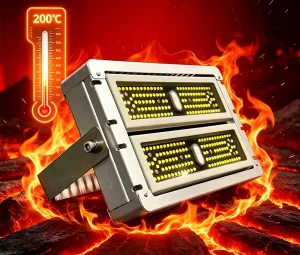
Best Ultra High Temperature LED Light - Rated 200°C (392°F) with IP68 Waterproof Protection Factory, Manufacturers
View Technical Specs
Engineered to mitigate catastrophic driver failure, phosphor degradation, and pyrophoric particulate infiltration in continuous ambient operating temperatures.
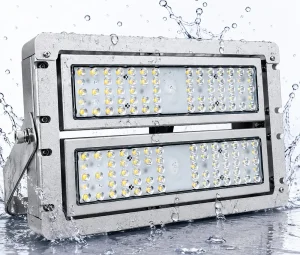
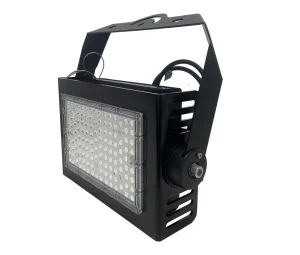
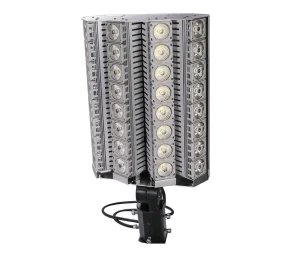
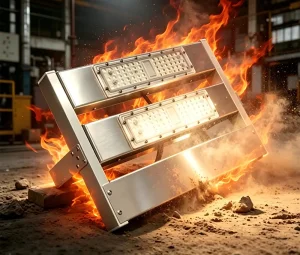
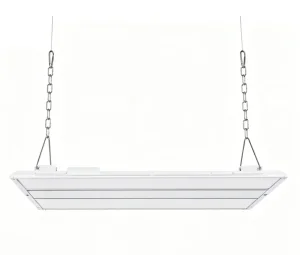
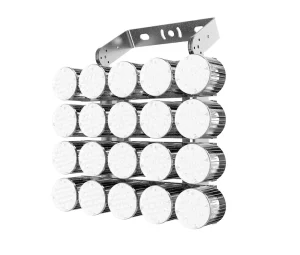
Why commercial grade and even standard industrial high-bays fail within hours inside furnace halls, and how our multi-stage heat dissipation paradigm breaks the Arrhenius rate law.
Standard LED drivers rely on electrolytic capacitors whose liquid electrolytes boil at >105°C, resulting in immediate catastrophic dielectric breakdown. Our 200℃ Dustproof High-Temperature Resistant Light implements an architectural decoupling protocol.
Power electronics are housed in an intrinsically isolated thermal enclosure engineered with specialized solid-state tantalum capacitors and wide-bandgap Silicon Carbide (SiC) semiconductors, or deployed remotely up to 100 meters away via high-temperature shielded mineral-insulated cabling.
Standard MCPCBs (Metal Core PCBs) use epoxy dielectric layers with abysmal thermal conductivity (1.0 to 3.0 W/m·K), acting as thermal insulators in high ambient air.
We utilize custom-machined ceramic Aluminum Nitride (AlN) micro-substrates offering thermal conductivities exceeding 170–200 W/m·K. This allows instantaneous heat evacuation away from the epitaxial junction to the engineered 6063-T6 forged aerospace aluminum housing.
Dust accumulation in steel casting bays and cement grinding plants forms a dense thermal blanket. A 3mm layer of foundry carbon dust degrades convection efficiency by over 64%, creating thermal runaway.
Our exterior heat sinks feature continuous vertical chimney fin geometries with superhydrophobic and anti-static fluoropolymer powder coatings. The structural convection air channels accelerate natural draft velocity, sweeping settling particulate away before it can sinter onto the radiating surfaces.
Global manufacturing and heavy processing operate under extreme thermal conditions. Plant managers are moving from cheap, high-maintenance legacy discharge lamps to highly reliable high-temperature solid-state lighting.
In metallurgy, steel melting shops (EAF/BOF), glass container tempering lehrs, and pulp black-liquor recovery boilers, average ceiling ambient temperatures routinely hover between 90°C and 180°C, with thermal updraft peaks striking 200°C (392°F). Historically, facilities relied on 400W–1000W High-Pressure Sodium (HPS) or Metal Halide lamps.
While these antiquated lamps tolerate ambient heat, their system efficiency decays below 50 lm/W within 4,000 hours, requiring frequent relamping. Relamping over an active molten ladle requires shutting down casting cranes, costing upwards of $15,000 to $45,000 per hour in metallurgical downtime.
As an elite OEM/ODM factory and specialized supplier, our 200℃ dustproof fixtures solve the ROI dilemma by providing verified 50,000 to 100,000-hour continuous service life without personnel intervention, cutting operational expenses (OPEX) by up to 82%.
| Performance Parameter | Standard Commercial LED Fixture | Conventional Industrial High-Bay | Our 200℃ Dustproof Heavy Luminaire |
|---|---|---|---|
| Max Safe Ambient Temp | 40°C (104°F) | 55°C – 65°C (149°F) | 200°C (392°F) Continuous / 220°C Peak |
| Driver Failure Mechanism | Capacitor rupture at < 85°C | Thermal shutdown at < 90°C | Solid-State Remote / SiC Hybrid Topology |
| Dust Ingress Defense | IP20 – IP54 (Dust Enters Easily) | IP65 (Gaskets degrade under heat) | IP68 / IP69K Viton Hermetic Seal |
| LED Die Interconnects | Gold/Copper Wire Bonding | Standard Wire Bonded SMD | Eutectic AuSn / Ag-Sintered Flip-Chip |
| Lens Degradation | PMMA / PC Yellows & Cracks >80°C | Polycarbonate softens >110°C | Non-Degrading Borosilicate Glass 3.3 |
| Lifespan in 150°C+ Ambient | Instant Failure (< 24 hours) | 100 – 500 Hours Maximum | 50,000 – 100,000 Hours (L70 Projected) |
From primary smelting plants in North America to clinker production facilities in the Middle East and heavy chemical manufacturing across Europe, our fixtures deliver proven performance.
Positioned directly above melt shop charging decks and ladle transfer cranes where radiant convective heat surges push temperatures above 190°C.
The fixtures withstand heavy acoustic shocks, sulfur dioxide fumes, and conductive graphite dust without internal contamination.
Rotary kiln discharge hoods and grate coolers produce extreme heat and micro-fine abrasive lime and silica dust.
Our borosilicate optics resist abrasive micro-sandblasting, and our IP68 hermetic vacuum seal blocks particulate entry into the optical cavity.
Continuous ribbon glass drawing requires uninterrupted, uniform illumination in ambient zones ranging from 130°C to 200°C.
Eliminates maintenance shutdowns over delicate molten glass baths and prevents color shift (CCT drifting), protecting strict inline visual inspection standards.
Thermal drying tunnels, carbon fiber curing autoclaves, and heavy asphalt batching towers combine intense baking heat with airborne combustible dust.
Our certified explosion-proof, dust-ignition-proof housings isolate electric arcing hazards under extreme operational stress.
Deploying luminaires into hazardous, high-temperature industrial environments requires full compliance with international safety codes and reliable on-site engineering support.
Certified for explosive atmospheres under ATEX / IECEx Zone 21, Zone 22 (Dust) and Class II, Division 1 & Division 2 (NEC 500 / NEC 505).
The fixture surface temperature is limited to prevent ignition of surrounding dust layers (T-Class rating: T3C / T4A / T5), keeping facilities fully compliant with OSHA, NFPA 70, and ATEX safety directives.
We don't just supply fixtures; our optical engineering team provides comprehensive, certified DIALux and AGi32 photometric studies before production starts.
We optimize fixture placements, select specialized beam distributions (15°, 30°, 60°, 90°, or 120° forward-throw), and calculate precise horizontal and vertical lux levels, glare indices (UGR < 19), and lumen degradation factors.
Supported by our international project coordination network, we supply complete high-temperature mounting hardware, marine-grade 316 stainless steel brackets, and custom input voltages (100–277VAC, 347–480VAC, or 24–48VDC).
Each unit passes 100% full-load thermal burn-in chamber testing at our Shenzhen manufacturing center prior to international freight dispatch.
Industrial thermal limits continue to advance. Our R&D team is developing new materials and smart systems to push operational performance beyond existing thresholds.
Moving beyond passive solid aluminum conduction, our next-generation heat sinks integrate two-phase closed loop thermosyphons with dielectric working fluids.
These systems deliver an equivalent thermal conductivity exceeding 12,000 W/m·K—nearly 60 times that of pure copper—allowing 250W–400W LED cores to run cool even in 220°C ambient temperatures.
Conventional LEDs bond phosphor powder in organic silicone resin, which yellows, carbonizes, and shifts color above 140°C.
Our advanced models feature inorganic Phosphor-in-Glass (PiG) ceramic plates directly bonded to the sapphire/GaN emitter die. These components are completely inorganic and immune to thermal browning, cracking, and optical output loss up to 300°C.
Each smart luminaire integrates embedded thermocouple probes connected to a specialized microprocessor.
If production anomalies cause radiant heat to spike above normal limits, the fixture automatically adjusts power down to safe operating levels, shielding components from damage while notifying control engineers over an RS485/Modbus or wireless LoRaWAN network.
Clear, practical answers to common questions about thermal ratings, optical stability, remote driver wiring, and dust ingress protection.
Reliable 200°C operation requires complete system re-engineering. We isolate the driver away from peak thermal zones, run emitters well below their maximum current capacity, use inorganic Phosphor-in-Glass (PiG), and mount chips on direct-bonded Aluminum Nitride (AlN) substrates. This ensures that even in a 200°C ambient atmosphere, the internal LED junction temperature ($T_j$) stays safely below its maximum limit.
Airborne dust creates two failure points: it clogs heat sink fins and forms an insulating blanket that blocks natural convection, causing temperatures to rise rapidly. Fine carbon or coal dust can also ignite if surface temperatures aren't carefully managed. Our fixtures feature wide, self-cleaning vertical convection fins and sealed IP68 housings with fluorosilicone seals to prevent dust accumulation and internal ingress.
Using our heavy-duty shielded, low-capacitance cable bundles, remote driver enclosures can be installed up to 100 meters (328 feet) away in climate-controlled electrical rooms. Our power supplies feature integrated line-drop compensation to offset voltage drop across long cable runs, ensuring consistent lumen output without high-frequency flicker.
Repeated heating and cooling cycles create a "breathing" effect due to air pressure changes, which can pull ambient moisture and dust past ordinary seals. Standard EPDM or nitrile gaskets quickly dry out and crack under heat. We use custom-molded Viton and Fluorosilicone O-rings combined with sintered bronze equalizing vents that relieve pressure differentials while blocking moisture and dust down to sub-micron sizes.
At elevated temperatures, all LED light sources experience thermal droop, resulting in an expected 15% to 25% decrease in luminous flux compared to 25°C laboratory ratings. We account for this in our DIALux lighting calculations by using elevated-temperature photometric files rather than standard lab data, ensuring your installation meets required lux levels under real-world operating conditions.
Yes. The fixture housings undergo a multi-stage pre-treatment wash followed by an architectural-grade thermoset powder coating certified to ISO 12944 C5-M / C5-I standards for extreme marine and industrial chemical resistance. External hardware is built from grade 316 stainless steel to resist corrosive gases like sulfur dioxide, chlorine, and ammonia.
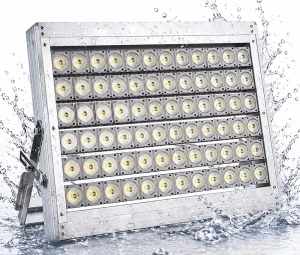
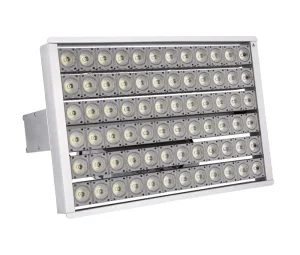
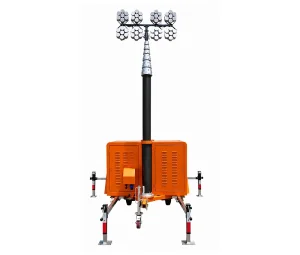
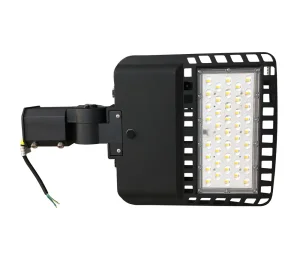
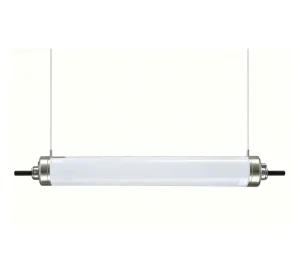
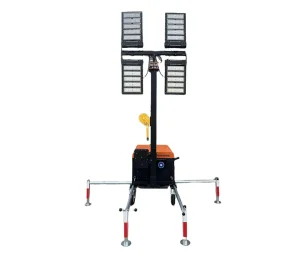
Explore our full range of heavy-duty luminaires, including portable light towers, offshore marine systems, and specialty harsh-environment fixtures.
Contact our thermal engineering team with your site photos, operating ambient temperatures, mounting heights, and hazardous area classifications. We will deliver tailored photometric simulations, comprehensive thermal feasibility reports, and sample quotations within 24 hours.