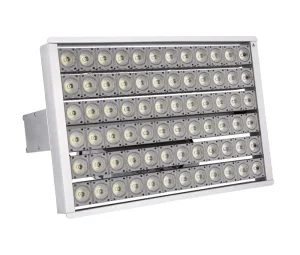
Precision-Engineered Heavy Duty Industrial Fixtures
Explore heavy-duty illumination models factory-rated for high thermal zones, coastal salt-spray, and extreme physical environments.
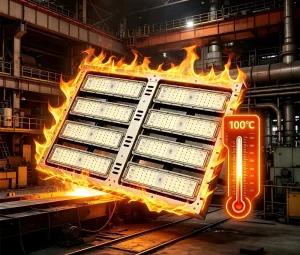
Overcoming The 200°C (392°F) Thermal Boundary in Heavy Industry
A comprehensive technical analysis of solid-state luminaire survival in continuous, high-heat metallurgical, petrochemical, and manufacturing operations.
The Engineering Reality of 392°F (200°C) Ambient Operations
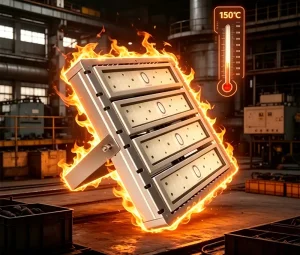
Standard industrial LED fittings undergo critical degradation at ambient levels beyond 50°C (122°F). When ambient ceiling temperatures surpass 200°C (392°F)—typical around smelting lines, glass Lehr annealing kilns, and coke battery tops—standard gallium nitride (GaN) junctions fail through non-radiative recombination and phosphor carbonization. Our factory designs resolve this via isolated drivers, phase-change thermodynamic convection , and ceramic-substrate die mounting.
Phosphor Matrix Resilience
Conventional silicone encapsulants yellow and degrade past 150°C. Our 392°F configurations deploy vacuum-bonded borosilicate lenses directly over ceramic phosphor-in-glass (PiG) matrices, completely eradicating chemical yellowing and ensuring chromatic stability across 60,000 continuous hours.
Galvanic & Thermal Decoupling
At 200°C (392°F), electrolytic capacitors dry out rapidly. We mandate isolated architectural power topography: mounting remote-rated smart drivers up to 100 meters away in temperate enclosures, feeding shielded multi-phase DC lines straight to passive heatsink luminaires.
Fluid Loop Micro-Heat Pipes
By employing 6063 aerospace cold-forged aluminum with integrated sintered copper wicked heat pipes, thermal resistance from junction to heatsink surface is depressed below 0.08°C/W, avoiding heat pocket buildup even inside dust-laden enclosed plants.
Shifting Industrial Procurement Mandates (2025–2030)
Why multi-national heavy fabrication facilities, smelters, and chemical processors are rapidly revamping legacy discharge fixtures to engineered 392°F high-temp LED arrays.
HID / HPS Phaseouts
High-Pressure Sodium and Metal Halide lamps generate massive internal heat, compound ambient room loads, and hold high catastrophic explosion risks. Transitioning to specialized 392°F fixtures cuts facility power demands by over 65%.
Zero-Downtime Protocols
In hot strip mills, stopping production cranes to swap blown high-bay lamps costs tens of thousands of dollars per hour. Engineering luminaires with proven L70 > 100,000h lifetimes at extreme temperatures converts maintenance into scheduled capital gains.
Strict Occupational Safety
Low-grade lighting causes optical fatigue, leading to crane hoisting inaccuracies. Our optics produce CRI > 80 with uniform, glare-controlled diffusion, ensuring overhead workers distinguish slag, molten streams, and machine guards clearly.
ESG & Carbon Credits
Lower luminaire energy dissipation directly decreases the kilowatt-hour loads of primary ventilation and chilled cooling curtains in modern high-heat processing bays, expediting carbon neutrality targets.
China Industry 4.0: Supply Chain Agility & Factory Excellence
Combining end-to-end component vertical integration in Shenzhen with advanced thermal simulation, rapid prototyping, and automated climatic validation.
Complete Vertical Integration
From tool-and-die casting of high-purity aluminum enclosures to in-house surface-mount technology (SMT) with gold-wire bonding, our Shenzhen infrastructure bypasses intermediate supplier markups and reduces project lead times by 40%.
Dynamic Thermal Simulation
Every bespoke luminaire profile undergoes rigorous computational fluid dynamics (CFD) profiling to simulate localized airflow and thermal buoyancy, verifying heat sinks dissipate BTUs effectively prior to production cut.
Accelerated Burn-in Chambers
Fixtures undergo continuous multi-day testing inside computerized climatic ovens exceeding 200°C (392°F). Thermal stress testing eliminates early infant mortality defects before batch dispatch to overseas clients.
Mission-Critical Installation Environments
Engineered structural lighting systems designed around exact industrial site stresses, ambient radiant heat, and environmental contaminants.
Steel Mills & Foundry Ladle Bays
Overhead cranes transporting molten steel radiate intense infrared energy directly onto ceiling bays. Deploying 392°F specialized optics ensures zero fixture failures, protecting worker paths and ingot handling tracks from dark spots.
Glass Manufacturing & Lehr Annealing
Glass bottle, sheet, and float glass plants maintain elevated 24/7 baking profiles. Our sealed, tempered-glass luminaires resist thermal shock while operating reliably inches above cooling lines and shaping rollers.
Paper & Pulp Drying Cylinders
Pulp facilities blend severe ambient steam, extreme temperatures, and chemical bleaching off-gassing. Fixtures integrate corrosion-proof anodization and fluorocarbon sealing to survive continuous steam washing.
High-Temperature Industrial Lighting FAQ
Insights into thermal management, mounting distances, optical stability, and custom factory engineering capabilities.
What is the technical threshold separating 392°F (200°C) lights from standard high bay fixtures?
How do remote-mounted driver systems function over industrial distances?
How are optics protected against clouding in caustic, dusty smelting conditions?
Can custom brackets and beam patterns be tailored for legacy high-bay crane retrofits?
What third-party testing and warranties accompany factory orders?
Explore Advanced Industrial Solid-State Portfolios
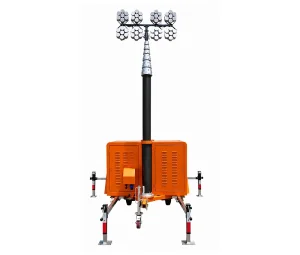
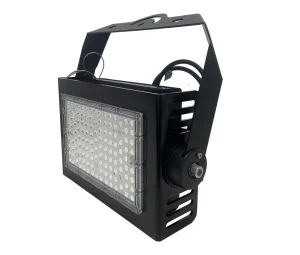
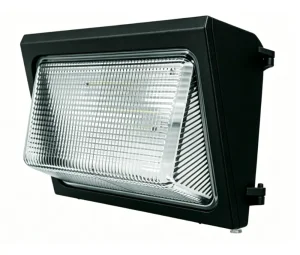
Browse active configurations built to withstand deep marine immersion, extreme thermal loads, outdoor wind-loading, and mobile towers.