High-Output Industrial & Specialized Architectural Luminaires
Engineered to exceed standard commercial capabilities. Review our prime production runs certified for high luminous efficacy, thermal defense, and extreme ingress containment.
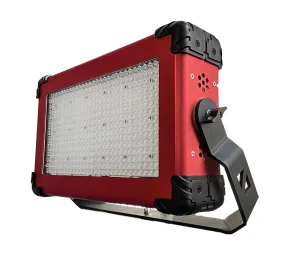
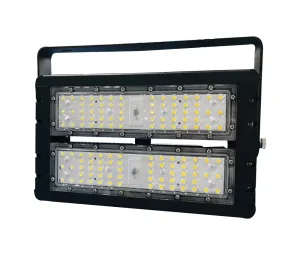
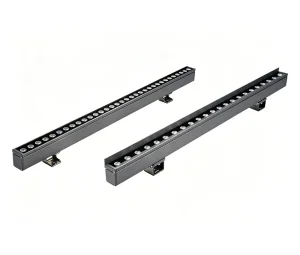
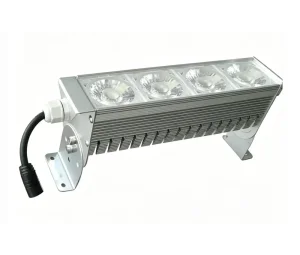
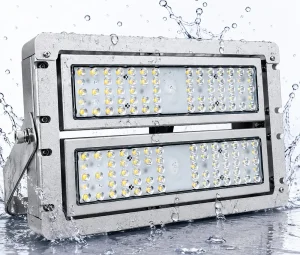
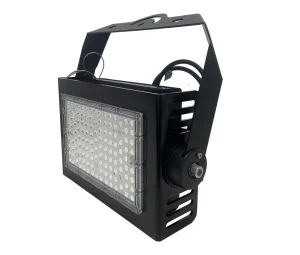
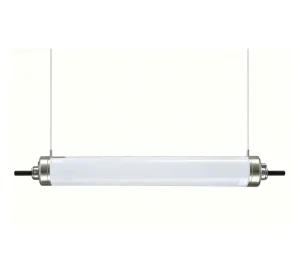
High Lumen LED Tri-Proof Architecture: The Demise of the 130 lm/W Benchmark
Modern industrial EPC specifications require far more than generic IP65 water-resistance. High-bay ceiling heights above 8 meters require high lumen density, rigorous chromatic consistency, and robust chemical shielding.
Thermal Decoupling & Heat Sinking
Unlike off-the-shelf plastic vapor-tights that cook their LED emitters, high-lumen units (>18,000 lm) employ aviation-grade 6063 extruded aluminum backplates. Thermally isolating the constant-current Mean Well or Philips driver from the SMD arrays ensures junction temperatures ($T_j$) remain strictly below 65°C under continuous duty.
Material Science: PMMA vs. Polycarbonate
Tri-Proof ("Water, Dust, Corrosion") fixture longevity hinges on polymer chemistry. Where UV and mechanical shock dominate (logistics, railways), UV-stabilized virgin Polycarbonate (PC) is prescribed. Where ammonia gas, esters, or alkalis prevail (swine farms, chemical wash facilities), optical grade PMMA prevents crazing and yellowing.
Seamless Through-Wiring & Rapid Install
Industrial retrofit labor routinely accounts for 60% of total project expenditure. High lumen tri-proof luminaires incorporate internal tool-free terminal blocks, 5-wire or 7-wire through-wiring busbars (up to 2.5 mm² AWG14), and loop-in/loop-out PG13.5 or M20 glands to enable continuous daisy-chaining up to 40 units per circuit breaker.
Strategic OEM/ODM Sourcing: The Shenzhen-Guangdong Ecosystem Edge
Sourcing high lumen LED fixtures directly from specialized Chinese manufacturing hubs unlocks structural economies of scale, component traceability, and ultra-flexible customization.
Vertical Upstream Integration
Shenzhen and the Greater Bay Area house the planet’s dense concentration of die-casting tooling plants, automated high-speed SMT lines, and optical lens molding facilities. This proximity reduces Tier-1 prototyping turnaround from 8 weeks to under 12 days, giving procurement heads immediate access to premium Osram, Lumileds, and San'an high-efficacy chips.
Bespoke OEM/ODM Capability
Tier-1 Chinese factories do not enforce rigid catalog-only limitations. From custom emergency backup driver modules (90–180 minutes runtime) and integrated microwave motion sensors to custom marine-grade 316 stainless steel mounting clips, custom engineering requests are executed on the assembly line with minimal minimum order quantities (MOQs).
Rigorous In-House Qualification
Leading factories maintain in-house CNAS-accredited laboratories equipped with integrating spheres, goniophotometers, salt spray corrosion test chambers, vibration tables, and high-pressure hot water jets for IP69K testing. Every production batch undergoes a mandatory 72-hour thermal stress burn-in test before container loading.
Localization Support, Grid Compliance & EPC Risk Mitigation
Deploying luminaires across multinational jurisdictions demands stringent adherence to regional electrical codes, harmonic distortion limits, and safety standards.
North American Compliance: UL, cUL & DLC 5.1
Supplying projects in the USA and Canada requires strict adherence to UL 1598 (Luminaires) and UL 8750 (LED Equipment). Compliance with DesignLights Consortium (DLC) 5.1 Premium is mandatory to unlock substantial energy efficiency rebates from utility companies, mandating strict efficacy metrics (>140 lm/W) and integrated dimming performance.
European Directives: CE, RoHS & ENEC
For European Union tenders, fixtures must conform to the Low Voltage Directive (LVD 2014/35/EU) and Electromagnetic Compatibility (EMC 2014/30/EU). In critical installations, the ENEC mark serves as independent verification of electrical safety, while photobiological safety compliance (IEC 62471 RG0/RG1) guarantees optical workplace safety.
Sanitary Cleanroom Standards: NSF/ANSI 2 & HACCP
In food processing facilities, cold storage, and pharmaceutical laboratories, the fixture’s external chassis must eliminate horizontal ridges, exposed screws, and recessed cavities that harbor bacterial biofilm. High lumen tri-proof luminaires compliant with NSF Splash/Non-Food Zones ensure trouble-free food audit certifications.
Mission-Critical Use Cases Demanding High-Lumen Ruggedized Lighting
Examining harsh environments where standard commercial lighting degrades within months due to thermal load, water ingress, or chemical attack.
Food & Beverage Processing
Subjected to high-temperature caustic water jets (up to 80°C at 100 bar pressure). Fixtures require IP69K sealing with food-grade silicone gaskets and chemical-resistant PMMA covers that endure routine alkaline/acid disinfection washes.
Heavy Chemical & Fertilizer Storage
Sulfur, chlorine, and ammonia vapors rapidly erode metal coatings. Fully encapsulated vapor-tight luminaires with anti-corrosive polycarbonate bodies and corrosion-proof clips protect the electronic engine from terminal oxidation.
Car Washes & Heavy Vehicle Bays
Continuous relative humidity (95%+) paired with constant detergent and foam sprays requires an unwavering IP66/IP67 ingress barrier. High-output lumens ensure glare-free illumination over vehicle detailing surfaces.
Underground Logistics & Transport Hubs
Subway tunnels, railway maintenance pits, and multi-story parking structures experience non-stop vibrations and low-frequency shocks. IK10-rated enclosures safeguard against impact, while high lumen density cuts maintenance closures.
Emerging Industry Trends: The Smart, Circular Lighting Revolution
The industrial illumination sector is transitioning from static fixtures to sensor-rich IoT nodes that report power analytics and optimize asset lifetime.
DALI-2 & Wireless Mesh Networking
Standalone fixtures are giving way to intelligent lighting grids. Modern tri-proof fixtures integrate internal Zhaga Book 18 sockets or Bluetooth SIG Mesh controllers, allowing facilities managers to configure daylight harvesting, scheduled dimming, and occupancy grouping via intuitive building management software (BMS).
Circular Economy & Modular Repairability
Driven by strict European Ecodesign directives (Right to Repair), next-generation industrial luminaires avoid permanent adhesive sealing. Fast-release waterproof latches and quick-disconnect driver/gear trays permit driver replacement in under 3 minutes, slashing life-cycle electronic waste by 65%.
Ultra-High Optical Efficacy (>200 lm/W)
With global industrial electricity tariffs climbing, R&D efforts focus on next-generation flip-chip packages and low-loss frosted diffusers. Efficacy metrics are targeting 200 lm/W at fixture level, delivering accelerated ROI horizons within 9 to 14 months of 24/7 operational duty.
High Lumen LED Tri-Proof Technical Matrix & Selection Criteria
Compare standard industrial parameters to ensure your specification fits your physical ceiling elevations and thermal thresholds.
| Nominal Length / Power | System Lumen Output | Housing Chemistry | Impact / Ingress Class | Mounting Height Application | Dimming & Smart Options |
|---|---|---|---|---|---|
| 2ft (600mm) / 30W–40W | 5,100 – 6,800 lm | UV-Stabilized Polycarbonate | IP66 / IK08 | 2.5m – 4.0m (Workbenches, Service Pits) | 0-10V, Microwave Sensor |
| 4ft (1200mm) / 50W–75W | 8,500 – 12,750 lm | Extruded AL + PMMA / PC | IP66 / IP69K / IK10 | 3.5m – 6.0m (Warehouses, Food Plants) | DALI-2, 1-10V, Emergency Pack |
| 5ft (1500mm) / 80W–100W | 14,400 – 18,000 lm | Heavy-Duty PC / AL Core | IP66 / IP68 / IK10 | 5.0m – 8.0m (Logistics Aisles, Hangars) | Zigbee, DALI, Daylight Harvest |
| 8ft (2400mm) / 120W–150W | 21,600 – 27,000 lm | Reinforced 6063-T5 Extrusion | IP67 / IP69K / IK10 | 7.0m – 12.0m (High-Bay Industrial Lines) | Smart Wireless Mesh Node |
Industrial Buyer's FAQ: High Lumen LED Tri-Proof Procurement
Definitive answers to common technical, logistics, and compliance inquiries encountered by electrical contractors and industrial buyers.
What distinguishes an IP69K rated fixture from an IP66/IP67 luminaire?
How does ambient operating temperature influence high lumen industrial fixtures?
When should Polycarbonate (PC) diffusers be specified over PMMA (Acrylic)?
How does through-wiring architecture reduce EPC contracting costs?
What documentation and photometrics do Chinese factories provide for project bids?
High-Temperature, Hazardous Location & Structural Solutions
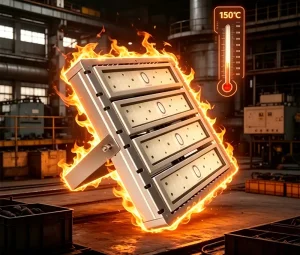
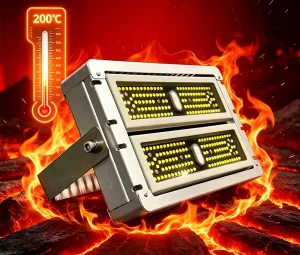
Explore heavy-duty industrial fixtures engineered for extreme temperatures up to 150°C, explosive atmospheres, maritime salt fog, and large-scale industrial projects.