
High-Temperature & Specialized Industrial Lighting Showcase
Explore top-tier engineered luminaires direct from certified high-temperature LED factories built for extreme thermal tolerance, marine corrosion resistance, and heavy industrial applications.
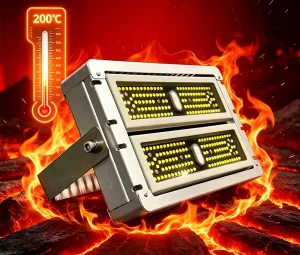
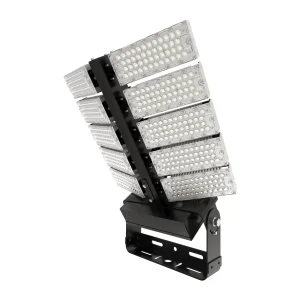
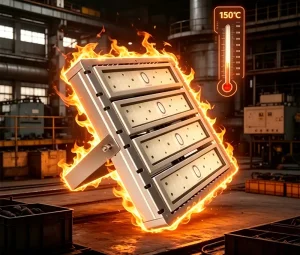
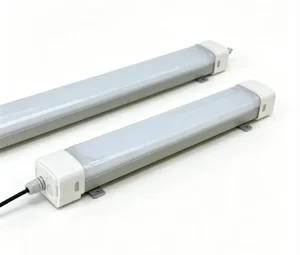
Why Standard Industrial Lighting Fails in High-Temperature Manufacturing Facilities
A comprehensive technical analysis of solid-state lighting physics under severe thermal stress in heavy metallurgical and processing environments.
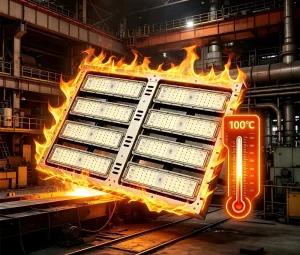
In modern industrial facilities such as steel rolling mills, glass manufacturing plants, aluminum smelters, forge shops, and power generation stations, ambient temperatures at ceiling heights often exceed 60°C to 150°C (140°F to 302°F). Standard commercial and even heavy-duty industrial LED floodlights rated for standard 40°C or 50°C operation experience catastrophic thermal degradation under these extreme operating environments.
Thermal Runaway & Driver Failure
Electrolytic capacitors inside standard LED drivers rapidly dry out when ambient temperatures surpass 65°C, causing total power power unit failure within months of installation.
Lumen Depreciation & Color Shift
Elevated junction temperatures ($T_j > 120^\circ\text{C}$) accelerate phosphorus degradation in blue LED chips, resulting in irreversible color temperature shifting and massive lumen dropoff.
Optical Encapsulation Yellowing
Standard PMMA and PC optical lenses micro-crack, yellow, and lose up to 40% light transmittance under continuous thermal exposure combined with airborne industrial chemical particulates.
Finding the best high temperature flood lights factories requires evaluating manufacturers based on their engineering capability to decouple thermal pathways, integrate ceramic substrate packaging, utilize remote driver topologies, and implement custom optics rated for continuous high ambient operation without lumen degradation.
Architectural Engineering for 100°C to 300°C High-Temp Floodlights
How specialized OEM factories engineer zero-failure thermal dissipation systems for extreme ambient conditions.
Remote Driver Architecture & Thermal Decoupling
To withstand ambient temperatures up to 200°C or 300°C, the LED driver is housed in a secondary remote enclosure positioned 10 to 50 meters away in a cooler zone, or equipped with stainless steel thermal barrier isolation joints that eliminate conductive heat transfer from the heatsink.
Cold-Forged 1070 Aluminum & Vapor Chamber Heatsinks
1070 pure aluminum provides thermal conductivity of ~226 W/m·K—nearly double that of traditional die-cast aluminum (A380 ~96 W/m·K). Combined with internal phase-change vapor chambers, heat is dissipated instantly across high-density vertical cooling fins.
High-Tg Metal Core Printed Circuit Boards (MCPCB)
Utilizing ceramic-based Substrate or Aluminum MCPCBs with glass transition temperatures ($T_g > 180^\circ\text{C}$) and ultra-high thermal conductivity dielectric layers (3.0 W/m·K to 8.0 W/m·K) to ensure solder joints remain pristine under thermal shock.
High-Borosilicate Tempered Glass Optics & Fluorocarbon Seals
Replacing plastic lenses with precision-ground 95% high-transmittance tempered borosilicate glass optical lenses. Gaskets are replaced with military-grade Viton / Fluorocarbon silicone O-rings rated for continuous 300°C stress.
Technical Parameter Matrix: Standard vs. High-Temperature Flood Lights
| Engineering Metric | Standard Commercial LED Flood Light | Industrial High-Temp Light (80°C–100°C) | Extreme Thermal Flood Light (150°C–300°C) |
|---|---|---|---|
| Max Ambient Rating ($T_a$) | 40°C to 45°C (104°F - 113°F) | 80°C to 100°C (176°F - 212°F) | 150°C to 300°C (302°F - 572°F) |
| Driver Topology | Internal Integrated Plastic/AL Driver | High-Temp Metal Case Driver ($T_c = 90^\circ\text{C}$) | Fully Remote Thermal Decoupled Driver Box |
| Heatsink Material | Die-Cast A380 Aluminum | Cold-Forged 1070 Pure Aluminum | 1070 Aluminum + Vapor Chamber Heat Pipe |
| Optical Lens Material | Polycarbonate (PC) / Acrylic (PMMA) | UV-Stabilized Anti-Glare PC / Glass | High-Borosilicate Heat-Resistant Glass |
| Ingress & Washdown | IP65 Waterproof | IP67 / IP68 Heavy Duty | IP68 / IP69K Hermetically Sealed |
| Expected Service Life | < 6 months (in high heat zone) | 50,000 to 80,000 Hours | 100,000 Hours @ Peak Ambient Temp |
Why Leading Global EPCs Partner with China High-Temperature LED Factories
Unmatched supply chain integration, rapid OEM engineering customization, and rigorous quality validation clusters in Guangdong lighting hubs.
Full-Chain Vertical Integration
From raw ingot cold-forging and precision CNC module milling to automated SMT chip mounting and thermal chamber testing, China's specialized LED hubs in Shenzhen offer raw material to finished product turnaround in under 15 days.
Custom OEM/ODM Engineering Flexibility
Industrial projects rarely accept off-the-shelf specs. Chinese high-temp flood light manufacturers excel at custom bracketry, tailored beam angles (15° narrow spot to 120° wide flood), custom voltage drivers (100-480V AC / 24-48V DC), and specific thermal modeling.
The manufacturing ecosystem in China allows factories to source high-specification components—such as Cree/Bridgelux flip-chip LED packages, Meanwell / Inventronics high-temperature drivers, and military-grade silicone seals—at optimized scale, giving international procurement directors significant cost efficiency without sacrificing quality standards.
Deployed Application Scenarios for High-Temperature LED Flood Lights
Real-world deployment environments where specialized thermal lighting guarantees worker safety and operational efficiency.
Steel Mills & Blast Furnace Overhead Cranes
Operated above molten steel ladles and hot rolling beds where ambient air reaches 90°C–150°C. High-temperature flood lights illuminate crane runways and pit areas, resisting heavy vibration, ambient heat, and iron dust accumulation.
Power Plant Boiler Rooms & Steam Turbines
Boiler rooms and turbine halls experience continuous 80°C ambient heat alongside pressurized steam moisture. Tri-proof high-temp flood lights provide zero-flicker illumination for critical control checks and safety inspections.
Glass Kilns & Ceramic Sintering Production Lines
Continuous annealers and glass forming machines generate radiant temperatures over 200°C. Remote-driver high-temperature spotlights illuminate inspection points along the conveyor belt without thermal shutdown.
Shipyards, Ports & Hot Maritime Engine Bays
Combining IP68 waterproof ratings with salt-spray anti-corrosion coatings (5000-hour salt spray test passed), marine high-temp lights illuminate vessel engine rooms, dry docks, and marine repair yards.
Mobile Mining & Outdoor Construction Towers
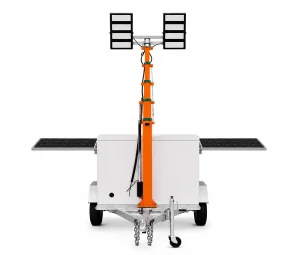
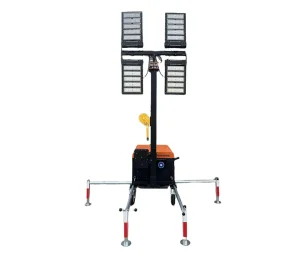
Heavy-duty solar light towers and articulating high bay floodlights built to withstand extreme desert temperatures (50°C+ ambient with high solar load) and rugged site transportation.
Chemical & Petrochemical Refining Plants
Hazardous explosion-proof high-temperature LED floodlights certified for ATEX/IECEx Zone 1 & Zone 2 environments where flammable vapors coincide with elevated process heat.
Global Compliance Standards & Factory Testing Protocols
Rigorous validation processes executed by professional high-temp LED manufacturing facilities.
When procuring high-temperature LED floodlights for industrial EPC projects, engineering compliance and international safety certifications are non-negotiable. Qualified factories adhere to comprehensive testing workflows before shipping:
- Thermal Bake-In Burn-In Testing: Luminaires undergo 100% full-load operation inside environmental heat chambers set at 80°C, 100°C, or 150°C for 72 continuous hours to verify junction temperature stability.
- IP68 Submersion & IP69K High-Pressure Jet Test: Verification of hermetic silicone gasketing under high-pressure, high-temperature water jet spraydown.
- IK10 Mechanical Impact & Vibration Testing: Ensuring mounting brackets, articulating knuckles, and toughened glass housings resist 20J impact forces and continuous crane movement.
- Photometric DIALux Simulation Files (.IES / .LDT): OEM factories provide custom photometric layouts to ensure lux levels, uniformity ratios, and glare indices (UGR) match project tenders.
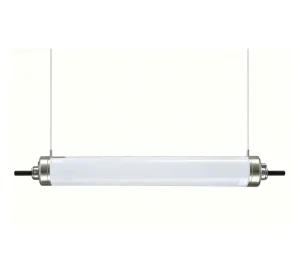
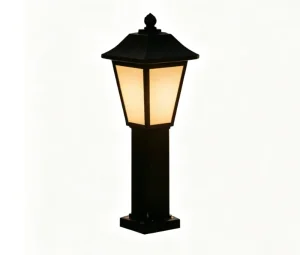
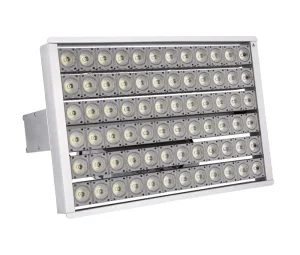
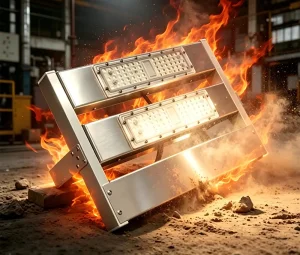
Additional High-Temperature & Industrial Lighting Catalog
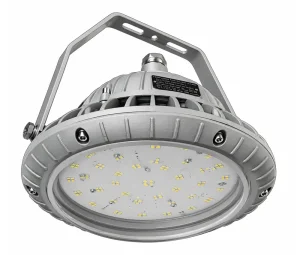
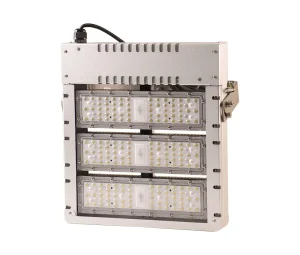
Review additional high-performance luminaires engineered for tri-proof applications, high bay industrial facilities, explosion-proof zones, and mobile solar towers.
Frequently Asked Questions: High Temperature Flood Lights Procurement
Expert answers addressing thermal engineering, factory selection, OEM capabilities, and procurement specs for high-ambient lighting systems.
Q1: What ambient operating temperatures can your high-temperature LED flood lights withstand?
Q2: How does remote driver technology extend luminaire lifespan in high heat zones?
Q3: What optical materials are used to prevent lens yellowing and cracking at 150°C+?
Yes. As a direct OEM/ODM manufacturer, we customize power wattages (50W to 1500W), beam angles (15°, 30°, 60°, 90°, 120°, and asymmetrical flood optics), input voltages (100-277V, 347-480V AC, or 24V-48V DC), mounting brackets (heavy-duty U-brackets, vibration-dampened crane mounts), and specialized anti-corrosion marine coatings.
Q5: Do you provide photometric files (.IES / .LDT) and DIALux lighting design support?
Q6: What certifications are available for international heavy industrial tenders?
Q7: What is the typical lead time for OEM factory orders and international shipping?
Future Innovations in Thermal Lighting Technology & Industrial IoT Integration
Where high-temperature solid-state lighting technology is headed over the next decade.
As heavy industry accelerates digital transformation under Industry 4.0 standards, high-temperature LED floodlights are evolving beyond simple light emitters. Next-generation factory platforms integrate real-time thermal micro-sensors directly onto the MCPCB board to transmit thermal telemetry back to facility SCADA systems.
Gallium Nitride (GaN) High-Temp Drivers
Transitioning from silicon components to GaN power semiconductors allows driver circuitry to operate stably at temperatures above 125°C without efficiency loss, enabling smaller form factors and onboard driver integration.
Predictive AI Thermal Throttling
Smart embedded controllers automatically adjust lumen output during brief extreme heat spikes (e.g., when a ladle of molten steel passes directly underneath), protecting LEDs from over-temperature failure while preserving worker visibility.