
Enterprise Illuminance Solutions — Engineering Showcase Part I
Specialized heavy-duty luminaires engineered for structural reliability, extreme operating temperatures, maritime salt spray resilience, and demanding outdoor field deployments.
Global Macro Paradigm: Sourcing Portable LED Camping & Expedition Lights
The global shift from consumer throwaway lanterns to ruggedized, multi-functional expedition power-lighting hubs with high energy density and lifecycle sustainability.
The global market for portable LED camping lights has undergone an unprecedented transformation. Previously pigeonholed into seasonal outdoor retail and low-cost consumer gadgets, the sector has consolidated into an advanced sub-discipline of high-performance optoelectronics. Industrial basecamps, scientific expeditions in permafrost and equatorial biomes, tactical field operations, and luxury eco-tourism infrastructure now mandate portable luminaires capable of operating across catastrophic thermal gradients (-40°C to +65°C), surviving multi-meter drops onto granite, and interfacing seamlessly with portable photovoltaic arrays.
For international enterprise buyers, brand owners, and governmental emergency supply contractors, identifying the best portable LED camping light suppliers & manufacturers is no longer a matter of comparing gross lumen claims. Modern B2B procurement demands a rigorous audit of upstream wafer supply chains, battery cell provenance, surface-mount device (SMD) soldering accuracy under thermal stress, and the intellectual property maturity behind driver topologies.
Tier-1 Component Integrity
Direct partnerships with tier-1 LED package innovators (OSRAM, Lumileds, Nichia, Cree) ensuring strict MacAdam 3-step ellipse chromaticity consistency and L70 lumen maintenance exceeding 54,000 hours in demanding off-grid environments.
BMS Safety Architectures
Transition from standard ternary lithium 18650 packs to certified Automotive-grade 21700 and LiFePO4 chemistry. Multi-layer active thermal runaway suppression, over-voltage/over-discharge clamping, and UN38.3 transport compliance.
Global ESG Traceability
Full lifecycle compliance with EU Battery Directive 2023/1542, RoHS 2.0 hazardous material eradication, and closed-loop recyclability engineering, facilitating seamless duty clearance across North American and European borders.
Engineering Architecture: Thermal, Optical, and Battery Physics
Evaluating the mechanical and optoelectronic boundaries of portable field illumination systems.
Engineering a portable LED camping or expedition light involves tackling an aggressive packaging bottleneck: cramming high-lumen multi-die emitters, an intelligent constant-current step-down driver, bi-directional fast-charging controllers (USB-C Power Delivery up to 65W/100W), and a dense chemical battery bank into an airtight, ingress-sealed enclosure.
1. Junction Temperature (Tj) Management & Micro-Extrusion Heat Sinks
The primary point of failure in portable outdoor lighting is LED junction overheating leading to phosphor degradation and irreversible chromaticity shifting. While stationary industrial high-bays utilize heavy die-cast fins, portable fixtures rely on lightweight 6063-T6 aircraft-grade extruded aluminum cores integrated with 2.0 W/m·K Metal Core PCBs (MCPCB). Thermal energy is transferred outward across silicone gap-pad interfaces into CNC-machined structural bezels that double as convective heat sinks without compromising ingress seals.
2. Spectral Tuning: High CRI, Dual CCT & Entomological Optoelectronics
Commercial camping applications increasingly reject low-CRI, harsh cool-white diodes. Modern expedition standards demand full-spectrum Color Rendering Indexes (CRI Ra ≥ 95, R9 ≥ 80) ranging from 2200K (candle-flame ambiance to preserve human night adaptation and avoid attracting nocturnal insects) to 5700K (daylight task illumination for field surgery, culinary prep, and precision mechanics). Advanced units incorporate 660nm deep-red auxiliary diodes for astronomical observation and perimeter security without dilating the ocular pupil.
| Technical Parameter | Consumer Standard Grade | Enterprise Field Expedition Grade | Industrial / Tactical Standard |
|---|---|---|---|
| Luminous Efficiency | 90 – 120 lm/W | 160 – 195 lm/W | 200 – 220 lm/W (Derated for reliability) |
| Color Rendering (CRI) | CRI 70 (Color distorting) | CRI 90 – 95 (Full spectrum) | CRI 95+ (R9 > 85, TM-30 Rf > 92) |
| Battery Architecture | Recycled 18650 NMC Cells | Grade-A 21700 NMC / High-Drain | LiFePO4 Deep-Cycle or Solid-State Pack |
| Drop Resistance | 1.0 Meter (Plastic cracking) | 2.0 Meters (Impact elastomer bumpers) | 3.0+ Meters (MIL-STD-810H Drop Certified) |
| Ingress Protection | IPX4 (Splash resistant only) | IP66 / IP67 (Total immersion safe) | IP68 / IP69K (High-pressure steam washdown) |
| Driver Topology | Linear PWM (Noticeable flicker) | Buck-Boost Synchronous CC (0 Flicker) | Digital PWM with GaN Efficiency Stage |
Localized Applications: Beyond Recreational Camping
How institutional clients, commercial outfits, and off-grid facilities deploy high-durability portable LED camping light systems across varied operating environments.
Eco-Resort & Luxury Glamping
Decentralized hospitality projects utilize autonomous, battery-powered LED lanterns featuring magnetic induction docks, brass-accented CNC bodies, and 1800K–2700K warm dimming to offer five-star hotel lighting without trenching high-voltage underground cables across pristine ecosystems.
Disaster Response & Field Hospitals
In the wake of seismic or extreme weather grid disruptions, high-output portable LED units with magnetic clamping and 360-degree diffused arrays provide immediate, shadowless triage lighting while functioning as reverse-charging power banks for satellite communication gear.
Mining Exploration & Geosurvey Camps
Remote geological exploration crews stationed in extreme aridity or freezing altitudes require portable camping lamps with IK10 impact armor, explosion-proof ATEX Zone 2 certifications, and battery packs designed to maintain charge at -30°C.
Maritime & Remote Coastal Outposts
Marine research camps and island outposts deploy salt-spray-resistant fixtures tested under 1,000-hour ASTM B117 standards. Stainless steel 316 fittings and hermetic fluorosilicone O-rings stop salt crusting and galvanic electrolysis cold.
Compliance Framework & Enterprise Procurement Safeguards
Navigating mandatory international legal standards, electromagnetic compatibility, and transportation logistics for lithium-integrated portable luminaires.
Procuring portable LED camping lights at wholesale volume introduces strict regulatory friction points. Luminaires that combine active LED drivers with large lithium secondary cells are legally treated as both portable electronic appliances and hazardous goods under worldwide freight protocols. Premier manufacturers maintain comprehensive internal QA protocols and third-party laboratory accreditations to verify compliance before container dispatch.
UN38.3 & Battery Logistics
Mandatory for all air and sea freight. Verifies altitude simulation, thermal tests, vibration, shock, external short circuit, impact, overcharge, and forced discharge. Never procure battery-integrated luminaires from suppliers unable to produce legitimate UN38.3 test summaries alongside MSDS documentation.
UL 153 / UL 2743 Certification
Essential for US retail and enterprise distribution. Governs the safety of portable electric luminaires and portable power packs. Strict scrutiny on internal wiring insulation, fire hazard protection, flame-retardant polymers (UL94 V-0), and battery charging control safety circuits.
CE-EMC & FCC Title 47 Class B
Guarantees that high-frequency switching circuits in modern buck/boost LED drivers do not leak electromagnetic emissions that disrupt handheld GPS units, satellite phones, or military-spec communications equipment used during field excursions.
In addition, environmentally certified factories enforce stringent IP (Ingress Protection) testing routines via calibrated sand-dust chambers and dual-axis rotational water pressure chambers (IEC 60529). High-end fixtures undergo MIL-STD-810H method 514.8 vibration cycling to guarantee that surface-mounted components will not dislodge during rough transportation across unpaved mountain roads or washboard desert trails.
Technological Roadmap (2025–2030): Next-Gen Field Illumination
How pioneering manufacturers are merging micro-computing, solid-state batteries, and satellite protocols into portable lighting systems.
Solid-State Lithium Batteries
The transition toward semi-solid and all-solid-state lithium electrolyte packs will eliminate flammability risks entirely, doubling volumetric energy density up to 450 Wh/L and extending freezing operational capacity down to -40°C without requiring battery preheating.
Matter-over-Thread & BLE Mesh
Industrial camp lighting is adopting interoperable decentralized mesh networking. A single base station or satellite hub can coordinate hundreds of perimeter lanterns, dynamic SOS beacons, and automated circadian dimming rhythms across an entire square kilometer without cellular infrastructure.
Gallium Nitride (GaN) Micro-Drivers
Replacing silicon MOSFETs with wide-bandgap GaN switches reduces power-stage conversion losses by up to 60%, drastically cutting internal parasitic heat generation and unlocking ultra-compact form factors capable of sustained 3,000+ lumen outputs without rapid thermal step-downs.
Enterprise Q&A: Portable LED Lighting Procurement
In-depth technical answers addressing core engineering dilemmas, custom OEM tooling, thermal testing, and wholesale manufacturing verification.
Low-tier suppliers often market high peak outputs (e.g., 2,000 lumens) that throttle to 10% after 90 seconds due to heat build-up. Premier OEM manufacturers specify ANSI/NEMA FL1 compliant runtime curves, incorporating closed-loop thermal regulation using thermistors (NTC) on the MCPCB. This guarantees stable, continuous high-output illumination backed by integrating sphere photometric test files (.IES).
For ultra-lightweight personal handheld gear where gravimetric energy density is king, 21700 NMC cells (250–270 Wh/kg) are preferred. However, for basecamp lanterns, mobile towers, and institutional emergency kits, Lithium Iron Phosphate (LiFePO4) is far superior: it delivers 3,500+ cycles, exceptional thermal stability up to 60°C, and virtually zero risk of explosive thermal runaway.
For custom industrial design involving clean-sheet aluminum die-casting or plastic injection tooling (PC/ABS/TPU), tooling lead times range from 35 to 50 days. Initial CNC functional prototypes are delivered within 10 to 14 days. Tooling investments typically range from $8,000 to $25,000 depending on mold cavitation, side actions, and two-shot overmolding specifications.
Top manufacturers replace manual silicone gluing with robotic automated dispensable silicone gaskets and molded liquid silicone rubber (LSR) seals. Crucially, 100% of finished housings undergo dry-air differential pressure decay leakage testing on the production line prior to packaging, ensuring no unit escapes with microscopic sealing flaws.
Yes. High-performance portable expedition lights now feature integrated MPPT (Maximum Power Point Tracking) charge controllers directly on their internal circuit boards, accepting wide DC input voltages (5V to 24V) directly from portable folding solar mats, avoiding intermediate inverter conversion losses.
Low-frequency pulse-width modulation (PWM < 1,000 Hz) causes subconscious neurological fatigue, stroboscopic dizziness, and catastrophic video banding when using smartphones or cameras in camp. Industrial-grade suppliers mandate either pure analog constant-current DC dimming or ultra-high-frequency PWM (> 25,000 Hz), guaranteeing 100% flicker-free operation (IEEE 1789 standard).
Enterprise Illuminance Solutions — Engineering Showcase Part II
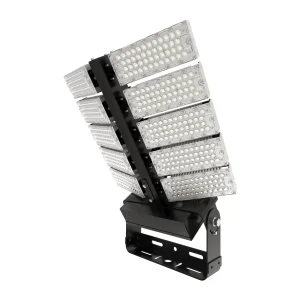
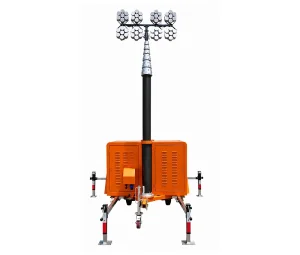
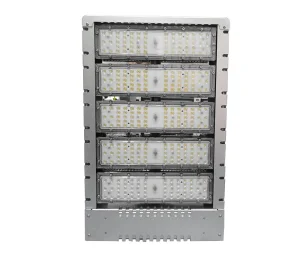
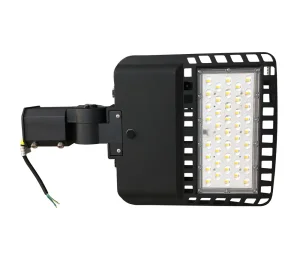
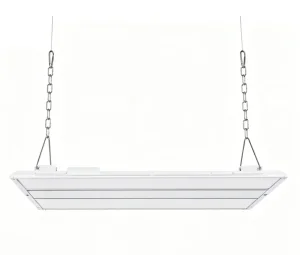
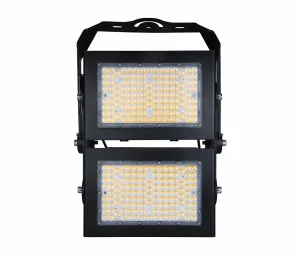
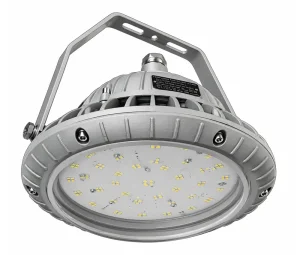
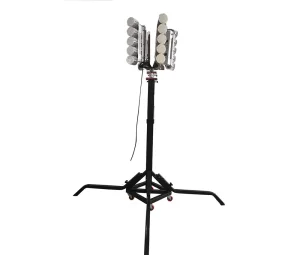
Explore our heavy-duty articulated floodlights, mobile mast lighting systems, high bays, and explosion-proof luminaires engineered for challenging industrial and off-grid project applications.
Enterprise Buyer's Supplier Audit Scorecard
Key checkpoints and factory audit criteria when qualifying Chinese and global manufacturers of mission-critical portable LED camping systems.
1. SMT Yield & Reflow Profiling
Verify factory surface-mount tech lines utilize 10-zone nitrogen reflow ovens with automated 3D optical inspection (AOI) to eliminate solder voids beneath thermal pads of high-power SMD LEDs.
2. In-House Integrating Spheres
Suppliers must possess calibrated 2-meter integrating spheres and goniophotometers to supply unedited chromaticity reports (CCT, CRI, Duv, TM-30-20, lumens/watt) across production batches.
3. Automated Battery Cycling
Factory QA must run dedicated charge/discharge aging bays testing incoming cylindrical and pouch cells for capacity grouping, internal resistance matching, and automated safety venting.