Featured Underwater & Mission-Critical Solutions
Engineered for hydrostatic pressure resistance, zero hermetic decay, and exceptional thermal conductivity in water-cooled or ambient operations.
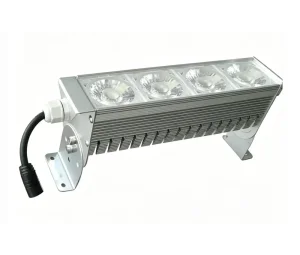
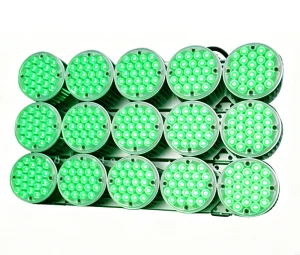
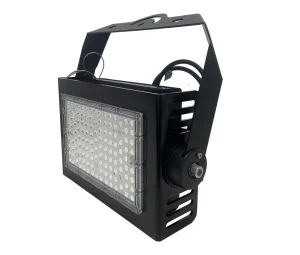
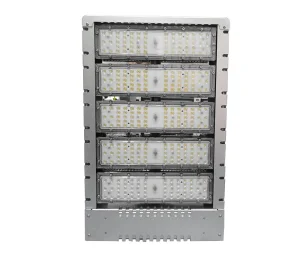
Technological Evolutions in Deep-Water & Heavy Industrial Lighting
The submersible lighting domain has transitioned from simple shallow pool illuminators to ruggedized optoelectronic systems operating under hyperbaric stress, severe salinity, and high thermal interfaces.
Hermetic Hydrostatic Sealing
Traditional mechanical compression gaskets invariably degrade over cyclic exposure to hydrostatic expansion and vacuum pull. Advanced polymer potting matrices and secondary molecular bonding techniques guarantee IP68 longevity at deep submersion.
- Elimination of capillary water ingestion via molded cable gland cores
- Passivated Marine-Grade 316L Stainless Steel and anti-electrolysis titanium
- Hydrostatic pressure chamber tested to 30-meter operational depth
Coupled Fluid-Thermal Dynamics
While submerged fixtures use water as a natural heatsink, industrial wet-dry cycles (e.g., tidal docks, water processing washdowns, industrial kilns) require autonomous thermal management that prevents LED phosphors from thermal shock breakdown.
- Dynamic temperature-sensing ICs for dry-burn protection
- High thermal-conductivity ceramic substrates (AlN)
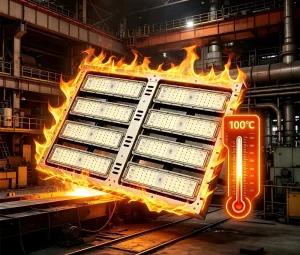
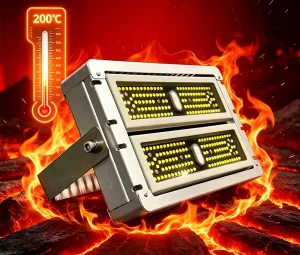
- Engineered heat dissipation profiles rated from -40°C to 150°C/300°C
Underwater Chromatic Fidelity
Water functions as a severe optical spectral filter, selectively absorbing the red and warm wavelengths. Submersible luminaires now implement custom spectral engines (TLCI 98+, High CRI) tailored to underwater filming and marine bio-observation.
- Non-refractive optical lenses minimizing internal backscatter
- Flicker-free pulse-width modulation (PWM) up to 25,000Hz
- DMX512/RDM integrated protocol for dynamic synchronized displays
Navigating Critical Global Enterprise Sourcing Demands
Industrial buyers and civil procurement engineers face rigorous compliance and life-cycle demands when vetting submersible and harsh-duty luminaire manufacturers.
Certifications & Safety
Compliance across UL676 (Underwater Luminaires), IEC/EN 60598-2-18, and ATEX/IECEx for hazardous gas or petrochemical drainage locations is non-negotiable for commercial infrastructure.
Corrosion Lifecycle Cost
Electrochemical galvanic corrosion in marine environments quickly destroys lower-grade aluminum alloys. True suppliers utilize 316Ti, PEEK composites, or multi-stage e-coatings ensuring 10-year life expectancy.
Photometric Verification
Global projects require verified IES/LDT data calculated through underwater refraction models, enabling optical clarity, zero luminous depreciation, and compliant lux levels prior to civil installation.
Supply Chain Durability
B2B tier-1 contractors demand suppliers capable of scaling custom mold tooling, delivering batch-to-batch chromatic consistency, and retaining direct-from-factory warranty backing.
China Industry 4.0: High Precision Engineering for Harsh Environments
Capitalizing on Shenzhen’s optoelectronic cluster, Lsledsus merges advanced robotic fabrication, rigorous automated quality validation, and supply chain vertical integration.
CNC Multi-Axis Machining
All marine-grade and submersible housings are fabricated utilizing 5-axis CNC machining, ensuring micro-level dimensional tolerances for hermetic O-ring seating and zero-gap pressure integrity.
Automated Potting & Vacuum Impregnation
Our clean-room automated vacuum chambers eliminate microscopic air bubbles within structural resins, preventing internal gas expansion and moisture ingress under hyperbaric pressure.
Vertical Component Integration
Partnering with world-class chipmakers such as OSRAM and Mean Well driver architectures, our ecosystem ensures trace-level QA testing, end-to-end BOM security, and accelerated prototyping speeds.
Technical Comparison: Conventional vs. Lsledsus Industrial Submersible Standards
| Engineering Dimension | Standard Commercial Grade | Lsledsus Extreme-Duty Standard |
|---|---|---|
| Ingress Protection | IP65 - IP67 (Transient exposure only) | True IP68 (Continuous Submersion to 30m) & IP69K Pressure Wash |
| Chassis Construction | Die-cast ADC12 standard aluminum | Forged Marine-Grade 316L Stainless Steel / Anodized 6063 Aluminum |
| Thermal Endurance | Tmax: 40°C - 50°C (Risk of seal expansion) | Continuous 80°C - 100°C - 150°C (Custom architectures up to 300°C) |
| Pressure Chamber Testing | Random batch sampling (1/100 units) | 100% Individual Hyperbaric Chamber Tested Before Dispatch |
| Optical Efficiency | Standard PMMA lenses (Yellowing in water) | High-Transmission Quartz Glass / Optically Pure Silicone Lenses |
Engineered Scenarios: Where Standard Lighting Fails
From offshore commercial ports to film studios and metallurgical plants, our luminaires solve complex visibility and environmental challenges.
Commercial Ports & Shipyards
Tidal docks, vessel bilges, and splash zones exposed to constant sodium chloride corrosion, high impact, and seawater surge require unyielding IP68 marine luminaires.
Subsea Cinematography & Video
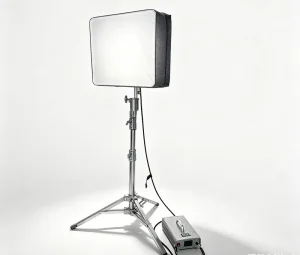
Zero-housing submersible cinema panels providing flicker-free CRI 98+ lighting at up to 30-meter depths, dramatically simplifying film crews’ staging requirements.
Industrial Water Treatment
Wastewater clarifiers, chemical neutralization ponds, and municipal aeration basins demanding high chlorine and acidic chemical vapor resistance.
Civic Fountains & Monuments
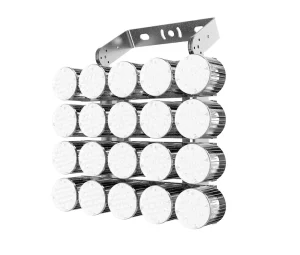
High-powered 1000W-2000W architectural color flood lighting and submerged RGBW systems transforming public landmarks, high towers, and grand fountains.
Engineering & Procurement Q&A
Key technical specifications, custom fabrication capabilities, and durability standards explained by Lsledsus design engineers.
IP67 fixtures are tested only for temporary immersion up to 1 meter for 30 minutes. True IP68 submersible fixtures from Lsledsus are rated for indefinite, continuous hyperbaric immersion at specified depths (such as 2m, 10m, or 30m), featuring sealed cable transitions and chemically bonded resins.
We split the electronics into remote driver enclosures, utilize high-temperature fluorosilicone gaskets, incorporate military-grade aluminum-nitride PCBs, and run validated heat-pipe systems, ensuring continuous operation at 80°C, 100°C, 150°C, and custom ratings up to 300°C.
Yes. Our in-house lighting engineers use advanced DIALux modeling to simulate exact lux levels, beam throw, glare values (UGR), and underwater attenuation profiles so contractors verify compliance before placing manufacturing orders.
Our marine and underwater fixtures utilize marine-grade 316L/316Ti stainless steel or electrophoretically coated structural aluminum with copper content below 0.05%, accompanied by titanium screws to completely eliminate galvanic corrosion.
High-Heat, Explosion-Proof & Submersible Systems
Complete OEM/ODM industrial lighting portfolios designed for heavy commercial facilities, stadium masts, and zero-housing underwater environments.