High-Spec Industrial Luminaires & Engineering Deployments
Explore specialized industrial fixtures engineered to withstand harsh operating parameters, high thermal gradients, and intense duty cycles with zero unscheduled maintenance.
The Global Commercial & Industrial High Bay Landscape
Why Tier-1 industrial buyers, EPC contractors, and corporate energy managers no longer accept nominal specs without a verified 5-year, 24/7 continuous duty lifecycle warranty.
The 43,800-Hour Operating Threshold
Standard commercial lighting is rated for 8 to 12 hours of daily use. Industrial manufacturing plants, cold distribution hubs, and port hangars operate on a continuous 24/7/365 schedule. Over a 5-year contract, this equals 43,800 hours of continuous thermal stress. A legitimate 5-year warranty high bay light factory must design around catastrophic failure risks driven by driver electrolytic dry-out and phosphor degradation.
Levelized Cost of High-Ceiling Maintenance
Replacing a defective fixture mounted at 12 to 18 meters costs between $250 and $600 per point in scissor lift rentals, OSHA-certified safety riggers, and factory downtime. The initial purchase price of the luminaire accounts for less than 18% of the 5-year Total Cost of Ownership (TCO). A certified 5-year industrial warranty functions as financial insurance against OPEX volatility.
DLC 5.1 Premium & Decarbonization Mandates
Utility rebate eligibility across North America and strict European EcoDesign directives require systems reaching 160 lm/W to 200 lm/W system efficacy with aggressive glare control (UGR < 19). Certified manufacturers must deliver photometrics that meet DLC Premium 5.1 standards while maintaining color rendering fidelity (CRI > 80 / R9 > 0) across all operational shifts.
Engineering Anatomy of an Authentic 5-Year High Bay
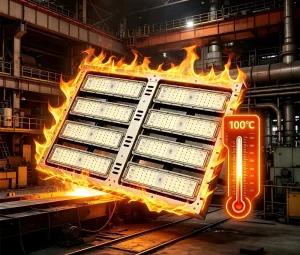
Luminaires operating under 50°C to 65°C ambient roof deck conditions experience accelerated Arrhenius aging. We examine the three core failure nodes: driver topologies, thermal paths, and optical transmission loss.
1. Thermal Decoupling & Chimney Heat Dissipation
Traditional UFO high bays fail when the driver compartment is stacked directly against the LED heat engine without a thermal break. As heat rises, the driver absorbs thermal energy from both the ambient room air and the LED junction layer, pushing the internal temperature past 85°C. At this level, internal electrolytic liquid capacitors rapidly dry out.
True 5-year warranty luminaires use center-vented aero-fin chimney designs cast from ADC12 aluminum or cold-forged 1070 pure aluminum (> 226 W/m·K). The driver sits on isolated standoffs with a convective air channel that creates natural convective airflow. This keeps capacitor ripple temperatures under 65°C, ensuring a field-proven 50,000 to 100,000-hour driver service life.
2. Semiconductor Over-Driving vs. Under-Driving Philosophy
To reduce bill-of-materials cost, low-grade assemblers often overdrive 0.2W SMD 2835 chips at 150mA to 200mA, producing high initial lumens at the expense of lifetime. Operating above 85°C causes rapid silicone browning and accelerated lumen decay.
Professional engineering facilities use tier-1 SMD 3030 or 5050 packages (such as Osram, Lumileds, or Seoul Semiconductor) under-driven at 45% to 55% of maximum rated current. This practice keeps junction temperatures well below the critical 70°C threshold. The result is verified TM-21 calculated L80B10 performance exceeding 72,000 hours.
China's Manufacturing Efficiency & QA Ecosystem
Why modern Shenzhen and Greater Bay Area industrial lighting hubs provide unmatched economies of scale, component traceability, and automated production quality for global buyers.
| Manufacturing Stage | Typical Budget Assembly Shop | Certified Tier-1 OEM/ODM Factory (Shenzhen) | Engineering Impact on 5-Year Warranty |
|---|---|---|---|
| Die-Cast Metallurgy | Recycled scrap aluminum, micro-porosity defects | Virgin high-purity ADC12 or 1070 cold forged aluminum | Eliminates structural hot-spots; improves thermal dissipation efficiency by 38% |
| SMT Surface Mount | Manual stencil, non-calibrated reflow profile | Automated Yamaha / Panasonic SMT lines with 3D AOI inspection | Zero micro-bridging, uniform solder fillets, near-zero open-circuit failures under thermal shock |
| Driver Isolation | Unbranded potting, cheap 85°C capacitors | Mean Well, Inventronics, or Sosen with automated vacuum potting | Immunity against high-humidity condensation, dust ingress, and electrical harmonics |
| Quality Stress Screening | Spot-check 30-minute burn-in at room ambient | 100% 4-hour high-temp dynamic cycling burn-in (45°C chamber) | Weeds out early infant mortality defects before products ship overseas |
| Photometric Verification | Copied IES files from public datasheets | On-site Type-C goniophotometer & 2-meter integrating spheres | Guarantees exact candela distribution, UGR angles, and validated lumen output for dialux designs |
Demanding Industrial Deployment Environments
How optical beam configurations, environmental ingress protections, and mechanical engineering adapt to unique industrial settings across world markets.
1. Automated E-Commerce & High-Bay Logistics (12m - 18m)
Modern distribution facilities rely on narrow aisles (VNA) and automated stacker cranes. Standard round 120° UFOs direct unnecessary light toward the tops of storage racks while leaving aisle floors dim. We specify specialized 60°×90° or 40°×100° aisle optics that focus clean, uniform light directly onto the travel floor and lower tier shelving. Integrated microwave motion sensors cut run hours during shift downtime to lower overall energy use.
2. Cold Chain Storage & Blast Freezers (-40°C to 0°C)
While low temperatures improve LED chip efficacy, they present serious challenges for conventional driver startup and power electronics. Plastic diffusers turn brittle and silicone gaskets shrink, letting moisture in when the room enters defrost mode. Our cold-storage high bay builds use specialized low-temp drivers with integrated PTC heating elements, food-grade poly-carbonate lenses (NSF/ANSI Standard 2 Splash Zone), and dual-stage VMQ silicone seals.
3. Heavy Foundries, Chemical & High-Vibration Sites
Operating near heavy overhead traveling cranes, stamping presses, and forging furnaces exposes luminaires to continuous mechanical vibration and caustic atmospheric vapors. We configure high-bay housings with stainless steel 316 safety tether cables, an IK10-rated toughened borosilicate glass faceplate, and a chemically inert C5-M marine-grade powder-coat finish that resists sulfur and ammonia corrosion.
Global EPC & Enterprise Procurement Specifications
A reference checklist for sourcing directors, quality inspectors, and mechanical/electrical consultants writing engineering tenders for large industrial projects.
Input Parameter Sourcing Verification Checklist
- Nominal vs. True Input Voltage: Ensure universal input drivers support 90-305VAC or 277-480VAC industrial Delta systems without phase-dropout damage.
- Total Harmonic Distortion (THD): Demand verified laboratory test reports showing THD < 10% across the full dimming range and a Power Factor (PF) ≥ 0.95.
- Photobiological Safety: Check for IEC 62471 / IEC TR 62778 certification showing RG0 or RG1 status to protect worker vision at deep ceiling drops.
- Flicker Index & Pst LM: Insist on ripple-free drivers with SVM < 0.4 and Pst LM ≤ 1.0 to prevent visual fatigue and dangerous stroboscopic effects near rotating machine spindles.
- Dialux/Relux IES Modeling: Require authentic laboratory goniophotometric files with calibrated lumen depreciation factors (LLF 0.82) to confirm compliance with target lux levels.
Understanding Warranty Terms: Component Replacement vs. Labor
Many standard 5-year commercial warranties are "return to factory at buyer expense," leaving facilities to handle high-bay uninstallation, ocean shipping, and reinstall logistics on their own.
A true factory partnership provides transparent warranty terms: rapid replacement unit dispatch via air freight, complete modular spare assemblies on-site for immediate swap-outs, and pre-negotiated support based on strict serial-number lot tracking across every production run.
Emerging Trends Reshaping Industrial High Bay Lighting
How the shift from simple fixtures to integrated IoT endpoints is transforming smart warehouses, automated assembly floors, and modern logistics centers.
DALI-2, D4i & Zhaga Book 18 Connectivity
The industry is rapidly phasing out basic hardwired 0-10V dimming in favor of intelligent, addressable systems. Next-generation high bays incorporate standard Zhaga Book 18 receptacles or D4i driver chipsets. This lets operators snap in wireless Bluetooth mesh, Zigbee 3.0, or LoRaWAN nodes without opening the driver enclosure. Fixtures can automatically report energy consumption, real-time operating temperatures, and impending driver component failures back to the facility's central BMS.
Circadian Industrial Productivity & Tunable White
Round-the-clock shift work disrupts worker circadian rhythms, contributing to fatigue and safety incidents. Advanced manufacturing facilities are adopting dual-channel CCT tunable high bays (3000K to 5700K). These systems shift from cool, high-melanopic white during morning and mid-day hours to warm, non-glare illumination as the night shift winds down. This automated transition helps maintain worker alertness and boosts assembly throughput without requiring additional fixtures.
Circular Economy & Modular Remanufacturability
With corporate ESG policies and European circular economy directives taking effect, permanently potted, non-serviceable luminaires are being rejected in project tenders. Leading factories are redesigning high bays with field-replaceable gear trays, tool-less quick-disconnect wire harnesses, and fully recyclable unpainted ADC12 aluminum castings. This modular approach reduces long-term electronic waste and cuts lifecycle carbon emissions by over 60%.
High Bay Engineering & Sourcing FAQ
Straightforward answers to the most common questions raised by electrical consultants, lighting contractors, and global sourcing teams.
What is the technical difference between an authentic 5-year warranty and a marketing warranty?
An authentic industrial 5-year warranty is backed by comprehensive TM-21 lumen maintenance calculations, LM-80 test reports for the specific chip configuration, and accelerated thermal chamber data. In contrast, marketing warranties often use cheap components that operate beyond their safe thermal limits. When these lower-tier fixtures face continuous 24/7 runtimes or elevated ceiling temperatures, they experience premature driver burnout or severe phosphor degradation within 18 to 24 months. Authentic warranties clearly outline continuous duty ambient limits (typically 50°C to 65°C) and provide direct, hassle-free replacement pathways.
How does mounting height affect the choice between a round UFO high bay and a linear high bay?
Round UFO high bays use point-source optical arrays with symmetrical beam spreads (60°, 90°, or 120°). They perform exceptionally well in open production halls, fabrication facilities, and gymnasiums with ceiling heights from 6m to 12m. Linear high bays, on the other hand, feature elongated rectangular formats that excel in narrow-aisle warehousing. When paired with specialized asymmetric lenses, linear fixtures deliver uniform vertical foot-candles along the face of high rack storage systems without casting deep shadows or creating excessive high-angle glare.
Why is surge protection (SPD) so critical for industrial high-ceiling installations?
Industrial power grids experience frequent switching transients, inductive load kicks from high-tonnage motors, and nearby lightning strikes. High bay luminaires mounted on steel building frames are particularly vulnerable to these high-voltage spikes. While standard commercial fixtures rely solely on basic 2kV-4kV driver varistors, ruggedized industrial fixtures incorporate a dedicated, coordinated 6kV-10kV surge protection device (SPD) ahead of the power supply. This extra layer absorbs high-voltage transient energy, preventing catastrophic driver failure and avoiding the costly crane work required to replace overhead fixtures.
What testing and certifications should overseas buyers request prior to issuing a deposit?
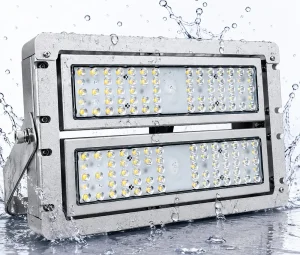
Before issuing a production deposit, buyers should request: (1) Official NRTL UL 1598 / CSA 250.0 test certificates for North American markets, or ENEC / CE-LVD / CE-EMC reports for Europe; (2) Verified DLC 5.1 Premium laboratory listings for utility rebate verification; (3) Third-party LM-79 photometric reports from accredited labs, complete with absolute lumens and spectral power distribution; (4) Third-party LM-80/TM-21 extrapolation files for the exact drive current used; and (5) IP65/IP66 ingress protection and IK08/IK10 mechanical impact test documentation.
High-Output Flood, Tower & Area Luminaires
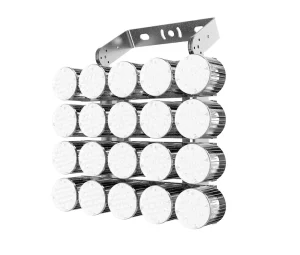
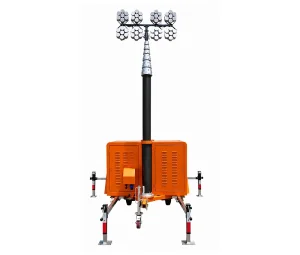
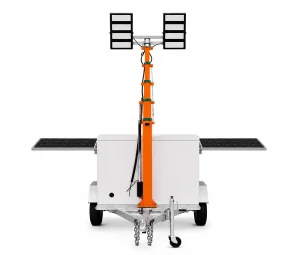
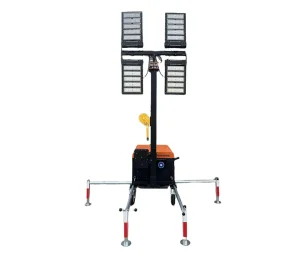
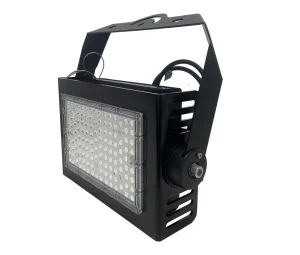
Complete your facility infrastructure with our field-proven stadium projectors, mobile lighting towers, marine-grade floodlights, and extreme-temperature solutions.