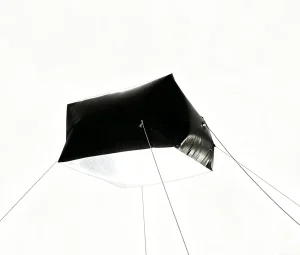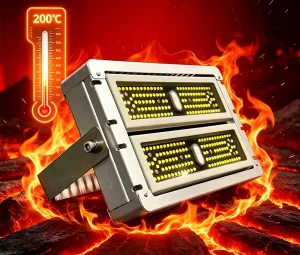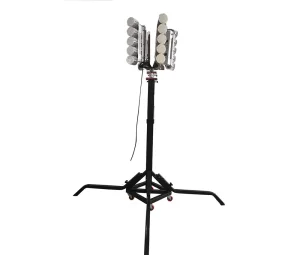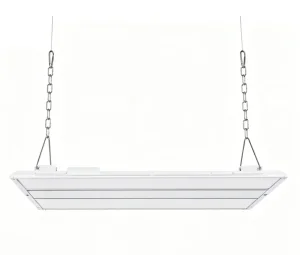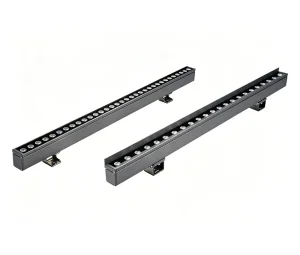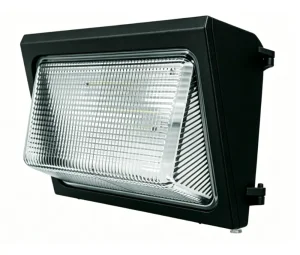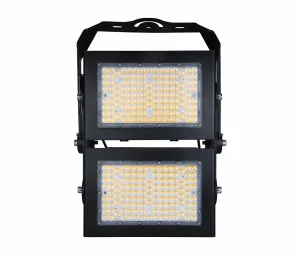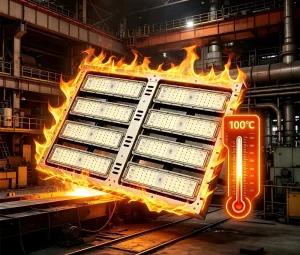
Featured Extreme-Condition Lighting Fixtures (Series I)
Heavy-duty illumination systems tested in high thermal saturation, underwater conditions, and rigorous structural environments.
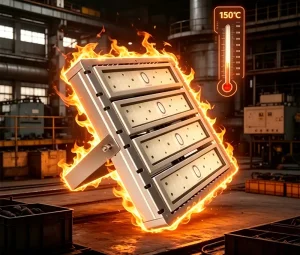
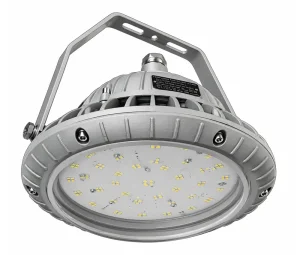
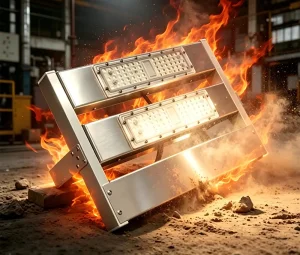
Thermal Saturation Realities in Modern High-Ambient Industrial Facilities
Why standard commercial-grade luminaires experience rapid catastrophic failures in 90℃ ceiling ceiling-level ambient heat zones, and how precision thermal engineering circumvents solid-state lumen degradation.
The Ceiling Stratification Trap
Industrial facility managers often report ambient floor temperatures around 35°C to 45°C. However, buoyant thermal convective plumes in heavy smelting, boiler rooms, and forging bays routinely build sustained upper-ceiling stagnation layers exceeding 85°C to 95°C. Commercial high-bay LEDs installed in these zones experience junction temperatures (Tj) well over 135°C, resulting in accelerated silicone encapsulation browning, phosphor matrix quenching, and catastrophic electrolytic driver capacitor dry-out within months.
Semiconductor Physics at 90℃ Ambient
Operating InGaN/GaN semiconductor dies at a continuous 90℃ ambient requires engineered sub-millimeter thermal conductance. Without specialized Ceramic Aluminum Nitride (AlN) Direct Bonded Copper (DBC) substrates and micro-phase vapor chambers, thermal resistance ($R_{th-jc}$) backs up into the die. Lsledsus integrates proprietary thermal dissipation channels that guarantee die junction temperatures remain safely clamped under 105°C even during peak 90℃ environmental continuous shifts.
Total Cost of Ownership Disruption
In continuous-process facilities such as steel mills or glass sheet lines, renting crane lifts or halting production lines to replace standard failed fixtures incurs massive downtime costs. Investing in purpose-built 90℃ rated high-temperature LED luminaires eliminates unplanned plant downtime, protects work safety compliance under OSHA and ISO 8995-1 / CIE standards, and amortizes the capital expenditure within single-digit fiscal quarters through maintenance avoidance.
Shenzhen Factory Efficiency & High-Precision Production Ecosystem
How our vertically integrated Greater Bay Area manufacturing facility delivers unmatched metallurgical casting, driver isolation architectures, and rapid OEM/ODM lead times.
A380 Copper-Free Extrusions
Our in-house die-casting foundry utilizes high-purity, copper-free A380 and 6063-T6 aluminum alloys featuring thermal conductivities exceeding 200 W/(m·K). Structural cooling fins are hydro-formed with aerodynamic chimney draft channels, maximizing natural convection currents in stagnant factory air pockets.
Decoupled Driver Topology
Electronic driver power converters are the primary failure point in thermal chambers. We engineer split-body physical architectures where the driver enclosure is isolated from the LED engine via thermal stand-offs, ceramic air barriers, or remote quick-connect wiring options extending up to 50 meters away from heat epicenters.
Automated Hot SMT Bonding
High-speed surface-mount technology (SMT) lines incorporate 99.99% gold-wire bonding and eutectic solder pastes containing silver alloys with liquidus temperatures past 280°C. This ensures zero micro-fracturing or intermetallic fatigue under continuous 24/7 cyclical thermal stress.
105℃ Chamber Stress-Testing
100% of production runs pass through multi-point thermal validation chambers soaking at 105°C ambient conditions for 72 consecutive hours. Every lumen curve and power factor variation is digitally tracked via automated spectrometer rigs to eliminate premature infant mortality in heavy industry.
Engineered Resilience for Mission-Critical Production Environments
From metallurgical foundry crucible platforms to high-temperature paper drying lines, our 90℃ LED luminaires replace failure-prone metal halide and high-pressure sodium fixtures.
Foundry & Continuous Casting Bays
Steel melting shops, electric arc furnaces (EAF), and ladle metallurgy stations generate intense infrared radiation bursts coupled with ambient air pockets rising above 85°C-90°C. Standard luminaires flicker, color-shift to deep blue, and extinguish. Our 90℃-rated high bays preserve full CRI 80+ clarity, enabling crane operators and floor crews to clearly discern molten metal boundaries and slag lines without ocular fatigue.
Glass Manufacturing & Annealing Lehrs
Container glass, float glass, and optical glass manufacturing lines utilize prolonged annealing furnaces spanning hundreds of meters. Air convection immediately above the cooling lehrs maintains a sustained 80°C to 92°C blanket. Lsledsus fixtures utilize ultra-hardened borosilicate glass front lenses that resist silica chemical etching, thermal micro-cracking, and caustic washing cycles.
Pulp, Paper & Chemical Evaporators
Paper machine dryer hoods, black liquor evaporation plants, and chemical processing cracking towers combine elevated continuous 88°C-90°C thermal conditions with near-saturation humidity and sulfuric vapors. Featuring IP66/IP68 hermetic double-gasketed fluoroelastomer seals, our fixtures stop airborne moisture and corrosive mist ingress cold.
Next-Generation Engineering Trends in High-Temperature Solid-State Illumination
How advanced wide-bandgap semiconductors, intelligent thermal sensing, and circular repair architectures are redefining durability metrics across global heavy industries.
GaN & SiC Power Converters
Gallium Nitride (GaN) and Silicon Carbide (SiC) switches are superseding silicon MOSFETs in industrial drivers. Operating with virtually zero switching losses up to 175°C junction thresholds, GaN/SiC platforms enable ultra-compact, high-efficiency power supplies that live natively within 90℃ housings without degradation.
NTC Adaptive Thermal Throttling
Integrated Negative Temperature Coefficient (NTC) micro-sensors dynamically monitor real-time junction thermodynamics. Should an industrial furnace experience an uncontrolled heat surge pushing environmental ambient past 95°C, intelligent firmware gracefully trims driving current by 10-15%, preventing die damage until nominal conditions return.
Optical Borosilicate Refractors
Polycarbonate (PC) and PMMA acrylic lenses discolor and craze when exposed to sustained temperatures above 80°C alongside UV radiation. The industry is rapidly pivoting toward high-transmittance non-aging borosilicate micro-prismatic glass optics capable of retaining 98% clarity at temperatures surpassing 350°C.
Field-Replaceable Modules
In line with global ESG directives and circular industrial design mandates, future-proof 90℃ LED fixtures utilize modular quick-latch mechanical housings. Plant electrical crews can hot-swap power driver packs or optical engines from catwalks in under two minutes without demounting the structural cast body.
Procurement Specification Benchmark: Commercial vs. Lsledsus 90℃ Class
Essential technical benchmarks required by EPC contractors, industrial plant engineers, and electrical project directors when tendering high-ambient illumination contracts.
| Evaluation Parameter | Standard Commercial LED High Bay | Generic High-Temp Fixture | Lsledsus 90℃ Industrial Grade |
|---|---|---|---|
| Rated Ambient Operating Temp ($T_a$) | -20°C to +45°C | Up to +65°C max | Continuous -40°C to +90°C |
| Thermal Interface Material (TIM) | Standard silicone paste (1.5 W/mK) | Standard thermal pad (3.0 W/mK) | Phase-change metal pad (8.5 W/mK) |
| Driver Isolation Topology | Integrated in same thermal cavity | Compartmentalized with thin barrier | Thermally decoupled or remote rack |
| Optical Material Integrity | Polycarbonate (Yellows above 70°C) | Treated acrylic / Semi-tempered | Pure borosilicate tempered 5mm glass |
| Capacitor Lifespan at Max Rating | < 5,000 Hours (Electrolyte boil) | ~ 20,000 Hours | > 100,000 Hours (Rubycon/Nichicon 125°C) |
| Ingress & Corrosion Defense | IP54 / Standard powder coat | IP65 / Basic anodizing | IP67/IP68 + C5-M Marine anti-corrosion |
Frequently Answered Engineering & Procurement Questions
In-depth technical answers addressing thermodynamic limitations, installation distances, power harmonics, and custom modifications.
What happens to the LED driver if ambient heat briefly spikes past 90℃?
Our industrial drivers are populated with solid-state, long-life capacitors rated for 125°C internally and feature intelligent thermal feedback. If temperatures exceed 90°C during an unpredicted plant upset, the driver automatically attenuates drive current linearly rather than abruptly shutting down, protecting solid-state integrity while maintaining essential work-floor safety illuminance.
How does remote driver mounting operate for steel furnace canopies?
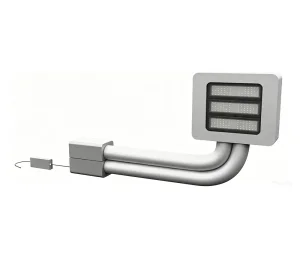
For extreme locations where ceiling temperatures hit 100°C to 150°C, we provide remote driver consoles pre-housed in IP66 stainless-steel or powder-coated cabinets. These are installed in climate-controlled electrical rooms or lower-level catwalks up to 50 meters away, connected via high-temperature silicone multi-core shielded cabling.
Why is borosilicate glass required instead of standard polycarbonate?
Under sustained 90℃ conditions, standard polycarbonate (PC) and acrylic (PMMA) degrade rapidly: volatile plasticizers leach out, creating microscopic hazing, yellowing, and optical distortion that reduces usable lumen output by up to 40%. Borosilicate glass provides pure zero-aging optical clarity and complete immunity to chemical vapor scouring.
Can you provide customized beam angles and photometric layouts?
Yes. Every industrial lighting project begins with complete Dialux or Relux photometric modeling. We offer interchangeable precision beam angles ranging from 25°, 60°, 90°, to 120° wide-area distributions, allowing project managers to hit precise Lux targets and UGR (Unified Glare Rating) limits directly on active work planes.
Featured Extreme-Condition Lighting Fixtures (Series II)
Specialized mobile light towers, high bays, ultra-high temperature luminaires, and precision architectural floodlights ready for international deployment.