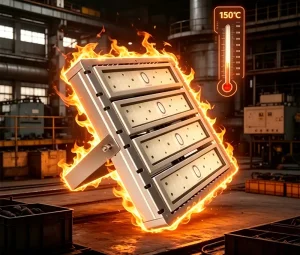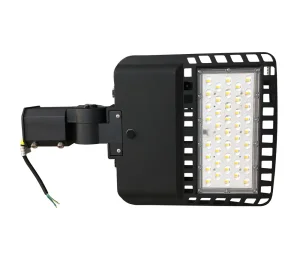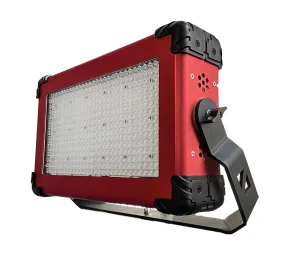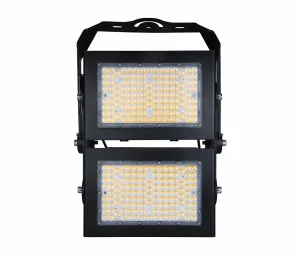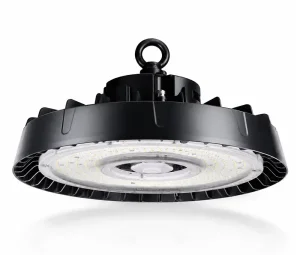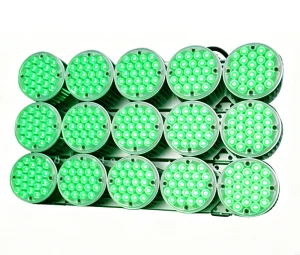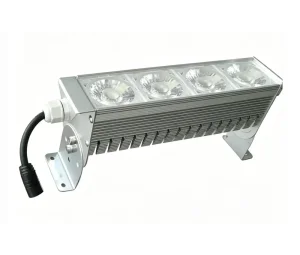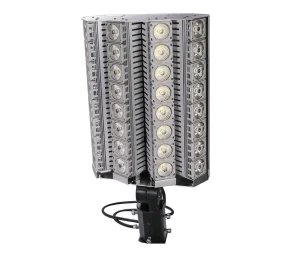
Industrial & Color-Changing Engineering Fixtures
Explore heavy-duty architectural wash, high-temperature illumination, and specialized project fixtures manufactured under strict ISO/CE certifications.
Technological Vectors in Dynamic Landscape Illumination
The transition from static exterior architectural lighting to dynamic, software-driven color changing systems has transformed nocturnal urbanism and commercial hospitality master plans globally.
RGBAW & Tunable Spectral Engines
Traditional RGB systems suffer from narrow gamut limitations and poor color rendering index (CRI) in amber and pastel zones. Modern Tier-1 municipal installations mandate 5-in-1 RGBAW or RGBW emitters (incorporating 3000K/4000K true white chips) to achieve deep saturation while guaranteeing natural vegetative color rendering.
Bidirectional RDM Remote Telemetry
DMX512-A combined with ANSI E1.20 Remote Device Management (RDM) enables bi-directional operational feedback. Fleet operators can remotely interrogate individual luminaires for junction temperature, diode decay, forward voltage instability, and driver lifespan without sending maintenance crews on hydraulic lifts.
Circadian & Dark-Sky Compliance
Municipal codes across North America and the EU enforce stringent IDA (International Dark-Sky Association) parameters. Cutting-edge dynamic luminaires feature optical snoots, micro-louvers, and sub-1-degree cutoff lenses paired with automated software scheduling that curbs upward light spill and ecological blue light disruption after midnight.
Decentralized AI-Driven Mesh Protocols
High-end landscape architectures are deploying Bluetooth SIG mesh alongside Art-Net over fiber nodes. Dynamic luminaires process real-time environmental input (visitor presence, acoustic changes, tides) to trigger organic color waves without requiring latency-inducing centralized cloud computational overhead.
Corporate Buyer Criteria & Procurement Mandates
Enterprise procurement departments, electrical contractors, and master lighting designers adhere to rigid operational performance benchmarks when vetting color changing landscape fixture suppliers.
Thermal & Environmental Hermeticity
Landscape luminaires buried in earth or mounted near waterways face cyclic hydrostatic pressure. Leading specifications demand dual-chamber die-cast aluminum (ADC12) housings, structural potting silicone, Gore-Tex breathing valves preventing internal condensation, and certified IP67 to IP68 submersion integrity with IK10 impact resistance.
Chromatic Consistency (MacAdam Ellipse)
Global mega-developments cannot tolerate color discrepancies along 500-meter boulevard facades. B2B buyers enforce tight 3-step or 2-step MacAdam ellipse binning protocols across Tier-1 diode vendors (Lumileds, Cree, Osram), guaranteeing exact wavelength uniformity in multi-thousand unit shipments.
Signal Integrity Over Long Run-Lengths
Voltage drops and DMX packet reflections along sprawling outdoor circuits lead to flickering and frozen frames. Enterprise specifications prioritize onboard constant-current wide-input step-down driver topologies (24V–48V DC or 120V–277V AC) with RS-485 differential transceivers capable of 300-meter uninterrupted DMX signal transmission.
Macro Application Frameworks & Site Solutions
Architectural lighting is not a commodity fixture; it is a unified electrical and optical ecosystem designed around distinct geographic and structural demands.
Heritage Civic Structures & Stone Facades
Historic stone requires zero structural invasiveness and narrow-angle optical sculpting (4° to 10° beams) to avoid light pollution into interior chambers. Our factory engineers low-profile RGBW grazing bars with customized bracket offsets and micro-prismatic anti-glare louvers that blend seamlessly into historical masonry without aesthetic degradation.
Fountain, Marine & Submerged Waterways
Dynamic underwater lighting requires chemical resistance against chlorination, bromides, and salinity. We utilize electropolished 316L stainless steel enclosures, chemically toughened quartz glass, and fully vulcanized Neoprene rubber cabling designed for continuous submersed operation at depths exceeding 2 meters under full hydrostatic load.
Commercial Boulevard & Botanical Parks
Botanical landscapes necessitate precise root-zone thermal management. Our in-ground burial luminaires integrate cold-forged passive heat dissipation channels that keep surface lens temperatures below 50°C, ensuring public pedestrian safety and eliminating biological root scorch in manicured gardens.
Luxury Hospitality & Theme Park Dynamic Shows
Large entertainment resorts require milliseconds-fast scene changes without strobe jitter. We implement high-frequency 16-bit PWM dimming (flicker-free up to 25kHz for HDTV broadcast cameras), allowing broadcast studios and high-speed park attractions to capture rich dynamic lighting displays with zero banding.
Global Regulatory Compliance & Localized Support
Our OEM/ODM manufacturing plant complies with worldwide engineering standards, accelerating project inspection approval from municipal inspectors and safety boards.
North American Compliance (UL 1598 / CSA)
Fixtures engineered for the United States and Canadian markets carry verified cULus listings for wet and submerged locations, Class 2 low-voltage power supply certifications, and compliance with FCC Part 15 Class A/B electromagnetic interference standards.
European Directives (CE, RoHS, CB)
Full CE certification adhering to EN 60598-1 and EN 60598-2-18 (luminaires for swimming pools and similar applications), EN 62471 photobiological safety standards, and RoHS/REACH material environmental mandates.
Photometric & IES Custom Modeling
Our in-house goniophotometer laboratory generates customized .IES and .LDT photometric data files. We assist MEP consultancies and lighting designers with Dialux and AGi32 optical simulations before manufacturing commences.
Field Commissioning & Factory Support
Factory-direct engineering support extends to on-site DMX address mapping, optical aiming calibration, custom firmware authoring for proprietary central automation systems, and rapid global supply chain replacement parts dispatch.
Technology Roadmap: The Future of Architectural Photonic Systems
Discover next-generation photonic developments engineered in our Shenzhen advanced R&D facility, setting tomorrow's benchmarks for commercial dynamic illumination.
Micro-Pixel Multi-Channel Emitter Arrays
Integrating high-density CSP (Chip Scale Packaging) LED arrays with integrated per-pixel addressable silicon. This breakthrough delivers ultra-narrow projection mapping directly from discrete landscape floodlights without necessitating bulky projection enclosures.
Graphene Thermal Conductive Matrices
Integrating synthetic nano-graphene composite coatings onto our aluminum heat-sink fins. This enhances thermal dissipation efficiency by 28%, significantly shrinking the physical envelope of high-wattage 1000W+ RGB fixtures while extending operating life at 60°C ambient temperatures.
Automated Self-Balancing Chromatic Feedback
Next-gen integrated photodiode spectral feedback loops built directly inside the optical lens cavity. The fixture detects thermal or temporal diode decay and continuously modulates PWM driver outputs to maintain absolute chromatic calibration throughout its 10-year operational lifecycle.
Frequently Asked Engineering & Sourcing Questions
In-depth technical answers addressing electrical specifications, installation environments, and custom engineering manufacturing capabilities.
Standard RGB synthesizes white by combining red, green, and blue light, producing a cool, unbalanced white with low CRI (often below 65) that distorts plant foliage and earth tones. Adding a dedicated white diode (RGBW) or amber (RGBAW) provides a continuous spectral output with CRI 85-95, delivering rich dynamic saturation alongside natural architectural illumination.
We employ a multi-barrier defense strategy: precision CNC-milled 316L stainless steel or passivated aluminum, dual O-ring silicone seals, internal polyurethane structural potting encapsulating all driver electronics, and pressure-equalizing breathing vents that mitigate mechanical seal degradation caused by hot/cold cycling.
Our landscape product series natively supports standard DMX512-A with bi-directional RDM (ANSI E1.20). For centralized systems, we provide interface controllers supporting Art-Net, sACN (Streaming ACN), 0-10V, and Dali-2 protocols, alongside wireless options like LumenRadio CRMX or secure Bluetooth Mesh.
For long-run installations, we configure step-up central DC distributions (such as 48V DC) combined with onboard buck regulators inside each fixture, or integrate wide-range internal universal power supplies (100V–277V AC). This maintains rock-solid photometric consistency over cable runs extending hundreds of meters.
Yes. We tool precision PMMA optical grade lenses offering ultra-narrow (4°, 8°), medium (15°, 25°, 40°), wide flood (60°, 90°), and specialized asymmetric wall-wash distributions (e.g., 15°x45° or 10°x60°) tailored specifically for wall grazing and tree canopy illumination.
Standard production runs ship within 2 to 4 weeks. For custom OEM/ODM designs—including bespoke housing extrusions, custom brackets, marine-grade powder coatings, or specialized diode wavelengths—our engineering team delivers 3D prototypes within 7 to 10 days, followed by rapid tooling and mass production.
Specialized Commercial & High-Power Solutions
Explore heavy-duty architectural wash, high-temperature illumination, and specialized project fixtures manufactured under strict ISO/CE certifications.