Specialized Heavy-Industrial & High-Temperature Products
Select from our benchmark certified luminaires, precision-engineered for severe mechanical stress, volatile environments, and relentless high ambient temperatures.
Industrial Context: The Challenge of High Thermal & Particulate Loads
Across global primary processing sectors, illumination systems are the first line of operational reliability and occupational safety. Standard luminaires routinely fail under compounded ambient stress.
Thermal Stratification Impact
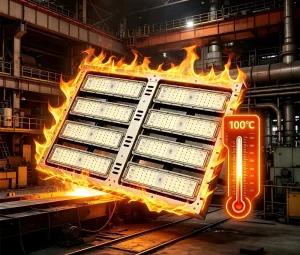
Under heavy production lines like basic oxygen furnaces or ladle metallurgy facilities, thermal layering drives ambient ceilings upwards of 80°C to 120°C, causing runaway capacitor breakdown in conventional LED drivers.
Particulate Blanketing & Insulation
In cement production and foundry casting bays, airborne micron-scale dust (PM2.5 to PM10) adheres to thermal sinks. When particulate layers accumulate past 1.5mm, cooling efficacy drops exponentially by 40%.
Chemical & Corrosive Stress
In petrochemical cracker units and primary smelting zones, airborne sulfurous gases combine with moisture to degrade silicone seals, turning standard IP-rated housings porous within months of initial startup.
Specialized Deployment Environments
Tailored configurations ensuring uninterrupted operation where conventional lighting fails through premature thermal trip or optical degradation.
Steel Mills & Forging Bays
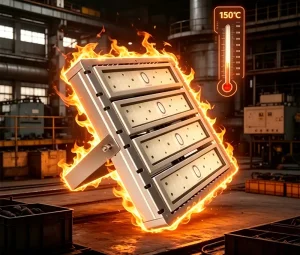
Capable of enduring constant radiation loads exceeding 100°C–150°C. Units leverage remote electronic drivers positioned up to 50 meters away in cooler microzones, isolating critical driver electronics.
Cement Plants & Bulk Terminals
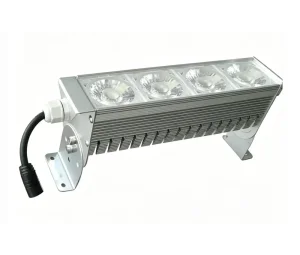
Engineered with non-stick aerodynamically inclined heat-dissipation fins. Smooth flow geometry prevents heavy lime and clinker dust accumulation while retaining an IP67/IP68 airtight seal.
Glass Manufacturing & Annealing
Where thermal shock is omnipresent near forming stations and lehrs. Toughened borosilicate glass lenses prevent micro-fracturing under rapid localized temperature swings.
Mining Processing & Smelting
Combines heavy-gauge copper heat pipes with mechanical anti-vibration mounting to ensure structural longevity alongside heavy ball mills, vibrating screens, and primary crushers.
Resilience & Efficiency: The Shenzhen Manufacturing Advantage
Operating from the heart of the world's most dense optoelectronic manufacturing cluster gives us unmatched agility, precision engineering, and delivery security.
Hyper-Localized Vertical Integration
Over 90% of raw inputs—from high-pressure die-cast ADC12 aluminum housings and metal core PCBs to custom wire assemblies—are sourced within a 45-minute radius in Shenzhen, eliminating inter-continental supply bottlenecks.
Tier-1 Component Partnerships
Strategic partnerships with OSRAM, Philips, and Mean Well allow us to customize driver firmware, low-ESR ceramic capacitor networks, and ceramic-base phosphor systems engineered specifically for ultra-high temperature profiles.
Scalable Rapid Prototyping
Advanced CNC tooling and rapid mold-flow testing enable customized bracketry, specialized IP69K silicone profiling, and photometrically simulated optics in as few as 10 business days for mission-critical industrial retrofits.
Engineering Architecture & Future Directions
Continual R&D investments pushing the physical operational boundaries of semiconductor lighting in hostile industrial settings.
Silicon Carbide (SiC) Integration
Transitioning driver architectures from traditional silicon switches to Wide Bandgap SiC MOSFETs, cutting driver internal heat generation by 60% and enabling driver integration at up to 125°C ambient without active air assists.
IoT Predictive Thermal Telemetry
Integrated micro-sensors monitor LED junction temperature ($T_j$), power factor, and lens transmission values in real time, notifying facility management via DALI-2/Modbus prior to component fatigue limits.
Superhydrophobic Nanocoatings
Application of sol-gel titanium dioxide / silica nanoparticle coatings on luminaire exteriors, eliminating electro-static dust adherence and inducing a self-cleaning surface state through high-heat convection.
Phase-Change Material (PCM) Reservoirs
For cyclical high-temperature bursts (e.g., blast furnace tapping), integrated PCM thermal mass absorbs peak heat spikes up to 400°C without transferring thermal flux to sensitive LED dies.
Compliance, Standards & Localized Engineering Support
International field readiness validated through rigorous destructive physical testing, third-party certification, and end-to-end engineering support.
Stringent Ingress Certification
Every light variant undergoes independent testing for IP66, IP67, IP68, and high-pressure steam cleaning IP69K protocols according to IEC 60529 and DIN 40050-9 standards to guarantee total seal security against fine ash and water ingress.
Harmonized Regulatory Access
Pre-certified for global operations with CE, RoHS, UL844 (Hazardous Locations where applicable), IECEx, and ATEX certifications, ensuring seamless safety audits across North America, Europe, Australia, and the Middle East.
Full Lifecycle Support & Photometrics
Our senior optoelectronics team provides full-spectrum DIALux simulations, custom cabling harnesses, and dedicated field engineering consultants to support project delivery from preliminary design through final commissioning.
Engineering & Procurement FAQ
Direct answers to the most critical technical questions encountered by mechanical, electrical, and plant managers.
What is the mechanical difference between standard fixtures and high-temperature LED luminaires?
Standard industrial fixtures rely on internal drivers rated up to 45°C ambient, plastic lenses, and thin die-cast frames. High-temperature fixtures utilize heavy ADC12 or 6063 aviation extruded aluminum housings, ceramic-packaged LEDs, high-temp fluorosilicone or Teflon gaskets, borosilicate lenses, and separated driver enclosures to ensure safe heat dissipation in extreme environments.
How does dust accumulation affect the operational lifespan of high-temperature LEDs?
Dust functions as a thermal insulator. If heat sink fin gaps fill with airborne particulates, the heat transfer coefficient decreases drastically, causing internal junction temperature ($T_j$) to exceed safe design limits (typically 105°C). This accelerates lumen depreciation and risks driver component blowout. Our luminaires use wide fin spacing and hydrodynamic contours to minimize settling areas.
When is a remote driver configuration recommended?
We recommend remote driver mounting when ambient temperatures at the fixture ceiling surpass 65°C, or when fixtures must operate directly above radiant heat sources like ladles or glass annealing tanks. Locating the driver box in a cooler environment (below 50°C) extends driver lifespan up to 100,000 hours.
Can you provide custom photometric simulations before we place a bulk order?
Yes. Our engineering department develops full DIALux photometrics based on your facility layout, crane clearances, structural obstacles, and required lux/uniformity thresholds to prevent glare, dark spots, and inefficient fixture over-specification.
Extended High-Output Industrial Solutions
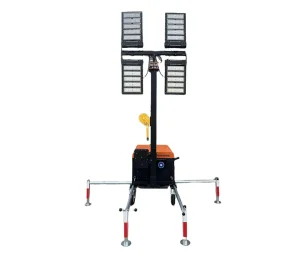
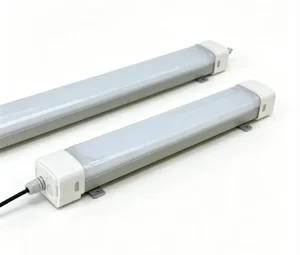
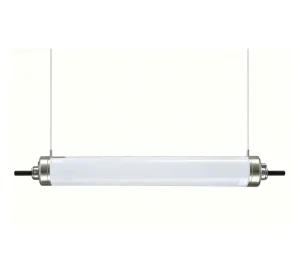
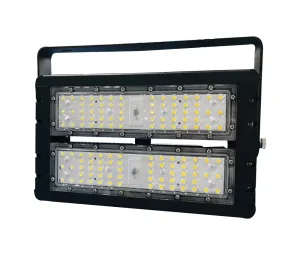
Explore our full line of specialized luminaires, built for hazardous duty, infrastructure, sports venues, and off-grid mobile operations.