Industrial High-Temperature & Specialty LED Solutions
Precision-engineered optical systems built to withstand extreme thermal, chemical, and atmospheric stress across global heavy manufacturing environments.
Macroeconomic Industrial Trends & The Thermal Challenge in Solid-State Lighting
As global heavy industries—including metallurgy, chemical processing, glass manufacturing, and energy generation—push toward automated, 24/7 continuous operations, operational environmental stresses on plant infrastructure have reached unprecedented levels.
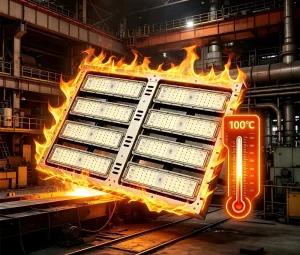
In conventional industrial facilities, general-purpose commercial LED luminaires suffer catastrophic failure rates when subjected to ambient operating temperatures exceeding 50°C (122°F). High-temperature manufacturing environments, such as steel mill furnace bays, foundry casting floors, glass annealing lines, and power station boiler facilities, routinely generate ambient air temperatures ranging from 70°C to well above 200°C. Deploying standard lighting fixtures in these zones triggers rapid thermal degradation of LED semiconductor junctions (p-n junctions), encapsulation yellowing, phosphor carbonization, and early electronic driver failure.
Global Market Shifts
The global market for extreme environment industrial LED lighting is projected to expand at a CAGR of 11.4%, driven by stringent occupational safety mandates (OSHA/ISO 45001) and global carbon reduction goals demanding low-energy luminaire replacements.
The Hidden Cost of Thermal Failure
Unscheduled lighting downtime in high-risk zones halts crane operations, degrades visual safety inspections, and requires hazardous maintenance interventions that cost industrial facilities up to $50,000 per hour in lost throughput.
Zero-Maintenance Architecture
Modern B2B procurement demands luminaires designed with active/passive hybrid thermal dissipation, isolated remote driver topologies, and L70/B10 lifespans exceeding 100,000 operating hours at elevated temperatures.
Engineering Deep Dive: Thermal Physics & Semiconductor Junction Integrity
To engineer a high-temperature LED luminaire capable of operating at 80°C, 100°C, 150°C, or up to 300°C, system designers must manage the thermal path from the microscopic gallium nitride (GaN) semiconductor junction down to ambient air. Light-emitting diodes are inherently heat-sensitive devices; approximately 65% to 75% of electrical power input is converted directly into heat rather than visible photons.
1. Junction Temperature ($T_j$) Dynamics & Efficacy Roll-Off
As the semiconductor junction temperature ($T_j$) rises, the semiconductor's bandgap narrows, leading to a shift in emitted wavelength (color shift toward higher nanometers) and a sharp reduction in internal quantum efficiency (IQE). Standard LEDs experience non-radiative recombination (Auger recombination) at elevated temperatures, causing light output to drop drastically. Our custom high-temperature LED engines utilize Direct Bond Copper (DBC) ceramic substrates and specialized flip-chip GaN dies that maintain flat efficacy curves even at $T_j > 135^\circ\text{C}$.
2. Driver Electrolytic Capacitor & Semiconductor Longevity
The weakest link in conventional LED fixtures exposed to ambient heat is the switch-mode power supply (SMPS). Standard liquid electrolytic capacitors experience electrolyte evaporation governed by the Arrhenius equation—for every 10°C rise in operating temperature, operational lifetime is halved. Our high-temperature systems decouple this failure mechanism through two critical architectural innovations:
- Solid-State & Ceramic Capacitor Driver Topology: Replacing wet electrolytic capacitors with pulse-rated, high-temp ceramic matrix capacitors rated for >125°C ambient stability.
- Remote Power Enclosure Modules (Up to 100 Meters): For extreme applications (such as 150°C–300°C furnace bays), the LED power supply is housed in a remote, temperature-controlled electrical room, transmitting regulated constant current to the optical head via high-grade fluoropolymer-insulated cables.
3. Optical Encapsulation & Silicone Degradation Mitigation
Conventional organic silicone lenses turn brown and brittle when subjected to intense blue photon flux combined with temperatures over 100°C. This degradation blocks light transmission and accelerates internal heat buildup. We utilize Non-Yellowing Borosilicate Optical Glass and Space-Grade Fluorocarbon Optics that maintain 98.5% light transmittance without optical discoloration across tens of thousands of thermal cycles.
Active vs. Passive Thermal Management Architecture
Understanding the engineering tradeoffs between passive convective dissipation and active thermal displacement for high-temperature LED deployment.
| Thermal Metric / Feature | Standard Commercial LED | Passive Heavy-Industrial LED | Active Hydro/Pneumatic Thermal LED |
|---|---|---|---|
| Max Ambient Temp Rating | 40°C – 45°C (113°F) | 80°C – 100°C (212°F) | 150°C – 300°C (572°F) |
| Heat Sink Material | Extruded Thin Aluminum | Cold-Forged 6063-T5 / Pure Copper | Liquid-Cooled Internal Loop / Phase Change |
| Thermal Interface Material (TIM) | Standard Silicone Grease (1.5 W/mK) | Nano-Diamond / Graphite Matrix (>8.5 W/mK) | Eutectic Metal / Vapor Chamber Bonded |
| Optical Lens Construction | Polycarbonate (PC) / Acrylic (PMMA) | Tempered Borosilicate Glass | Fused Quartz / High-Purity Borosilicate |
| Driver Location | Integrated Inside Housing | Thermally Isolated Driver Cavity | Remote Control Rack (50m - 100m distance) |
| Target Industrial Zones | Standard Warehousing, Commercial | Forging Shops, Paper Mills, High Bays | Steel Furnaces, Glass Kilns, Smelters |
3D Vapor Chamber Integration
Our 300°C rated series incorporates vacuum-sealed copper vapor chambers filled with working fluid. Heat from the LED substrate causes instant vaporization, spreading heat uniformly across the entire structural heat sink at 10 to 100 times the speed of solid copper.
Compressed Air Purge Cooling
For extreme hot-and-dusty locations (e.g., cement kilns and steel melt shops), an optional pneumatic air-purge jacket maintains positive pressure inside the optical housing, continuously blowing away ambient heat and fine particulate matter.
Aerospace-Grade Anodization
All external aluminum housings feature a hard-anodized protective layer (>50µm thickness) that resists acid rain, high-humidity corrosion, and chemical atmospheric pollutants common in petrochemical plants.
Global Procurement Analysis: ROI & Risk Mitigation
For enterprise procurement directors and facility engineers, initial luminaire purchase price (CAPEX) represents less than 15% of total lighting life-cycle costs in extreme industrial environments.
Deploying under-engineered lighting fixtures in high-heat zones creates recurring maintenance cycles, expensive equipment rental (scissor lifts, crane shut-downs), and catastrophic safety hazards. Below is a financial ROI comparison based on a 500-fixture steel facility operating 24/7 in an ambient temperature of 85°C.
Standard Commercial LED Fixtures
- Initial Unit Cost: $120
- Failure Rate at 85°C: 60% within 12 months
- Replacement Units Over 5 Years: 1,500 units
- Lift & Maintenance Labor Cost: $450,000
- 5-Year Total Cost: ~$630,000
Engineered High-Temp Industrial LEDs
- Initial Unit Cost: $480
- Failure Rate at 85°C: < 1% over 5 years
- Replacement Units Over 5 Years: 5 units
- Lift & Maintenance Labor Cost: $3,000
- 5-Year Total Cost: ~$245,000
Financial Summary for Executive Decision-Makers
By selecting specialized high-temperature rated LED fixtures, industrial facility managers reduce 5-year operational expenditures by over 60% ($385,000 net savings) while eliminating unquantified downtime risks and maintaining worker compliance standards.
Custom Lighting Architectures by Harsh Operating Sector
Every extreme industrial application presents a unique combination of thermal, physical, and chemical challenges. Our engineering teams customize optical, electronic, and mechanical systems accordingly.
Steel Mills & Metal Smelting
Environmental Challenges: Radiant heat up to 300°C, extreme vibration from overhead cranes, airborne metallic dust particles, airborne sulfur gases.
Tailored Solution: 300°C active thermal managed LED fixtures with remote driver racks, anti-vibration shock mounts (up to 20G), and borosilicate protective shields.
Marine, Ports & Shipyards
Environmental Challenges: Severe salt spray corrosion (C5-M environment), high wave shock impact, continuous moisture condensation, heavy UV degradation.
Tailored Solution: IP68 marine-grade electro-passivated aluminum alloys, 316 stainless steel hardware, asymmetric beam optics for port container cranes.
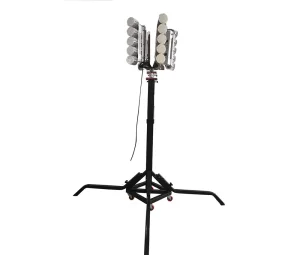
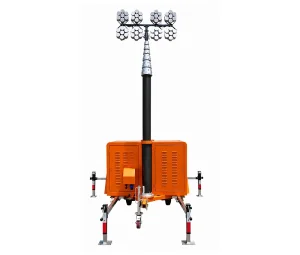
Mining & Construction Light Towers
Environmental Challenges: Rough terrain transit, continuous mechanical engine vibration, extreme temperature fluctuations (-40°C to +60°C), heavy dirt ingress.
Tailored Solution: Ultra-compact high-lumen floodlights, dynamic DC power inputs (12V/24V/48V), impact-resistant IK10 optical lenses, instant-on zero warm-up drivers.
High-Mast Stadium & Sports Arenas
Environmental Challenges: Requirement for flicker-free HDTV broadcast quality (TLCI > 98, CRI > 90), wind speeds up to 60 m/s, zero light pollution spilling outside venue.
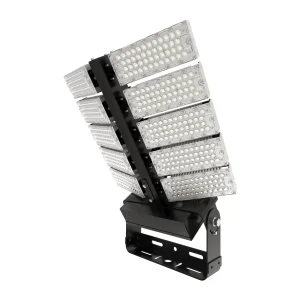
Tailored Solution: Ultra-high output fixtures (up to 3000W), precision laser-guided optical visor shields, low-weight aerodynamic housings.
Chemical Plants & Paper Mills
Environmental Challenges: Atmospheric chemical vapors (chlorine, ammonia, acids), high humidity steam zones, IP69K washdown requirements.
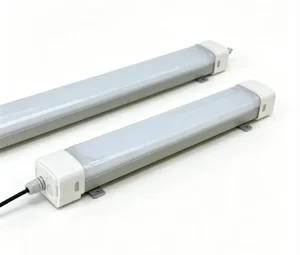
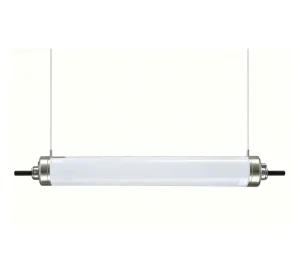
Tailored Solution: Monolithic tri-proof tubular designs, dual-layer silicone gaskets, anti-static fluoropolymer non-stick outer coatings.
Film Production & Underwater Motion Picture
Environmental Challenges: Complete water immersion under pressure, high-speed camera shooting (>10,000 FPS without flicker), strict color consistency.
Tailored Solution: Submersible IP68 LED arrays, Helium balloon diffused overhead units, high-resolution DMX512/RDM dimming integration.
International Compliance & Engineering Standards
Quality assurance is the cornerstone of extreme-environment luminaire manufacturing. Our products undergo rigorous laboratory validation prior to global shipment.
Ingress & Thermal Testing
Every luminaire batch undergoes 100% pressure-vessel immersion testing (IP68 at 10m depth for 24 hours), IP69K high-pressure thermal washdown tests, and thermal chamber burn-in at maximum rated temperatures ($T_a = 150^\circ\text{C}$).
Salt Spray & Vibration Standards
Fully compliant with ISO 9227 Corrosion Tests in Artificial Atmospheres (1,000+ continuous hours salt spray testing) and IEC 60068-2-6 sinusoidal vibration testing for high-stress heavy machinery installations.
Global Technical Regulatory Compliance
Certified and fully compliant across major global economic regions: UL 1598 / UL 1598A (Marine), CE-LVD, CE-EMC, RoHS, ATEX/IECEx (select hazard categories), and CB Scheme safety standards.
Custom OEM/ODM Engineering Roadmap & Local Support
We provide end-to-end technical support for international EPC contractors, engineering consultants, and industrial OEM distributors:
Frequently Asked Questions by Industrial Engineers
In-depth technical answers regarding luminaire thermal limits, system installation, and custom OEM capabilities.
What ambient operating temperatures can your high-temperature LED lights continuously withstand?
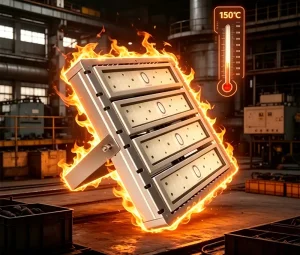
Our standard high-temperature product lines are engineered for continuous operating ambient temperatures of 80°C (176°F), 100°C (212°F), and 150°C (302°F). For extreme high-heat environments—such as blast furnace bays, glass annealing lines, and coke oven roofs—we engineer custom active thermal managed lighting systems capable of continuous operation in ambient conditions reaching up to 300°C (572°F).
How does remote driver mounting work for high-heat zones?
In applications where ambient temperature exceeds 100°C, electronic drivers are separated from the optical head and housed in a central electrical cabinet located up to 100 meters away in a cooler zone. The optical head contains only ceramic LED substrates, copper heat sinks, and high-temp Teflon/fluoropolymer wiring, eliminating delicate driver components from the heat zone entirely.
What is the expected lifespan (L70/B10) of your luminaires under maximum thermal stress?
All our industrial luminaires are rated according to IES LM-80 and TM-21 standards. At maximum rated ambient temperatures (e.g., 100°C for 100°C-series units), our luminaires maintain >70% initial lumen output (L70B10 rating) for a minimum of 100,000 continuous operating hours (equivalent to >11 years of continuous 24/7 operation).
Can you provide DIALux photometric design files and project simulation before ordering?
Yes. Our senior optical engineering team provides comprehensive DIALux illuminance modeling, false-color rendering, IES/LDT photometric files, and glare ratio calculations (UGR) tailored specifically to your facility's CAD floorplan prior to order confirmation.
What protective measures are used against corrosive industrial airborne chemicals?
Our housings utilize low-copper 6063-T5 aluminum coated with a 80–120 micron electrostatically applied epoxy-polyester powder coat, passing 1,000-hour ASTM B117 salt spray testing. Seals are molded from high-grade Viton / Fluorocarbon elastomers, providing chemical resistance against chlorine, sulfuric acid fumes, oil mists, and industrial solvents.
Explore Additional Specialty Industrial Lighting Products
From tri-proof linear fixtures to heavy marine floodlights and high-power mobile towers, discover engineered reliability.