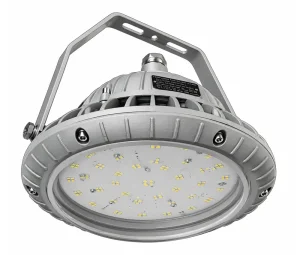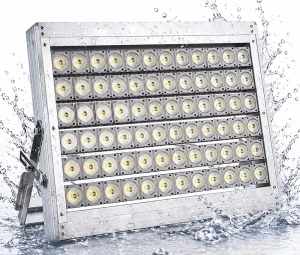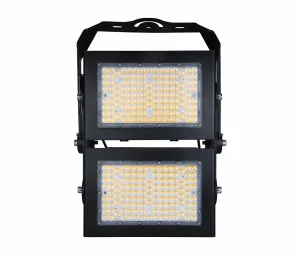
High-Performance & High-Temperature LED Luminaire Systems
Explore heavy-duty mobile lighting, asymmetric roadway installations, and extreme-heat luminaires certified for mission-critical reliability.
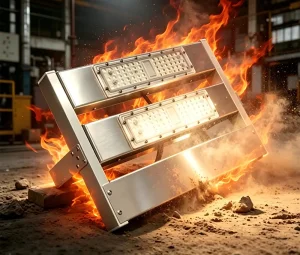
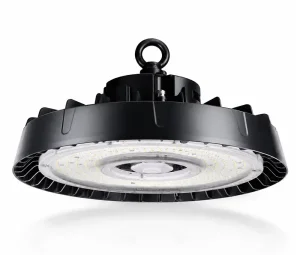
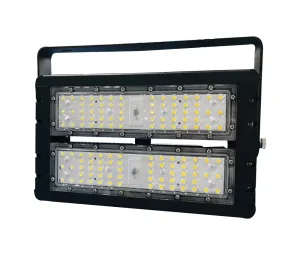
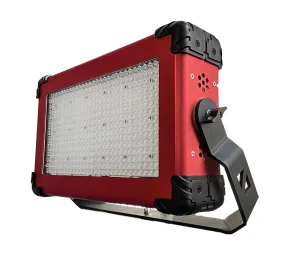
Engineering Physics: The Demands of High-Temperature Solid-State Illumination
Why conventional high bay luminaires catastrophically degrade at temperatures above 50°C, and how specialized architectural suppliers resolve solid-state junction heat transfer.
Arrhenius Degradation Dynamics
Standard industrial LED chips experience non-radiative carrier recombination escalation when junction temperature (Tj) exceeds 85°C. According to the Arrhenius reaction rate equation, every 10°C increase in semiconductor junction temperature cuts device operational longevity by 50%.
Premier suppliers utilize eutectic die-bonding with gold-tin (AuSn) metallurgical interconnections over traditional silver paste, mitigating intermetallic fatigue and sustaining crystal lattice integrity up to severe ambient thresholds.
Phosphor Quenching & Spectral Shift
Under persistent ambient conditions of 80°C to 200°C, traditional silicone encapsulants suffer thermal yellowing, irreversible polymer hardening, and thermal quenching of the cerium-doped YAG phosphors.
Advanced engineering incorporates polycrystalline phosphor ceramic conversion plates hermetically isolated from airborne oxidation, retaining chromaticity coordinates within a 3-step MacAdam ellipse under prolonged thermal stress.
Galvanic Isolation & Remote Power Conversion
Electrolytic capacitors inside switched-mode power supplies (SMPS) represent the most vulnerable link in high-temperature lighting. The liquid electrolyte volatilizes through rubber gaskets under excessive ambient conditions.
Leading manufacturers isolate the luminaire driver via custom umbilical harnesses, locating power conversion consoles 10 to 60 meters away in climate-regulated MCC rooms, or deploy military-grade ceramic film topologies rated to 125°C continuous ambient operation.
Global Industrial Infrastructure: Retrofit Challenges & Energy Transition
Heavy industry operations are confronting stringent Scope 1 and Scope 2 decarbonization mandates while operating under harsh environmental conditions that compromise standard equipment.
Primary Metallurgy & BOF Steelmaking
Blast furnaces, Basic Oxygen Furnaces (BOF), continuous slab casters, and ladle metallurgy stations produce radiant thermal spikes along with particulate iron oxide dusting. Traditional 1000W metal halide fixtures demand bi-monthly bulb replacements requiring crane stoppages.
High-temperature solid-state retrofits with sealed IP68 optical assemblies deliver uninterrupted illumination across 65°C to 120°C ceiling bays, dropping scheduled re-lamping downtime to zero and slashing high-altitude maintenance hazards.
Petrochemical Cracking & Flare Lines
Hydrocarbon processing facilities, delayed coking drums, and ethylene cracking units combine high ambient radiant heat with explosive gas concentrations (Zone 1/2, Class I Div 1). Standard luminaires quickly lose seal resilience due to thermal cycling fatigue.
Integrated explosion-proof, high-temperature LED fixtures utilize copper-free cast aluminum alloy enclosures and dual-chamber flanged flame paths, maintaining ingress protection against both extreme heat and volatile atmospheres.
Pulp, Paper, & Float Glass Annealing
Float glass production lines run continuously for years, generating ambient temperatures above 90°C near the tin bath and annealing lehrs. Simultaneously, paper drying drums create saturated, high-humidity steam atmospheres that accelerate galvanic corrosion.
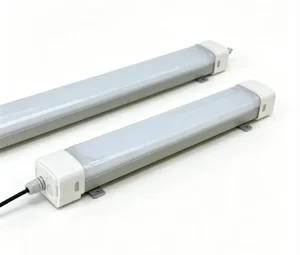
Specialized tri-proof linear and high-bay fixtures with electrophoretically applied fluorocarbon finishes withstand both thermal stress and acidic condensates without surface blistering or structural failure.
| Performance Parameter | High-Pressure Sodium (HPS) / Metal Halide (MH) | Commercial Grade LED High Bay | Engineered High-Temp Industrial LED Fixture |
|---|---|---|---|
| Max Ambient Rating | 55°C – 65°C | 40°C – 50°C | 80°C / 100°C / 150°C (Custom to 300°C) |
| System Efficacy (Hot Lumens) | 50 – 75 lm/W (heavily degraded by heat) | 90 – 120 lm/W (thermal roll-off) | 140 – 175 lm/W (stabilized Tj) |
| Lumen Maintenance Life | 10,000 – 15,000 Hours | < 15,000 Hours @ 65°C ambient | > 60,000 – 100,000 Hours (L70B10) |
| Thermal Interface Material | None (Radiation/Convection) | Standard thermal grease (1.5 W/m·K) | Phase-change alloy / Boron Nitride (8.0 W/m·K) |
| Driver Topology | Magnetic ballast (high core losses) | Integrated low-cost SMPS | Remote-mounted or ceramic potting Class I Div 2 |
| Restrike Time | 10 – 20 Minutes (Cold & Hot restrike) | Instantaneous | Instant on (< 0.2s), no arc tube delay |
Localized Support Infrastructure & Rigorous Compliance Frameworks
Deploying heavy industrial lighting fixtures across North America, the European Union, the Middle East, and Asia-Pacific requires end-to-end regulatory verification and rapid technical support.
Global Safety & Explosion-Proof Directives
Suppliers must satisfy complex testing protocols under extreme ambient thresholds. Fixtures comply with UL 1598 (Luminaires), UL 844 (Hazardous Locations), ATEX Directive 2014/34/EU, and IECEx schemes.
Temperature identification codes (T-Codes from T1 down to T6) undergo strict thermal runaway testing in sealed thermal chambers to ensure the outer housing does not exceed the autoignition point of volatile gases.
Photometric Layouts & Computational Lux Modeling
Industrial applications cannot rely on trial and error. Engineering teams deliver exhaustive DIALux and AGi32 photometric studies before cutting metal. This ensures target horizontal and vertical lux levels conform precisely to EN 12464-4 and OSHA requirements.
Simulations calculate Unified Glare Rating (UGR < 19) to preserve operator safety around molten metal transport paths and heavy overhead gantry cranes.
On-Site Commissioning & Local Spares Supply
Global presence is backed by regional logistics hubs in Rotterdam, Houston, Singapore, and Dubai. Suppliers maintain localized inventories of high-temp wiring harnesses, isolated drivers, secondary optical lenses, and mounting brackets.
Rapid dispatch teams assist EPC contractors with torque-tension mounting verification, harmonic distortion mitigation (THD < 10%), and grounding continuity over high-frequency inductive furnace sectors.
Challenging Industrial Application Scenarios
Review real-world deployment challenges across demanding temperature regimes and heavy-duty structural constraints.
Scenario A: Steel Mill Reheat Furnaces & Continuous Slab Casters
Operating Ambient: 85°C to 130°C continuous, with radiant flash up to 180°C during furnace tapping.
Challenge: Fixtures installed on roof trusses experience hot convection air pooling. High airborne soot and iron scale deposit on heatsink fins, choking convective heat exchange and causing standard driver capacitors to rupture.
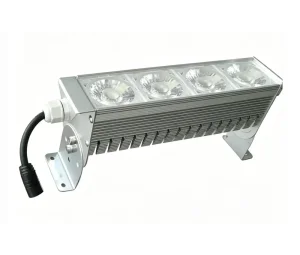
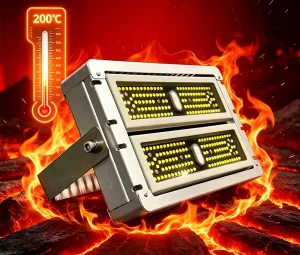
Engineered Solution: Installation of 200W high-temperature LED floodlights with vertical chimney-effect convection cooling fins. Die-cast ADC12 aluminum with a non-stick fluoropolymer coating stops slag adhesion. Drivers are remotely racked 35 meters away in a pressurized electrical switch room.
Scenario B: Glass Container Forming & Forehearth Zones
Operating Ambient: 70°C to 95°C continuous, accompanied by heavy lubricating oil mist and thermal radiation from molten gob feeders.
Challenge: Organic lubricating sprays vaporize and settle on hot polycarbonate lenses, causing crazing, brown discoloration, and severe transmission loss within weeks.
Engineered Solution: IP68-rated luminaires featuring 5mm thermally toughened borosilicate glass lenses held by high-tensile 316 stainless steel bezels and fluorosilicone seals. Optical efficiency remains stable after 24 months of exposure, with zero maintenance downtime.
Scenario C: Cement Clinker Coolers & Rotary Kilns
Operating Ambient: 75°C to 110°C, combined with abrasive lime dust and intense continuous structural vibration (up to 3G acceleration).
Challenge: Mechanical fastening failure and solder joint micro-cracking caused by low-frequency kiln vibrations coupled with high thermal fatigue.
Engineered Solution: Heavy-gauge mounting yokes with Belleville spring washers and vibration-damping neoprene bushings. LED arrays feature direct copper-bonded (DCB) ceramic substrates resistant to vibrational shearing forces up to 5G across all three axes.
Technology Roadmap: Solid-State Lighting for Extreme Regimes (2025–2030)
The transition from silicon-based thermal management to wide-bandgap semiconductors and active AIoT closed-loop telemetry.
Wide-Bandgap Gallium Nitride (GaN) Drivers
The traditional silicon MOSFET power switch is reaching its physical temperature limit. Next-generation luminaires are migrating toward GaN-on-Silicon and Silicon Carbide (SiC) power stages. These devices switch at higher frequencies with 98.5% efficiency and operate at junction temperatures up to 200°C without active cooling.
Vapor Chamber & Oscillating Heat Pipes (OHP)
Replacing solid copper and aluminum heat spreaders with two-phase oscillating heat pipes (OHP) filled with environmentally safe dielectrics. OHPs achieve effective thermal conductivities exceeding 10,000 W/m·K, carrying concentrated LED die heat flux outward to the perimeter cooling fins with near-zero thermal gradient.
AIoT In-Situ Health Monitoring & Predictive Derating
Embedded sensor suites measure heatsink temperatures, driver ripple current, supply voltage surges, and luminous flux decline in real time. Using wireless mesh networks (Bluetooth Mesh / Zigbee PRO), luminaires feed predictive maintenance data into plant SCADA systems, preventing unscheduled outages.
Procurement & Engineering Frequently Asked Questions
Detailed technical answers for specifying engineers, EPC contractors, and global supply managers.
How do high-temperature LED light fixtures withstand continuous 80°C to 150°C environments without rapid lumen depreciation?
When should an industrial plant specify a remote driver versus an integrated high-temperature driver?
What is the difference between an explosion-proof fixture and a high-temperature rated fixture?
How do lens materials compare under prolonged exposure to heat, chemical vapors, and UV radiation?
What maintenance routine is recommended to keep high-temperature luminaires performing at design levels?
Harsh-Environment Luminaires & Specialized Systems
Complete your facility specifications with tri-proof linear fixtures, explosion-proof units, deep-sea marine luminaires, and sports floodlights.