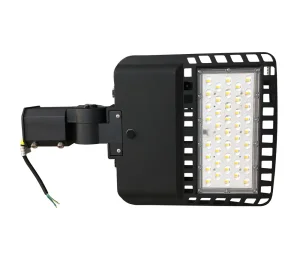
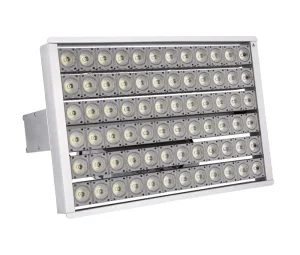
Precision Industrial Flood & Specialized Fixtures
Explore our heavy-duty lighting portfolio engineered to replace inefficient legacy discharge lamps in severe marine, hazardous, and high-ambient environments.
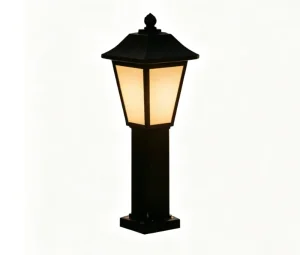
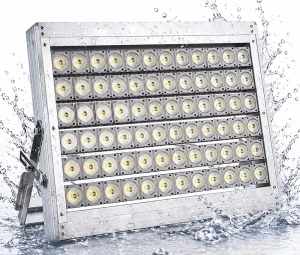
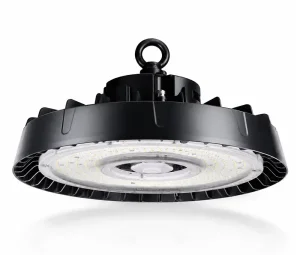
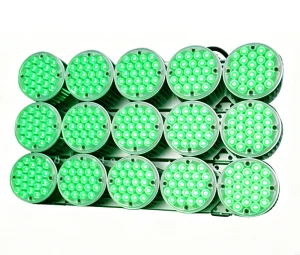
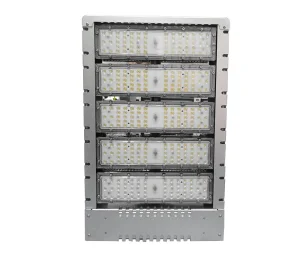
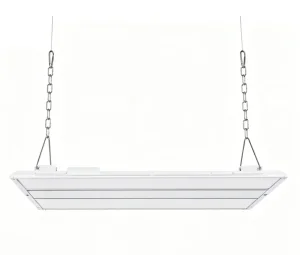
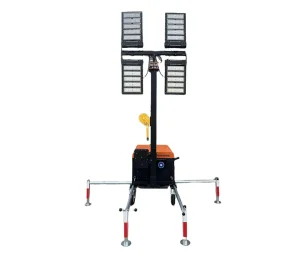
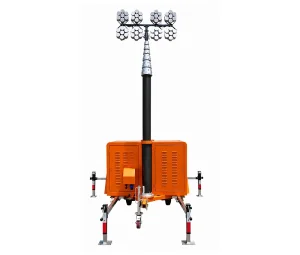
The 300W LED Flood Light: The Strategic Balance Point in High-Output Industrial Illumination
In modern industrial and infrastructure illumination design, the 300W LED flood light represents the optimal convergence of luminous output, aerodynamic profile, thermal dissipation efficiency, and electrical stability.
Optoelectronic Conversion Efficiency
High-grade 300W luminaires employ premium multi-die flip-chip or ceramic-packaged LED emitters (e.g., Lumileds, OSRAM, Cree, Sanan) operating at moderate junction drive currents (65–100 mA per diode).
- Luminous Efficacy: 150 lm/W – 195 lm/W system-level
- MacAdam Ellipse binning: SDCM ≤ 3 for uniform spectral consistency
- Color Rendering Index (CRI): Ra70, Ra80, or Ra90 for TV broadcast compatibility
Thermodynamic Phase-Change Engineering
Dissipating 300W of continuous heat requires advanced heat transfer mechanics. Top manufacturers avoid cheap die-cast aluminum alloys (ADC12) in favor of 6063 extruded profiles or 1070 cold-forged aluminum with integrated heat pipes.
- Thermal Conductivity: 1070 Al (226 W/m·K) vs. ADC12 (96 W/m·K)
- Junction Temperature ($T_j$): Maintained below 68°C at 45°C ambient
- Operational Lifespan: L90B10 rated > 65,000 hours; L70 > 100,000 hours
Optical Precision & Glare Suppression
Modern 300W flood lights discard standard flat glass in favor of custom UV-resistant optical silicone lenses or PMMA total internal reflection (TIR) optical arrays delivering pinpoint beam precision.
- Optical Distributions: NEMA 2×2 (15°), 3×3 (30°), 5×5 (60°), and Asymmetric Forward Throw (Type IV/V)
- Spill Light Control: Unified Glare Rating (UGR) < 19
- Upward Light Ratio (ULR): 0% full cut-off for Dark Sky compliance
Photometric & Operational Comparison: 300W LED vs. Legacy 1000W MH
| Performance Metric | Legacy 1000W Metal Halide | Commercial Tier 300W LED | Lsledsus Heavy-Duty 300W Engineered LED |
|---|---|---|---|
| Nominal System Wattage | 1,080W – 1,150W (including ballast) | 300W | 300W (Configurable 280W–320W) |
| Initial Delivered Lumens | 80,000 lm (Omnidirectional) | 39,000 lm – 42,000 lm | 51,000 lm – 57,000 lm (Targeted optics) |
| Useful Lumens on Target | ~32,000 lm (Optical efficiency ~40%) | ~36,000 lm (Optical efficiency ~88%) | ~51,300 lm (Optical efficiency ~94% TIR PMMA) |
| Rated Lifespan (L70) | 8,000 – 12,000 Hours | 50,000 Hours | 100,000+ Hours ($T_c \le 65^\circ C$) |
| Instant Restrike Capability | No (10–15 minute cool-down) | Yes (< 0.5 sec) | Instantaneous (< 100 ms) + Hot-Restrike DMX/DALI |
| Surge Protection (L-N / L-PE) | None built-in (Susceptible to spikes) | 4kV / 6kV standard | 10kV / 20kV SPD Class I + II Integrated |
| Corrosion Resistance Rating | Powder coat (Passes 240h Salt Spray) | Standard Epoxy (Passes 500h Salt Spray) | C5-M Super Marine Electrophoretic Coating (3,000h) |
Why China's Pearl River Delta Leads Global 300W LED Production
Procuring commercial and industrial LED floodlights directly from high-tier Shenzhen and Guangdong manufacturers delivers quantifiable engineering and cost-to-performance advantages.
Hyper-Integrated SMT Ecosystem
Shenzhen hosts the world's most concentrated cluster of ultra-high-speed surface mount technology (SMT) lines (Fuji, Panasonic, Yamaha), capable of mounting micro-die components with micron-level precision and multi-zone nitrogen reflow soldering.
Metallurgical & Tooling Excellence
Access to world-class die-casting foundries, automated mold manufacturing, and cold-forging presses ranging up to 2,000 tons. This enables complex thermodynamic fin designs and thin-wall cooling architectures impossible through standard machining.
Certified Testing Laboratories
Tier-1 Chinese factories maintain fully equipped internal testing facilities accredited by CNAS, UL, and TÜV Rheinland. Luminaires undergo 1,000-hour salt spray testing, thermal shock (-40°C to +100°C), IPX8 water ingress tanks, and goniophotometer spectral audits.
Total Cost Optimization (TCO)
Scale manufacturing compresses raw material procurement overhead for aluminum, copper, optics, and driver components (Mean Well, Inventronics, Philips). This gives global clients a 40%–60% lower CapEx per delivered kilolumen compared to European or North American domestic assembly.
Technological Frontiers Shaping Next-Generation 300W Floodlights
The transition from dumb lighting fixtures to intelligent, sensor-dense edge nodes is redefining industrial specification criteria across international markets.
Intelligent DALI-2, D4i & LoRaWAN Mesh Networking
Modern 300W luminaires integrate intelligent power supplies supporting DALI Part 250, 251, 252, and 253 protocols. Real-time telemetry reporting tracks fixture energy consumption, driver thermal operating hours, capacitor health diagnostics, and LED open/short circuit status. LoRaWAN modules allow long-range wireless control across expansive port facilities and solar installations without control wiring.
Dynamic Tunable-White & HDTV Broadcast Optics
High-end 300W sport and broadcast luminaires combine dual-channel warm and cool LEDs (2700K to 6500K) with Television Lighting Consistency Index (TLCI) ratings > 92. Equipped with pulse-width modulation (PWM) switching frequencies up to 25kHz, these fixtures completely eliminate high-speed camera flicker during 4K/8K ultra-slow-motion sports broadcasting.
Circular Design & Modular Maintainability
In accordance with the EU Ecodesign Directive (2019/2020) and circular economy targets, modern 300W flood lights feature toolless, push-latch housing designs. Field technicians can hot-swap LED engine plates and remote driver packs within 180 seconds, extending structural chassis field viability to over 20 years.
Mission-Critical Application Scenarios for 300W LED Flood Lights
Specific field conditions dictate precise mechanical seals, optical cutoffs, and electrical resilience parameters.
Maritime Ports, Shipyards & Offshore Rigs
Marine environments subject fixtures to aggressive chemical corrosion via airborne sodium chloride, continuous vibration from ship-to-shore (STS) container cranes, and heavy wave impact.
- Protective Standard: IP67/IP68 submersible seals, 316 marine-grade stainless steel hardware, and 1,000-hour ASTM B117 salt spray certified coatings.
- Vibration Resistance: Structural brackets verified against 3G/5G sinusoidal acceleration (ANSI C136.31).
Heavy Smelting, Glass Foundries & Steel Plants
Industrial processing zones routinely exceed ambient temperatures of 65°C to 80°C, alongside suspended iron filings and toxic sulfur gases that degrade standard silicone LED optics and electrolytic driver capacitors.
- Thermal Management: Remote-mounted driver configurations located in climate-buffered chambers, paired with gold-wire bonded LED packages resistant to sulfur embrittlement.
- Glass Optic Shields: High-impact borosilicate glass resistant to chemical pitting and high temperatures.
High-Mast Highway Interchanges & Airport Aprons
High-mast lighting poles (20m to 45m) demand asymmetrical optical throws that direct raw lumens downward onto road networks and aircraft aprons without projecting dangerous blinding glare toward cockpits or drivers.
- Aviation Compliance: ICAO Annex 14 compliant zero-upward spill light profile prevents pilot disorientation.
- Optical Cutoff: Full cut-off shielding with sharp $60^\circ \times 120^\circ$ asymmetric forward distribution for uniform pavement illuminance ($U_0 \ge 0.40$).
Comprehensive Optical Design, DIALux Simulations, and TCO Models
A true commercial lighting upgrade encompasses rigorous photometric simulations, electrical infrastructure audits, and total lifecycle financial projections.
Photometric Layouts & DIALux Evo Modeling
Every commercial flood lighting project must be modeled within DIALux Evo or Relux prior to manufacturing. By inputting exact structural heights, surface reflectance coefficients, and maintenance factors (typically 0.80 for LED vs. 0.55 for HID), engineers map target lux levels and uniformity ratios ($U_0$ and $U_1$), confirming compliance with CIE 140 and EN 12464 standards without costly site alterations.
Electrical Infrastructure Optimization
Replacing 1000W MH lamps with 300W LEDs delivers compounding upstream savings. Lower current draw reduces conductor sizing, allows smaller branch circuit breaker ratings, and cuts line voltage drop across expansive cable runs. With high power factors ($PF \ge 0.98$) and Total Harmonic Distortion (THD < 10%), corporate facilities avoid utility-imposed reactive power penalties.
5-Year Lifecycle ROI & TCO Breakdown
For a facility operating 100 fixtures at 12 hours/day and $0.14/kWh, migrating to 300W LEDs saves over 350,000 kWh annually—translating to roughly $49,000 per year in direct energy reductions. Factor in the elimination of routine bucket truck rentals, lamp re-striking labor, and frequent ballast replacements, and the capital expenditure typically amortizes within 11 to 14 months.
Procurement Due Diligence: What EPC Contractors and Global Wholesalers Demand
Evaluating industrial LED manufacturers requires rigorous validation of international certifications, quality controls, and warranty accountability.
North American Standards: UL 1598 & DLC Premium 5.1
Luminaires earmarked for the United States and Canada must carry authentic UL/cUL or ETL certification under standard UL 1598 (Luminaires). Furthermore, qualifying for DesignLights Consortium (DLC) Premium 5.1 mandates a minimum efficacy of 140 lm/W, rigorous spectral quality testing (CCT/CRI), integrated multi-level dimming controls, and 5-year full-chassis warranty commitments necessary for regional utility rebates.
European Directives: CE, RoHS, ENEC & CB Scheme
Shipments across the European Union require strict compliance with CE-EMC (EN 55015, EN 61547, EN 61000-3-2 harmonic limits) and CE-LVD (EN 60598-1/2-5). The CB Scheme report, overseen by the IECEE, serves as the universal passport facilitating expedited local certification across Latin America, the Middle East, and Asia-Pacific territories.
Hazardous Environment Classifications: ATEX / IECEx
For chemical refineries, fuel transfer depots, and spray paint booths, floodlights must feature specialized flameproof enclosures (Ex d) or increased safety designs (Ex e). Testing validates that surface temperatures do not exceed the autoignition threshold of ambient combustible gases (Temperature Classes T4, T5, or T6).
Frequently Asked Technical & Procurement Questions
Comprehensive engineering insights clarifying key specifications for industrial project managers and distributors.
What legacy fixtures can be directly replaced by a 300W LED flood light?
How does junction temperature ($T_j$) affect the longevity of a 300W LED fixture?
What is the difference between IP65, IP66, IP67, and IP68 for 300W flood lights?
Why are surge protection devices (SPDs) critical for high-mast 300W installations?
Can 300W flood lights be configured for corrosive marine coastal environments?
Extreme Temperature, Mobile Tower, and Hazardous Area Luminaires
Engineered for high thermal resistance, hazardous classification zones, and heavy transport integration.