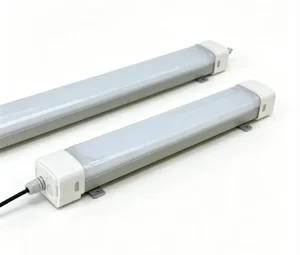
Engineered Excellence
High-Performance Lighting Modules & Stadium Fixtures
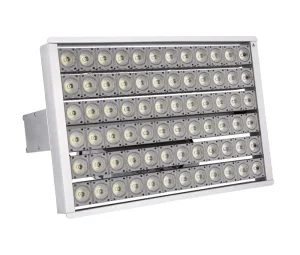
Explore our heavy-duty industrial luminaires, marine-proof floodlights, and stadium solutions designed to meet international FIFA, FIBA, and CIE photometric benchmarks.
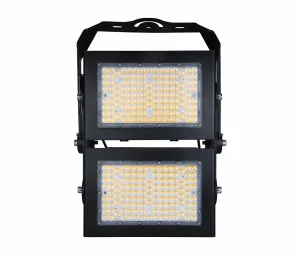
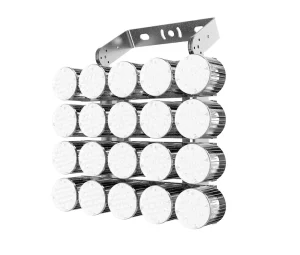
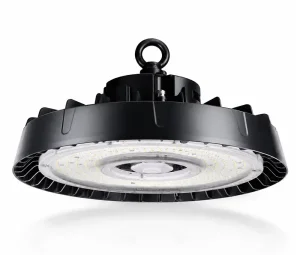
Technical Deep-Dive
Global Arena & Sports Infrastructure: The Solid-State Revolution
Transitioning from metal halide and high-pressure sodium to solid-state LED systems is no longer solely an energy-reduction measure—it is a critical imperative for HDTV ultra-slow-motion broadcasting, light pollution containment, and intelligent facility control.
Flicker-Free HDTV Broadcasting
Modern sports stadiums host global telecasts demanding super-slow-motion replay exceeding 1,000 frames per second. Conventional magnetic ballasts generate stroboscopic flicker visible on 4K/8K cameras.
- TLCF (Television Lighting Consistency Index) > 90
- Flicker rate engineered below 0.2% under full load
- Constant-current drivers with clean PWM modulation
Secondary Optical Distribution
Directing ultra-high lumen flux accurately across athletic fields without spillover into residential perimeters requires precision-formed optical silicone or PMMA total internal reflection lenses.
- Symmetrical & asymmetrical beams (10° to 90°)
- Cut-off visors reducing skyglow and glare rating (UGR < 19)
- Illuminance uniformity ratios (U1/U2) exceeding 0.7
Phase-Change Thermal Engineering
Concentrating high outputs up to 3000W into compact enclosures creates thermal loads that can degrade phosphor substrates and cut diode lifespans if unmitigated.
- 6063-T5 extruded cold-forged aluminum heatsinks
- Vapor chamber / copper heat-pipe heat dissipation
- Junction temperatures strictly maintained below 65°C
Manufacturing Hub
Precision Chinese OEM/ODM Manufacturing & Global Supply Chain Speed
Shenzhen and the Greater Bay Area provide an integrated ecosystem for solid-state sports lighting, fusing tier-one optoelectronics, automated precision SMT lines, and rapid tool prototyping.
Ecosystem Integration
Direct geographic access to world-class LED packaging (Lumileds, OSRAM, Cree), high-reliability programmable driver foundries (Mean Well, Inventronics), and CNC optical mold tooling shops.
Rigorous In-House Testing
Factory-owned environmental testing labs equipped with goniophotometers, integrating spheres, salt-spray corrosion chambers, and 16-level wind-tunnel aero-dynamic testers.
Flexible Custom Engineering
Tailored power outputs ranging from 200W to 3000W+, custom CNC mounting brackets for existing mast retrofits, and bespoke smart control configurations (DMX512, DALI-2, Zigbee).
170+ lm/W
System Luminous Efficacy
< 0.2%
Broadcast Flicker Metric
100,000+ Hrs
L80B10 Rated Service Life
IP66 / IP68
Ingress & Corrosion Protection
Application Fields
Diverse Application Scenarios: From Municipal Courts to Premier Arenas
Field-proven performance across demanding operational environments, balancing optical precision with structural integrity.
Professional Stadiums
Engineered for football stadiums, cricket arenas, and athletic complexes. Supports vertical illuminance up to 2500 Lux, meeting Olympic and FIFA broadcast standards.
Indoor Sports Arenas
Basketball courts, gymnastics centers, and tennis clubs requiring low UGR ratings to safeguard athletes against momentary blindness during high-angle play.
Ports, Shipyards & Aprons
Marine logistics hubs and airport aprons requiring continuous high-mast illumination, saltwater mist protection (C5-M coatings), and high wind load resistance.
Outdoor Municipal Fields
Community athletic parks, baseball fields, and school campuses that require cost-effective automated scheduling and minimal light intrusion on nearby homes.
Specification Matrix
High-Efficiency LED Sports Lighting vs. Legacy HID Systems
A comprehensive technical comparison highlighting energy usage, operational agility, and total cost of ownership (TCO) across enterprise installations.
| Performance Characteristic | Legacy Metal Halide (HID) | Modern Industrial Sports LED | Procurement Advantage |
|---|---|---|---|
| Luminous Efficacy | 75 – 90 lm/W (system level) | 150 – 180 lm/W | Over 55% reduction in ongoing power consumption. |
| Restrike & Warm-up Time | 10 – 15 min restrike delay | Instantaneous (< 0.1s) | Zero venue downtime; emergency restart compatibility. |
| Dimming & Dynamic Show Control | Non-dimmable or unstable step-dim | 0-10V, DALI-2, DMX512 dynamic | Enables music synchronization and game entertainment shows. |
| Broadcast Slow-Motion (TLCI) | TLCI < 65; high camera flicker | TLCI > 90; Flicker-Free (< 0.2%) | Complies with UEFA, FIFA, and NCAA broadcast standards. |
| Lumen Depreciation Rate | L70 at 6,000 – 10,000 hours | L80B10 > 100,000 hours | Eliminates frequent re-lamping at dangerous mast heights. |
B2B Procurement Guidelines
What EPC Contractors & Facility Owners Need to Verify
Procuring commercial-grade sports lighting systems requires rigorous due diligence across structural, electrical, and photometric factors to avoid costly retrofit errors.
1. Wind Surface Area (EPA) & Mast Integrity
Large sports floodlights carry significant effective projected area (EPA). During structural assessments for high mast towers (15m to 45m), fixture weight and wind resistance coefficients must be matched with local maximum gust velocity records to prevent mechanical failures during hurricane or typhoon conditions.
2. Remote vs. Internal Driver Architecture
For stadium masts higher than 25 meters, selecting fixtures with detachable or remote driver compartments installed at ground-level cabinets significantly lowers maintenance overhead, safeguards critical power supplies from thermal convection zones, and simplifies repair protocols.
3. Photometric Validation via DIALux / Relux
Ensure your lighting manufacturer generates complete IES / LDT photometric simulation profiles based on actual field elevations. Verifying horizontal Lux, vertical Lux facing broadcast cameras, and uniformity (U1, U2) before cutting metal ensures compliance with governing sport federations.
4. Transient Surge Protection (SPD)
Outdoor sports installations represent prime targets for lightning strikes and utility switching surges. Industrial-grade LED luminaires require built-in multi-stage 10kV / 20kV surge protection devices (SPDs) compliant with IEC 61643-11 standards to preserve internal solid-state components.
Knowledge Base
Frequently Asked Technical & Procurement Questions
In-depth responses curated by our chief lighting engineers for electrical consultants, facility directors, and OEM buyers.
What beam angle combination is ideal for high-mast sports illumination?
There is no universal single beam angle. Professional arena illumination pairs tight narrow optics (10°–15°) for cross-field throw with medium/wide optics (30°–60°) directly underneath the mast. This optical stacking guarantees seamless horizontal/vertical uniformity while cutting glare for players.
How does thermal dissipation impact LED fixture longevity?
Excess heat accelerates lumen depreciation and shifts color temperature. By maintaining junction temperatures (Tj) well below 65°C using die-cast 6063 aviation aluminum and vacuum vapor tubes, our sports fixtures maintain L80B10 stability past 100,000 operational hours.
Can modern sports floodlights integrate with DMX entertainment controls?
Yes. Our luminaires interface with standard DMX512, RDM, and DALI-2 protocols, enabling dynamic light sequences, instant blackout-to-chase transitions during player introductions, and synchronized halftime music visual effects.
What is the advantage of sourcing direct from a Shenzhen lighting factory?
Direct factory sourcing bypasses brand markups while providing access to rapid photometric simulations, tailored bracket engineering, customized driver branding, strict ISO9001/ISO14001 QA monitoring, and faster prototype turnaround.
Comprehensive Portfolio
Heavy-Duty Field Illumination & Mobile Light Towers
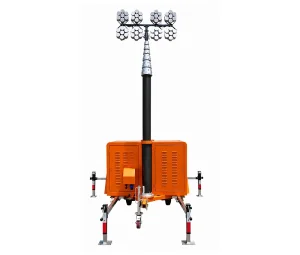
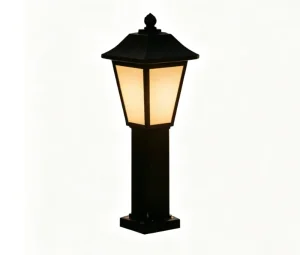
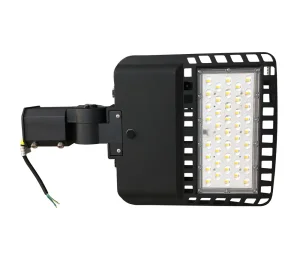
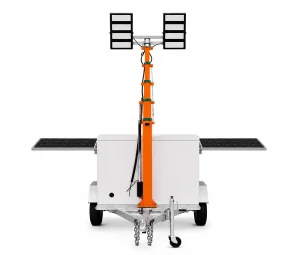
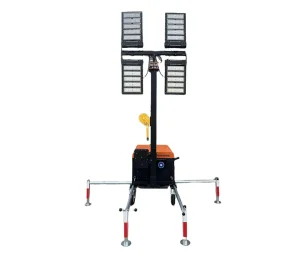
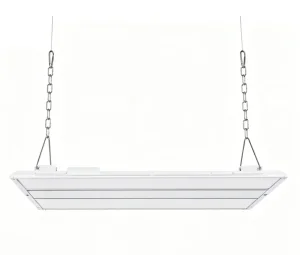
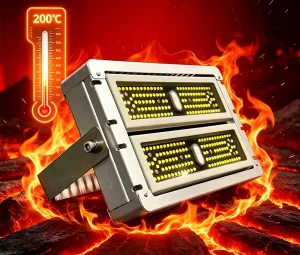
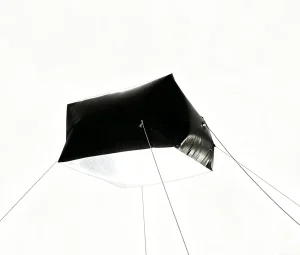
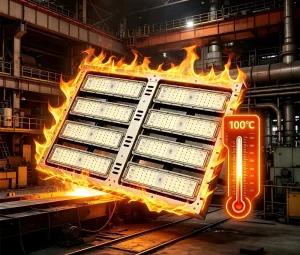
Review our specialized mobile lighting towers, high-temperature fixtures, and industrial street luminaires engineered to withstand heavy vibration, high heat, and corrosive environments.