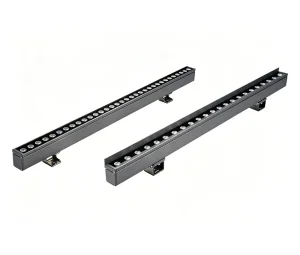
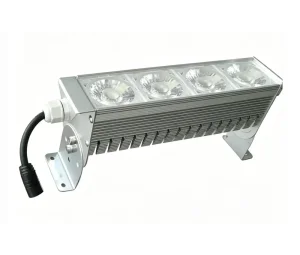
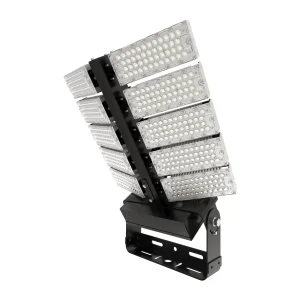
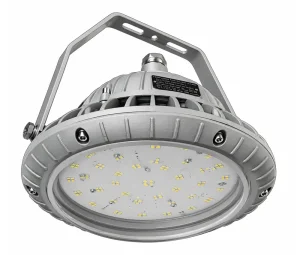
Specialized Arena & Industrial Luminaires
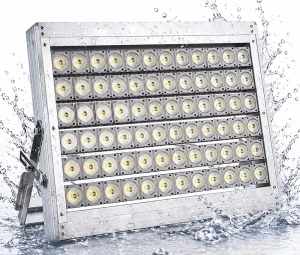
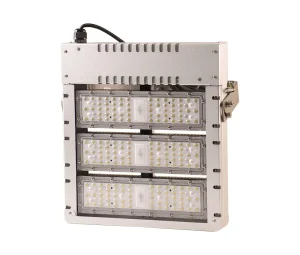
Precision-engineered luminaires tailored for heavy equestrian dust resistance, off-grid training arenas, outdoor paddock perimeter floodlighting, and harsh thermal industrial conditions.
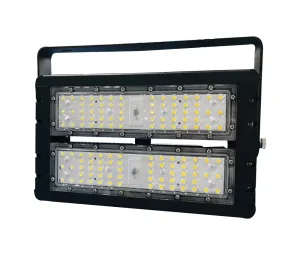
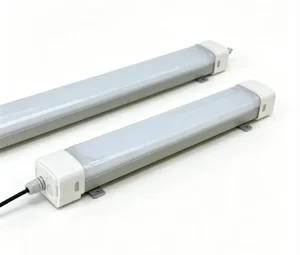
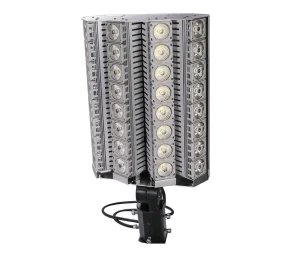
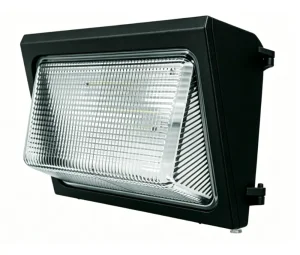
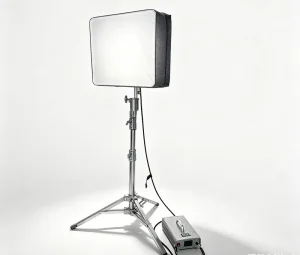
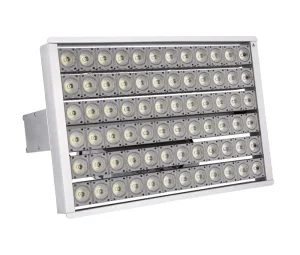
Global Industrial Context: The Science of Arena Illumination
Horses possess a dichromatic visual apparatus characterized by intense light-to-dark transition sensitivity, narrow binocular convergence, and high vulnerability to optical glare. Modern riding arena design has evolved past raw lumen output toward biologically compatible, shadowless uniformity.
Dichromatic Retinal Sensitivity
Equine eyes perceive the world through two types of cone photoreceptors tuned to 428 nm (blue) and 539 nm (green-yellow), completely lacking red-wavelength sensitivity. Standard metal-halide lamps cause unnatural spectral spatter. Our fixtures utilize custom phosphor blends producing continuous-spectrum daylight rendering (5000K, CRI > 85), minimizing ocular fatigue and flight-response spooking.
Shadow Mitigation & Uniformity (U0 ≥ 0.7)
Because a horse’s visual accommodation (focus shift) is mechanically slower than a human’s, harsh cutoff shadows across jump fences or arena track footing appear as physical drop-offs or obstacles. Our multi-cell secondary optical lenses disperse high-density lumens across a continuous flat field, maintaining a minimum lux ratio ($E_{min}/E_{avg}$) above 0.70 to eliminate ground disorientation.
FEI & EN 12193 Sports Compliance
Meeting International Federation for Equestrian Sports (FEI) specifications for national, international, and Olympic dressage and show jumping arenas requires strict horizontal illuminance (300 to 800+ Lux), zero-strobe driver regulation, and precise Unified Glare Ratings (UGR < 19). Our systems are certified to satisfy world-class sporting criteria without over-saturating ambient lumens.
Advanced Chinese Factory Efficiency & Production Architecture
Located in Shenzhen's precision hardware manufacturing hub, Lsledsus leverages end-to-end vertical integration—from raw optical die-casting to computerized SMT assembly—cutting procurement lead times and eliminating middlemen markups.
Automated Die-Casting & ADC12 Alloy
Our housings are die-cast using ADC12 high-thermal-conductivity aluminum alloys. Integrated aerodynamic fin geometries accelerate convection currents, discharging junction heat ($T_j < 65^\circ\text{C}$) even in dusty indoor arenas where airborne footing sand clogs typical passive radiators.
Stringent Photometric & Aging QA
Every manufactured production lot undergoes a rigorous 72-hour elevated-temperature burn-in protocol, IP6X sealed-chamber dust blasting, and spectrophotometer goniophotometric profiling. Clients receive authentic IES and LDT photometric files validated for Dialux simulations prior to factory dispatch.
Agile OEM / ODM & Modular Assembly
We support complete structural and electrical customization: custom powder coatings (C5-M marine-grade anti-ammonia finishes for stable environments), dual-voltage driver packs (100–277V / 277–480V), rotatable optical brackets, and pre-wired quick-disconnect industrial harnesses.
Engineered Layouts for Diverse Equestrian Facilities
Different disciplines—dressage, western reining, stadium jumping, polo, and therapeutic riding—demand tailored mounting heights, beam spreads, and lumen intensities to guarantee safety.
Indoor Arenas (20m x 40m & 20m x 60m)
Target: 250–400 Lux | U0 ≥ 0.65
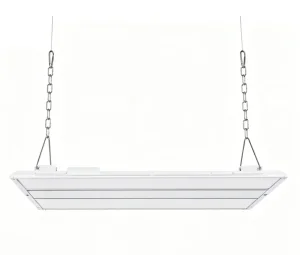
Low truss ceilings (4.5m to 7m) are prone to hot spots. We utilize wide 90° or 120° frosted beam distributions and linear high bays with anti-glare micro-prismatic lenses. Luminaires are spaced along the perimeter and centerline to keep light completely even across the arena perimeter kickboards.
Outdoor Show Jumping & Hunter Derbies
Target: 400–700 Lux | U0 ≥ 0.70
Outdoor arenas (30m x 70m or 50m x 100m) rely on 8m to 15m perimeter poles. Asymmetric forward-throw optics (Type IV/V) cast illumination directly into the ring without sending stray light into adjacent stables or neighboring residential properties, ensuring zero shadows beneath jump bars.
Covered Round Pens & Equine Therapy Rings
Target: 200–300 Lux | U0 ≥ 0.60
Circular training pens (15m to 20m diameter) require tangential flood positioning to prevent center-point glare during high-speed lungeing. Vapor-tight IP67 luminaires resist continuous high-pressure washdown water sprays and caustic equine ammonia vapors.
Legacy HID / Metal Halide vs. Lsledsus Industrial Arena LED
Compare the engineering parameters of legacy high-intensity discharge systems against modern Lsledsus solid-state sports illumination platforms.
| Performance Parameter | Legacy Metal Halide (400W–1000W) | Standard Commercial LED Flood | Lsledsus Equestrian LED Series |
|---|---|---|---|
| Luminous Efficacy | 65 - 80 lm/W Low | 110 - 130 lm/W Moderate | 160 - 180 lm/W Optimal |
| Restrike / Warm-up Time | 10 - 20 minutes delay Critical | Instant ON (< 1 sec) | Instant ON / 0-100% Dynamic Dimming |
| Flicker Metric (Pst LM / SVM) | > 30% AC ripple (Spook Risk) | 5% - 12% (Camera artifacts) | < 0.2% Flicker-Free (Broadcast Safe) |
| Optical Uniformity (U0) | 0.35 - 0.45 (Heavy shadow pools) | 0.50 - 0.58 (Uneven falloff) | 0.72 - 0.85 (Flat shadowless field) |
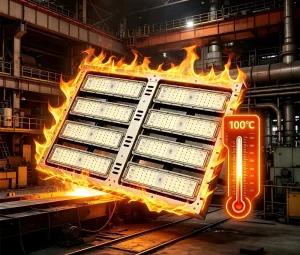
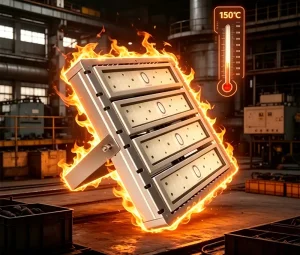
| Thermal Tolerance | Extreme bulb heat (Combustion hazard) | -20°C to +40°C | -40°C to +65°C (Extreme rated models ≤ 150°C) |
| Dust / Water Protection | IP54 - IP65 (Frequent socket failure) | IP65 (Silicone seal degradation) | IP66 to IP68 Dual O-Ring Sealed |
| Energy Savings Profile | Baseline Reference (High Draw) | 50% Power Reduction | 72% Power Reduction + Smart Motion Integration |
Next-Gen Tech & Global Procurement Requirements
Global equestrian contractors, stable developers, and municipal sports arenas demand intelligent network control and biosecure lighting hardware that meet rigorous environmental directives.
Circadian Equine Spectrum Control
Modern veterinary science shows blue-weighted night lighting disrupts equine melatonin secretion, contributing to behavioral stress and breeding cycle shifts. Our next-generation luminaires offer dual-channel CCT tuning (2700K warm twilight to 5700K daytime competition modes) to respect natural equine circadian rhythms.
Wireless Mesh IoT & Zone Scheduling
Large equine facilities require segregated lighting zones (e.g., active dressage track vs. perimeter observation seating vs. wash bays). Utilizing integrated Zigbee/Bluetooth Mesh and DALI-2 protocols, facility managers control lux levels via smartphones, scheduling automated dimming to slash operational utility costs.
Procurement & Tender Checklist
International bids require verifiable compliance documents: CE, RoHS, UL/cUL, DLC Premium certifications, ISO 9001 factory audits, minimum 10kV/20kV surge suppression (essential for open rural arenas prone to lightning strikes), and guaranteed 5-to-10 year non-prorated factory warranty coverage.
Frequently Asked Engineering & Procurement Questions
Direct engineering answers for stable owners, electrical engineers, and lighting contractors evaluating specialized riding arena LED luminaires.
Advanced Industrial Engineering & High-Output Luminaires
Expand your facility capabilities with specialized high-bay fixtures, articulating floodlights, marine-grade corrosion-resistant bodies, and hazardous-area certified systems.