
High-Performance Industrial Luminaires & Systems (Part I)
Engineered for mission-critical reliability, thermal resilience, and optimal photometric distribution in harsh industrial and technical environments.
Evolutionary Frontiers of the 15W High-Luminance Task Luminaire
Analyzing solid-state lighting efficacy shifts, driver topology breakthroughs, and photobiological compliance for modern enterprise workbenches.
In high-density industrial assembly, micro-soldering labs, cleanrooms, and technical drafting suites, task lighting has evolved past basic ambient illumination into an ergonomic instrument of yield efficiency and ocular health. Historically, workspace illumination relied on legacy incandescent, compact fluorescent (CFL), or 50W halogen architect lamps. These outdated systems suffered from rapid lumen depreciation, excessive thermal radiation toward the operator, and high harmonic distortion. The advent of the Super Bright 15W LED Desk Light platform represents an optimal nexus of radiant output, low operating current, and minimal junction thermal stress.
At 15 watts of stabilized primary DC input, modern solid-state luminaires driven by Tier-1 phosphor-converted Surface Mount Diodes (SMD 2835 / 3030 or custom Chip-on-Board arrays) yield between 1,800 to 2,400 lumens of usable luminous flux. Operating at systemic luminous efficacies exceeding 140–160 lm/W, a 15W luminaire cleanly replaces vintage 100W–150W incandescent or 35W halogen fittings while reducing electrical load by over 80%. More critically, high-quality manufacturers implement high Color Rendering Index (CRI Ra ≥ 95, R9 ≥ 90) emitters, guaranteeing true chromatic differentiation across printed circuit board (PCB) traces, wire harnesses, precision medical implants, and high-tolerance mechanical assemblies.
Driver Topology: Eliminating the Stroboscopic Effect (IEEE 1789 Compliance)
Low-grade consumer desk lamps frequently utilize low-frequency Pulse-Width Modulation (PWM) or budget resistance-capacitance (RC) buck circuits that output 100Hz/120Hz ripples. Although this high-frequency modulation may fall beyond conscious visual perception, it causes rapid ocular fatigue, migraine triggers, and hazardous stroboscopic illusions near rotating machinery. Tier-1 industrial 15W desk lights engineered in specialized Chinese manufacturing hubs employ isolated constant-current DC-to-DC step-down converters with two-stage active ripple rejection. Operating at switching frequencies above 500 kHz, these circuits achieve an absolute ripple factor below 0.5%, adhering strictly to IEEE 1789 Recommended Practice and the stringent photobiological safety standards of IEC 62471 (RG0 - Risk Group Zero Blue-Light Emission).
Precision Optics & Aerodynamic Thermal Dissipation
How cutting-edge optical distribution curves and AL6063 aerospace heat sink extrusions sustain continuous 24/7 duty cycles.
Asymmetric Optical Waveguides
Unlike symmetrical cone reflectors that wash out computer displays and introduce harsh specular glare (UGR > 22), high-end 15W task lights deploy 45-degree polarized asymmetric micro-prism lenses. Light is directed precisely over the target workstation plane (achieving >1,500 Lux at 45cm) while shielding the operator's direct sightline, ensuring unified visual comfort (UGR < 16).
Thermally Isolated Multi-Zone Heat Sink
Thermal degradation is the primary vector of solid-state spectral shift and lumen mortality. Professional fixtures integrate 6063-T5 extruded aircraft aluminum lamp heads functioning as high-efficiency conductive heat sinks. Coupled with 2.0 W/m·K aluminum metal-core PCBs (MCPCB), diode junction temperature (Tj) is stabilized below 65°C under nominal 35°C ambient conditions.
Tunable Spectrum & Ergonomics
Equipped with dual-channel step-less dimming algorithms (CCT range 2700K to 6500K), operators can calibrate spectral characteristics to specific workflow requirements: high blue-pump 6000K for high-contrast PCB inspection, and neutral 4000K for prolonged CAD drafting and document analysis, preventing circadian disruption.
| Performance Dimension | Commercial Grade 15W Luminaire | Consumer Grade Desk Lamps | Industrial Advantage |
|---|---|---|---|
| Luminous Output & Efficacy | 1,800 – 2,250 lm (≥ 140 lm/W) | 700 – 900 lm (∼ 60 lm/W) | +150% Usable Photometric Field |
| Color Accuracy (CRI / TM-30) | Ra ≥ 95, R9 ≥ 90, Rf ≥ 93, Rg ∼ 100 | Ra ∼ 80, R9 < 10 | Zero color distortion across critical components |
| Optical Glare Index (UGR) | UGR < 16 (Asymmetric Polarized Micro-prisms) | UGR > 22 (Direct exposed diffuse plate) | Protects operator eyes from direct & veiling reflections |
| Driver Topology & Flicker | Isolated constant-current, Ripple < 0.5% | Non-isolated linear IC or low-freq PWM | Complies with IEEE 1789; zero eye strain |
| Thermal Interface & Housing | AL6063 Aluminum Extrusion, MCPCB (2.0 W/mK) | Polycarbonate / ABS molded plastic | Tj < 65°C, 50,000h continuous lifespan |
China Industry 4.0: Supply Chain Resilience & Manufacturing Depth
How the Pearl River Delta industrial cluster unifies optoelectronic R&D, rapid tooling, and high-volume automated assembly.
End-to-End Vertical Integration
From aluminum ingot die-casting, high-precision 5-axis CNC arm articulation machining, surface anodization, and automated High-Speed SMT placement to final integrating-sphere photometric testing, tier-1 Shenzhen factories execute every phase within a unified 50-kilometer industrial corridor.
Automated QA & 100% Full-Load Burn-In
Industry 4.0 production lines deploy in-line Automated Optical Inspection (AOI) to eliminate solder bridging on driver boards. Every luminaire undergoes a mandatory 4-hour thermal soak burn-in followed by automated chromaticity testing, guaranteeing tight 3-step MacAdam ellipse CCT consistency.
Rapid OEM/ODM Engineering Agility
Global procurement teams benefit from rapid prototyping loops. Custom optical distribution adjustments, specialized C-clamp or heavy-cast base mountings, smart IOT sensor integration, and branded tooling can transition from CAD models to functional production samples in under 15 working days.
Mission-Critical Use Cases & B2B Procurement Specifications
Deploying targeted photometric power where visual accuracy directly impacts production yields, diagnostic speed, and workplace ergonomics.
Electronics & SMT Inspection
Microscopic manual inspection of micro-BGA solder joints, wire-bonding, and surface defects demands high central illuminance (>1,800 Lux) with zero shadowing. Multi-pivot articulated counterbalanced arms allow operators to manipulate light vectors without introducing specular blind spots on polished conformal coatings.
Medical Device Assembly & Labs
Sterile cleanroom and laboratory environments require smooth, anti-static electrostatic discharge (ESD) powder coatings, sealed IP54 joints, and chemically resistant finishes that withstand aggressive alcohol sanitation cycles without fogging optical-grade PMMA lens elements.
Aero-Defense & CAD Workstations
Avionics instrument assembly and technical drafting require strict compliance with the WELL Building Standard v2 for Light. The 15W high-efficacy architecture delivers superior uniformity (ratio > 0.8 across working planes) while mitigating screen reflection interference.
Global Certification Protocols for OEM/ODM Buyers
Essential regulatory certifications, safety standards, and factory audit verification checklists for institutional B2B procurement managers.
When enterprise purchasers, engineering procurement contractors (EPCs), and international distributors evaluate Super Bright 15W Desk Light factories in China, technical compliance extends far beyond initial price-per-unit. A dependable supply partner must possess documented certifications matching international market requirements:
North America
UL 153 standard for portable electric luminaires, FCC Part 15 Class B compliance for radiated emissions (essential to prevent interference with nearby laboratory oscilloscopes), and California Title 24 efficiency compliance.
European Union
CE-LVD (EN 60598-1/2-4), CE-EMC (EN 55015, EN 61547), RoHS 2.0 directive (hazardous substance restriction), and the new EU ErP (Energy-related Products) eco-design regulations for solid-state light sources.
Photobiology
Third-party test reports certifying IEC/EN 62471 compliance with classification as Exempt Group (RG0) under all operating modes, confirming zero risk of photochemical retinal blue-light damage during extended shifts.
Factory Quality Systems
ISO 9001 quality management, ISO 14001 environmental sustainability, and comprehensive ESD-safe assembly protocols across all SMT and manual driver wiring lines.
Frequently Asked Questions by Global Procurement Teams
Authoritative technical answers to common queries regarding specifications, customization, thermal limits, and logistics.
At systemic efficacies of 130–160 lm/W, a 15W solid-state engine outputs 1,800–2,400 lumens. This provides 1,200 to 2,000 Lux on the desktop plane at typical 40–50cm working heights—meeting strict ISO 8995-1 / CIE S 008 standards for precision assembly without generating excess heat that causes driver degradation or discomfort.
We specify Tier-1 LED packages with high-stability silicone encapsulants and multi-phosphor matrices. Diodes are binned within a 3-step MacAdam ellipse. Our aluminum core thermal structure keeps diode junction temperatures low, preventing phosphor carbonization and keeping chromatic shift (Δu'v') below 0.003 over 50,000 hours.
Our industrial models use analog constant current reduction (CCR) dimming or high-frequency PWM above 50 kHz. The circuits are enclosed in shielding metal housings and feature integrated EMI filtering stages, complying with CISPR 15 / FCC Part 15 Class B limits to prevent interference with sensitive RF equipment.
Yes. We engineer bespoke mounting configurations including reinforced aluminum G-clamps, weighted steel anti-tip desktop bases, wall/track mountings, and modular DIN-rail clips. Pantograph arms can be customized in reach from 600mm to 1,200mm with internal internal spring counterbalance mechanisms.
Standard production cycles are 25–35 days following approval of initial golden samples. Typical Minimum Order Quantities (MOQs) start at 500 units for standard housings with custom silkscreen logos and packaging, or 1,000 units for tailored extrusion profiles or custom color anodization.
Every production run is documented with comprehensive testing data. We provide standard .IES and .LDT photometric distribution files for DIALux modeling, alongside full Everfine spectral analysis reports detailing CRI (Ra, R1–R15), TM-30-18 metrics, CCT, SDCM, and electrical power factors.
High-Performance Industrial Luminaires & Systems (Part II)
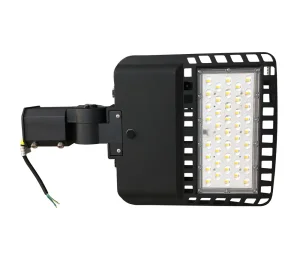
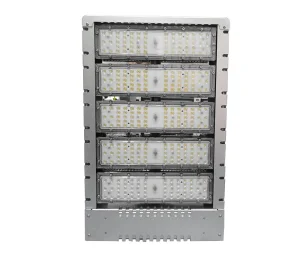
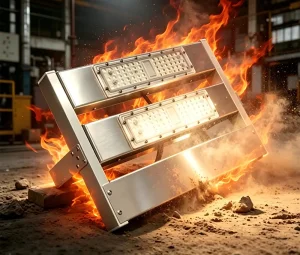
Heavy-duty, marine-grade, stadium-class, and extreme-environment lighting engineered for maximum survivability.
Consult Our Optoelectronic Engineering Team
Whether you require custom photometric analysis for industrial workstations, custom mechanical brackets, or high-volume OEM/ODM manufacturing, our engineering department delivers fast technical evaluations within 24 hours.