Precision Engineering
High-Efficiency Solid-State Luminaires & System Platforms
Explore heavy-duty, environmentally protected luminaires built to withstand industrial heat, marine salinity, and extreme continuous duty cycles.
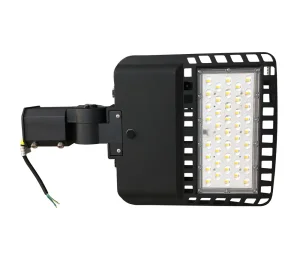
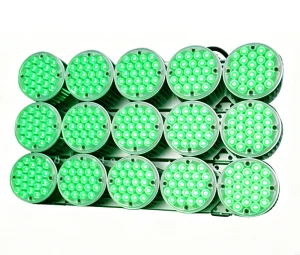
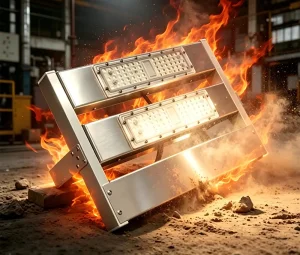
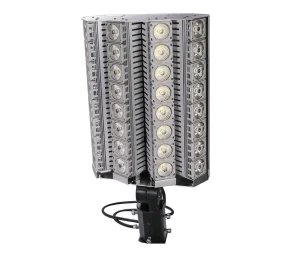
Industry Evolution
Technological Frontiers in 200W LED Street Light Architecture
A technical examination of thermal boundary dynamics, solid-state efficacy gains, and asymmetric beam distributions redefining large-scale civil infrastructure illumination.
System Efficacy Escalation (≥170 lm/W)
The transition from legacy metal-halide and high-pressure sodium (HPS) fixtures toward 200-watt LED architectures is defined by luminous efficacy optimization. Leveraging multi-die flip-chip packages with high-transmittance optical grade PMMA or borosilicate glass optics, modern 200W fixtures deliver between 32,000 to 38,000 system lumens, providing a 60-70% total energy reduction while improving road-surface luminance uniformity (U0 > 0.40).
Phase-Change & ADC12 Die-Cast Thermal Dynamics
Thermal mitigation is the primary determinant of continuous junction temperature (Tj < 75°C) and long-term lumen maintenance (L90B10 > 100,000 hours). Our 200W luminaire chassis incorporates ADC12 high-pressure aluminum with integrated thermal chimneys. Natural convective air currents break boundary-layer resistance, preventing phosphor degradation and ensuring reliable performance in harsh ambient heat reaching 50°C.
Smart City Nodes (Zhaga & ANSI C136.41 NEMA)
Contemporary infrastructure requires adaptive lighting interfaces. Standardized top-mounted 7-pin ANSI C136.41 NEMA receptacles or bottom-facing Zhaga Book 18 sockets enable plug-and-play installation of LoRaWAN, NB-IoT, and cellular photocell mesh controllers. Features include dynamic scheduled dimming, real-time current/voltage telemetry, automated fault isolation, and autonomous circadian lux management.
180+
Max Lumens / Watt Efficacy
100k
L90B10 Rated Lifespan (Hrs)
IP68/IK10
Harsh Environment Protection
20kV
Integral Surge Suppression
Procurement Strategy
Global Enterprise Sourcing & Rigorous Tender Requirements
Municipal departments of transportation, EPC contractors, and port authorities evaluate four critical engineering vectors when qualifying an OEM 200W street light manufacturer.
Driver Resilience & Transient Isolation
Driver longevity accounts for over 85% of field failure risks. Procurement standards require programmatic programmable constant-current drivers (Mean Well, Inventronics, or Sosen) with 10kV/20kV surge protection devices (SPDs), Total Harmonic Distortion (THD < 10%), active power factor correction (PF > 0.96), and dual IP67 sealed driver compartments.
Corrosion Barrier & Salt-Spray Resistance
Coastal bypasses, port terminals, and wet industrial corridors require corrosion protection matching ISO 12944 C5-M / C5-I environments. Enclosures must withstand over 1,000 to 2,500 hours of continuous neutral salt spray (ASTM B117) via multi-stage chromate conversion treatments, architectural-grade polyester powder coatings, and 316-grade stainless steel hardware.
Photometric Tailoring: IESNA Type II to V
Engineers evaluate polar candela charts and IESNA distribution files across Type II-M, Type III-M, and Type IV forward-throw patterns. Optics must maintain a longitudinal illuminance uniformity (UI ≥ 0.7), prevent high-angle glare (cutoff ratings per IESNA TM-15-11 BUG ratings: B3-U0-G3), and maintain zero upward light spill to protect dark sky conditions.
International Certification Matrices
Global cross-border deployments mandate compliance with CE, RoHS, ENEC, CB Scheme, UL 1598, and DLC Premium 5.1 qualifications. Complete technical verification dossiers require certified third-party LM-79, LM-80, and TM-21 degradation extrapolation datasets for municipal tenders.
Advanced Manufacturing
China Industry 4.0: Supply Chain Resilience & OEM Agility
How concentrated precision tooling ecosystems, end-to-end automated SMT lines, and cleanroom verification protocols provide rapid product iteration and competitive cost structures.
Automated High-Speed SMT Lines
PCB production runs on automated pick-and-place lines running Yamaha and Panasonic heads within ISO-7 cleanrooms. Nitrogen reflow ovens optimize solder wetting and eliminate micro-voids beneath ceramic LED substrates, maintaining direct-bonded copper (DBC) and aluminum substrate thermal resistance well below 1.5 °C/W.
Precision Die-Casting & Tooling Cluster
Located in the Shenzhen and Greater Bay Area manufacturing belt, our facilities integrate 800-ton to 1600-ton high-pressure die-casting cells. Tooling modifications, lens mold revisions, and customized spigot bracket adapters (ranging from 48mm to 76mm diameter) move from 3D CAD modeling to physical casting verification in under 20 business days.
100% Comprehensive Burn-In Testing
Quality control operates under strict ISO 9001 and ISO 14001 guidelines. Every finished 200W fixture completes a continuous 72-hour high-temperature dynamic burn-in test, including cold-start cycling at -40°C, continuous vibration endurance (3G/5G ANSI C136.31 test fixtures), and spectrophotometer integration testing for CCT/CRI verification.
Application Matrix
Engineered Environments: Specialized 200W Deployments
Matching polar beam shaping, mounting geometries, and enclosure metallurgy to project-specific operational requirements.
Multi-Lane Expressways & Arterials
Mounted on 10m to 14m masts with 35m to 45m pole spacing, the 200W luminaire utilizes Type II-M and Type III-M optics to produce continuous, glare-free illuminance on 4 to 6-lane motorways. Meets EN 13201 M1/M2 lighting classes with threshold increments (TI < 10%) to protect driver visibility at highway speeds.
Heavy Industrial & Petrochemical Perimeters
For chemical complexes, refinery access roadways, and heavy mining infrastructure, the 200W fixture provides mechanical resistance (IK10), gas-tight silicone gaskets, and Class I Division 2 / ATEX Zone 2 options. Vibration-resistant fasteners protect drivers and optoelectronic components against heavy continuous plant vibrations.
Maritime Ports & Intermodal Freight Hubs
Port operations require wide, high-intensity illumination across high-mast perimeter positions (12m to 18m). Outfitted with specialized anti-saline e-coatings and marine-grade stainless hardware, these luminaires maintain broad asymmetric throws across container berths and crane pathways, ensuring safety during 24/7 turnaround cycles.
Engineering Knowledgebase
Frequently Asked OEM & Procurement Inquiries
Detailed technical responses to the operational, certification, and hardware questions most often raised by tender evaluators and lighting engineers.
What legacy high-intensity discharge (HID) wattage does a 200W LED street light replace?
A high-performance 200W LED street luminaire delivering between 160 lm/W to 180 lm/W produces 32,000 to 36,000 system lumens. This output directly replaces 400W to 600W High-Pressure Sodium (HPS) or Metal Halide (MH) luminaires while reducing energy consumption by 55% to 65%. In addition, directional LED optics deliver 85% or more of generated flux onto the roadway surface, whereas omnidirectional HID fixtures frequently lose 30% to 40% of their output inside the reflector housing.
How is thermal degradation mitigated during high ambient summer conditions?
Thermal mitigation relies on high-conductivity ADC12 die-cast aluminum heat sinks designed with fin arrays that leverage ambient crosswinds to clear boundary layers. Metal Core PCBs (MCPCB) with high thermal conductivity (≥ 2.0 W/m-K) sit atop non-curing, high-performance thermal interface materials (TIM). This ensures internal LED junction temperatures remain below 75°C even when continuous outdoor ambient air temperatures reach 45°C to 50°C, preventing chromaticity shifts and premature lumen depreciation.
Can OEM 200W fixtures integrate directly with municipal central management systems (CMS)?
Yes. Luminaires can be specified with standard ANSI C136.41 7-pin NEMA twist-lock sockets or Zhaga Book 18 receptacles. These connect to DALI-2 and 0-10V dimmable drivers, allowing plug-and-play installation of third-party smart city controllers running on cellular (NB-IoT/LTE-M) or mesh wireless (LoRaWAN/Zigbee) networks. The system supports full dimming schedules, asset health tracking, and automated fault reporting.
What optical beam distributions are available for wide motorway applications?
Our optical platforms feature UV-stabilized optical-grade PMMA lenses providing IESNA Type II-Medium, Type III-Medium, Type IV-Forward Throw, and Type V distributions. For multi-lane motorways with extended pole setbacks, Type III-M optics are typically specified to project light across three to five lanes with high longitudinal uniformity (UI > 0.7) and controlled cutoff angles that prevent glare for oncoming drivers.
What are standard sample turnarounds, OEM minimums (MOQ), and volume lead times?
Custom OEM configurations—including color temperature adjustments (2200K to 6500K), specific driver brands, custom bracket castings, and private label markings—require an initial sample lead time of 5 to 7 business days. Full container orders (20GP/40HQ) typically ship within 20 to 25 business days. Flexible MOQs are available to support initial pilot installations, municipal trials, and tender qualification reviews.
Comprehensive Solutions
Specialized Heavy Industrial & Architectural Product Matrix
Purpose-built illumination systems engineered for corrosive environments, high ambient heat, underwater work, and critical industrial processing infrastructure.