
Precision Luminaires & Hazardous Location Systems
Explore our heavy-duty engineering solutions built for high-temperature thermal loads, high-lumen infrastructure, and specialized perimeter deployments.
The Global Shift to 50W Solid-State Roadway Luminaires
Analyzing the intersection of energy transition targets, total cost of ownership (TCO), and technical qualification requirements for secondary municipal arteries.
TCO & Municipal Payback Models
The 50W LED luminaire is the workhorse of municipal Class M4/M5 and ME4/ME5 installations, replacing legacy 100W–150W High-Pressure Sodium (HPS) and Metal Halide (MH) systems. OEM manufacturing focuses heavily on thermal and electrical resilience, enabling capital expenditure amortizations within 22 to 34 operational months while reducing substation reactive power penalties through power factor ratings exceeding 0.96.
Multilateral Bank Tender Compliance
Global procurement projects funded by organizations such as the World Bank, Asian Development Bank (ADB), and EBRD impose strict technical compliance benchmarks. Suppliers must provide comprehensive LM-79-08 testing data, third-party verified LM-80/TM-21 degradation extrapolations, strict RoHS 3 declarations, and accredited ENEC/CB certifications to navigate multi-tier international public bidding structures.
Supply Chain Decoupling & Modularity
Modern supply chain logistics demand modular engine assemblies. Our OEM architecture isolates the driver pocket, optical chamber, and peripheral sensor arrays into swappable modular nodes. This prevents single-point field failures from requiring entire luminaire replacements, drastically lowering localized labor, high-reach boom truck operating costs, and long-term municipal spare inventory demands.
Engineering Architecture of Industrial 50W LED Luminaires
In-depth technical breakdown of junction thermal dissipation, precision batwing optical distribution, driver topologies, and surge isolation systems.
Advanced Thermal Dynamics & Die-Cast Topology
The operational longevity of a 50-watt solid-state luminaire directly depends on managing the junction temperature ($T_j$) of the LED emitter matrix. Our OEM engineering utilizes high-pressure die-cast ADC12 aluminum alloys featuring high thermal conductivity ($\ge 96\text{ W/m}\cdot\text{K}$).
By implementing aerodynamically curved convective cooling fins with integrated self-cleaning channels, the housing prevents particulate and organic debris accumulation. This maintains natural thermal convection currents over years in desert, coastal, or high-pollution industrial corridors. The thermal resistance from junction to ambient ($R_{\theta ja}$) is stabilized at $< 1.8\text{ K/W}$, maintaining semiconductor temperatures below $65^\circ\text{C}$ even in tropical $45^\circ\text{C}$ ambient climates.
Asymmetric Roadway Photometrics & Glare Mitigation
Proper illumination requires directing lumens uniformly across asphalt surfaces without blinding drivers or wasting upward light into the night sky (Dark Sky compliance; ULOR = 0%).
Our luminaires employ optical-grade, UV-stabilized polymethyl methacrylate (PMMA) or polycarbonate (PC) multi-cavity lenses delivering IESNA Type II-Medium and Type III-Medium beam geometries. These configurations are tailored for mounting heights between 6 to 9 meters and pole spacing of 25 to 35 meters. This design ensures strict compliance with EN 13201 standards, delivering an overall luminance uniformity ($U_0$) greater than $0.40$ and longitudinal uniformity ($U_l$) over $0.70$, with Threshold Increments ($TI$) kept securely under $10\%$.
| Engineering Parameter | Standard OEM Configuration | High-Spec Industrial / Smart City Option | Validation Standard |
|---|---|---|---|
| Nominal System Power | 50 Watts (±3%) | Programmable 30W – 60W dynamic step | IEC 62722-2-1 |
| System Luminous Efficacy | 145 – 155 lm/W | 165 – 175 lm/W (Tier-1 Binning) | IESNA LM-79-08 |
| LED Chipset Topology | SMD 3030 (Lumileds / Sanan Opto) | SMD 5050 Multi-junction (High Flux) | LM-80 / TM-21 ($L_{90} > 60k\text{ hrs}$) |
| Driver Isolation & Topology | Isolated Class I, Mean Well / SOSEN | Isolated Class II, Inventronics / Philips Xitanium | EN 61347-1, EN 61347-2-13 |
| Input Voltage & Frequency | 100–240V AC, 50/60 Hz | Universal 90–305V AC or 12–24V DC Solar | IEEE C62.41.2 |
| Surge Protection Device (SPD) | Line-Line 6kV, Line-Ground 10kV | Enhanced 10kV / 20kA Gas Discharge Module | IEC 61643-11 |
| Ingress & Mechanical Impact | IP66 Rated / IK08 Impact | IP67 Sealed Core / IK09 / IK10 Toughened Glass | EN 60529 / EN 62262 |
| Color Rendering Index (CRI) | $Ra \ge 70$ (Optimal roadway efficacy) | $Ra \ge 80$ or $Ra \ge 90$ (Urban commercial zones) | CIE 13.3-1995 |
| Total Harmonic Distortion (THD) | $< 15\%$ at full operational load | $< 10\%$ down to 50% dimmed state | EN 61000-3-2 Class C |
| Surface Pre-treatment & Coating | Polyester Powder, 80–100μm | AkzoNobel Marine Grade, Salt Spray 1000h+ | ASTM B117 / ISO 9227 |
Connected Infrastructure: NEMA, Zhaga & Dynamic Controls
Transitioning standalone streetlights into multi-functional edge IoT nodes for modern municipal infrastructure.
ANSI C136.41 NEMA 7-Pin Receptacles
For North American, Latin American, and traditional utility frameworks, our housings support integrated ANSI C136.41 7-pin locking receptacles. This architecture includes standard line, neutral, and ground pins alongside four gold-plated low-voltage pads supporting 0–10V analog or DALI-2 digital dimming networks. These interfaces enable straightforward plug-and-play installation of photocells, microwave presence sensors, and centralized mesh telemetry controllers.
Zhaga Book 18 & D4i Ecosystem
To align with European and modern Smart City standards, our 50W streetlights offer dual Zhaga Book 18 sockets (top and bottom positions) integrated with D4i certified LED drivers. The bottom socket accommodates microwave Doppler motion detectors for dynamic pedestrian illumination, while the upward socket supports wireless IoT communication nodes. This setup enables asset management, predictive power telemetry, and diagnostic health monitoring without external gateway hardware.
LPWAN Protocol Scalability (LoRaWAN & NB-IoT)
Smart city connectivity demands low latency, minimal standby power consumption, and long-range propagation across varied topography. Our systems support both public Cellular IoT networks (NB-IoT / LTE-M) and decentralized private mesh protocols (LoRaWAN / Wi-SUN). Luminaires report voltage fluctuations, operational running hours, LED engine thermal trends, and optical failures in real time to centralized municipal SCADA platforms.
Environmental Protection & Factory Quality Control
Stringent production-line qualification protocols designed to withstand extreme thermal variance, chemical corrosion, and seismic stress.
Anti-Corrosive Chemical Pre-treatment
Streetlight fixtures installed in coastal marine environments face continuous exposure to airborne sodium chloride and sulfur dioxide ($SO_2$). To prevent galvanic corrosion, our foundry applies a multi-stage zirconium conversion pre-treatment before electrostatic spraying. We coat housings with thermosetting TGIC polyester powder from AkzoNobel or PPG at thicknesses between 90 and 120 microns.
This finishing process easily withstands more than 1,000 hours of continuous neutral salt spray testing according to ASTM B117 standards. Stainless steel 304/316 exterior fasteners and ozone-resistant, anti-aging silicone gaskets ensure the fixture preserves its IP66 seal integrity over a multi-decade design lifespan.
Factory Acceptance Testing (FAT) Protocol
Quality assurance at our manufacturing plant goes beyond standard sample checks. Every production run undergoes automated end-of-line electrical safety testing, covering dielectric voltage withstand (Hi-Pot at 3.75kV AC), ground continuity testing ($< 0.1\Omega$), and power factor verification.
Luminaires then complete a 24-hour continuous burn-in cycle in an elevated temperature chamber, accompanied by simulated grid switching tests (500 rapid on/off cycles). Our optical labs feature an automated Type C mirror goniophotometer to generate traceable IES and LDT photometric files, guaranteeing that delivered products match tender specifications precisely.
High-Performance Specialized Luminaire Series
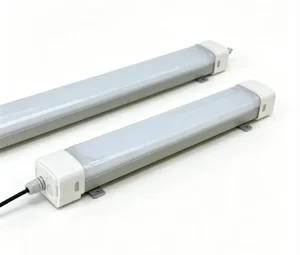
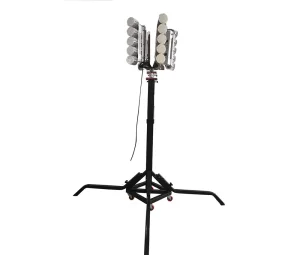
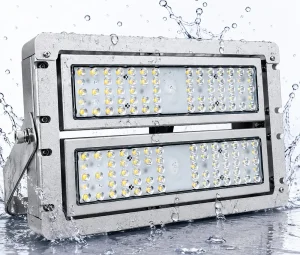
Specialized lighting equipment including marine-grade systems, sports stadium fixtures, mobile light towers, and industrial balloon luminaires.
Frequently Addressed Engineering & Procurement Inquiries
Direct technical answers covering luminaire mechanics, optical distribution, testing documentation, and OEM supply frameworks.