
Featured OEM Industrial & Sports Luminaires
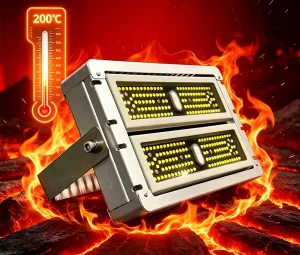
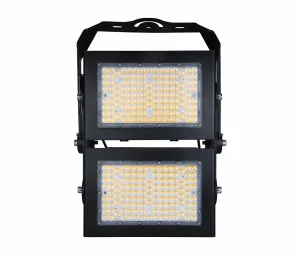
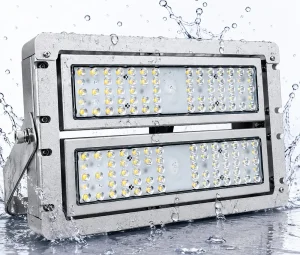
Precision-engineered floodlights, high-temperature fixtures, and specialized light arrays directly from our OEM manufacturing facility.
Global Commercial & Industrial Status of Cricket Stadium Lighting
An in-depth OEM white paper analysis of the technological shift, regulatory compliance, and market evolution in professional sports field illumination.
The global market for professional cricket stadium lighting has entered a transformative era. Driven by the rapid expansion of international T20 leagues, high-definition 4K/8K broadcasting imperatives, and stringent municipal energy-efficiency mandates, traditional Metal Halide (MH) and High-Pressure Sodium (HPS) systems are being systematically decommissioned worldwide. Modern cricket arenas require unprecedented levels of illuminance, extreme light uniformity, eliminate stroboscopic flicker during ultra-slow-motion camera replays, and strict light pollution cutoff control to prevent spill light into adjacent urban zones.
As a specialized OEM Cricket Stadium Light Factory and Manufacturer, we operate at the intersection of optoelectronic engineering, structural mechanical design, and digital lighting protocols. Cricket poses unique visual challenges compared to other field sports: a hard, small ball measuring merely 72.9mm in diameter travels at speeds exceeding 150 km/h across dynamic trajectories—from low ground sweeps to high-altitude parabolic pop-ups over 30 meters high. Consequently, lighting arrays mounted on massive 40-to-60-meter high-mast towers must deliver perfectly continuous vertical and horizontal lux levels without blinding fielders, batsmen, or match officials.
Energy Decarbonization & Operational ROI
Replacing legacy 2000W MH floodlights with high-efficiency 1200W-1500W solid-state LED modules reduces stadium energy consumption by up to 65%. Combined with instant ON/OFF functionality—eliminating 15-minute HID warm-up delays—stadium operators achieve operational payback within 24 to 36 months.
Super-Slow-Motion Broadcast Standards
International Cricket Council (ICC) Class I broadcast standards demand strict flicker-free power supplies. Our OEM high-power drivers maintain ripple currents under 0.5%, ensuring pristine, artifact-free 1000 FPS replay capturing for television channels and VAR/third-umpire reviews.
Asymmetrical Optical Precision
Advanced non-symmetric optical lenses direct maximum candela onto the pitch pitch pitch while implementing sharp upper-beam cutoff. This mitigates skyglow, prevents spill light from trespassing into nearby residential zones, and eliminates disabling glare for players tracking high catches.
Technical Architecture & Photometric Engineering
A granular look into hardware design, thermal dissipation physics, and broadcast-grade light distribution metrics.
1. Multi-Stage Phase-Change Thermal Management
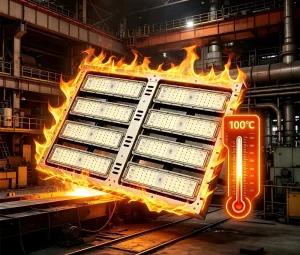
High-wattage LED stadium fixtures (ranging from 600W to 2400W per luminaire) generate massive thermal densities inside junction nodes. Without rapid heat dissipation, junction temperatures ($T_j$) rise above 85°C, triggering lumen depreciation, chromaticity shift, and premature driver degradation. Our factory utilizes high-grade ADC12 die-cast aluminum heat sinks integrated with copper phase-change heat pipes. By capitalizing on vapor-liquid phase transitions, heat is instantly pulled away from the LED micro-arrays and dispersed across convection fins, maintaining junction temperatures well below 65°C even in ambient desert temperatures of 50°C.
2. Optical Physics & Uniformity Ratios ($U_1$ & $U_2$)
Cricket pitch lighting requires precise ratio management between minimum illuminance ($E_{min}$) and average illuminance ($E_{ave}$). International tournament standards specify an overall uniformity ratio ($U_1 = E_{min} / E_{ave}$) of $\ge 0.7$ and a longitudinal uniformity ($U_2 = E_{min} / E_{max}$) of $\ge 0.8$. Achieving this requires customized optical engineering:
- Narrow-Beam Laser Optics (10° / 15°): Tailored for long-throw distances from 50+ meter masts to illuminate the central 22-yard pitch strip.
- Medium & Asymmetric Optics (30° / 60° / 45°x130°): Designed for outfield coverage, providing smooth transitions across boundary lines without hot spots or dark valleys.
- Anti-Glare Honeycomb & Visor System: Physical optical baffles that limit glare rating (GR) to <40, protecting players looking up into high fly-balls.
| Lighting Parameter | ICC Class I (International Broadcast) | ICC Class II (Domestic / Regional) | ICC Class III (Club / Practice Facilities) |
|---|---|---|---|
| Horizontal Illuminance ($E_{h}$) | ≥ 2500 - 3000 Lux | ≥ 1500 - 2000 Lux | ≥ 500 - 750 Lux |
| Vertical Illuminance ($E_{v}$) | ≥ 1800 - 2200 Lux | ≥ 1000 - 1200 Lux | N/A or ≥ 350 Lux |
| Uniformity Ratio ($U_1$) | ≥ 0.70 | ≥ 0.60 | ≥ 0.50 |
| Color Rendering Index (CRI / TLCI) | CRI ≥ 90 / TLCI ≥ 95 | CRI ≥ 80 / TLCI ≥ 80 | CRI ≥ 70 |
| Flicker Factor (FF) | < 1% (HDTV Ultra-Slow-Mo) | < 3% | Standard Dynamic |
Localized Application Scenarios & Environmental Adaptability
Tailoring OEM luminaire builds to withstand harsh geographical and meteorological conditions across major cricket-playing nations.
South Asia (India, Pakistan, Bangladesh)
Environment: Monsoonal rains, extreme ambient heat (up to 48°C), high humidity, and heavy air particulate matter.
OEM Specs: IP66/IP68 sealed optical chambers, hydrophobic breathable membrane valves to prevent internal condensation, and electrostatic dust-resistant powder coating.
Middle East (UAE, Oman, Qatar)
Environment: Intense UV radiation, airborne sandstorms, and extreme thermal cycling.
OEM Specs: UV-stabilized optical-grade polycarbonate or toughened glass lenses, active thermal throttling drivers, and AkzoNobel outdoor powder coating with anti-abrasion properties.
Oceania & Caribbean (Australia, NZ, West Indies)
Environment: Coastal saline air, high salt-spray corrosion, and violent typhoon-grade wind loads.
OEM Specs: ISO C5-M marine-grade anti-corrosion surface treatment, 316 stainless steel hardware, and aerodynamic wind-tunnel tested housings rated for 60 m/s wind resistance.
Macro-Industry Solutions & Smart OEM Control Systems
End-to-end turnkey manufacturing services, IoT control architecture, and modular retrofitting solutions.
DMX512 / RDM & DALI-2 Smart Arena Integration
Modern cricket matches are no longer just sporting events; they are multi-sensory entertainment shows. OEM cricket stadium lights manufactured in our facility feature fully integrated DMX512/RDM (Remote Device Management) or DALI-2 control protocols. This allows venue managers to trigger dynamic light shows synchronized with stadium audio systems, pre-match light sequences, boundary celebrations, and instant player entrance effects.
Furthermore, remote telemetry monitors luminaire health in real time. Operational metrics such as input voltage, power factor, driver temperature, operating hours, and diode health are transmitted to a centralized IoT management dashboard, allowing predictive maintenance long before any luminaire experiences physical failure.
DIALux Photometric Simulation & Custom OEM/ODM Capabilities
We provide full-spectrum engineering support for lighting contractors, system integrators, and stadium developers. Our engineering department delivers bespoke DIALux Evo photometric renderings, detailing:
- Exact high-mast mounting height, boom angle, and tilt orientation.
- 3D Lux mapping across the pitch, infield, outfield, and spectator seating areas.
- Glare Evaluation Index (GR) calculation reports.
- B.U.G. (Backlight, Uplight, Glare) ratings to ensure zero dark-sky contamination.
Technology Roadmap & Future Outlook (2025 - 2035)
Pioneering next-generation optoelectronic innovations to define the future of high-mast stadium lighting.
Transitioning from silicon-based driver electronics to GaN (Gallium Nitride) high-frequency switching power supplies. This innovation reduces driver footprint by 40%, increases driver efficiency to 97.5%, and drastically lowers fixture weight on high-mast towers.
Implementation of high-power dual-channel CCT mixing. Fixtures will dynamically adjust color temperature from 3000K (warm tone for post-match fan exit/maintenance) to 5700K/6500K (crisp daylight for live 4K TV broadcasts), optimizing circadian rhythms and viewer engagement.
Integrating micro-optical sensor arrays within luminaires to auto-correct beam degradation caused by surface dirt accumulation. AI algorithms automatically adjust micro-lens positioning and channel current to maintain constant target lux levels over a 10-year period.
Achieving 100% fully recyclable luminaire construction with solder-free modular click-lock components, allowing rapid field replacement of individual LED engines without disposing of aluminum heat sinks or structural brackets.
Complete High-Performance OEM Lighting Series
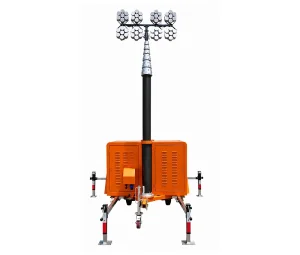
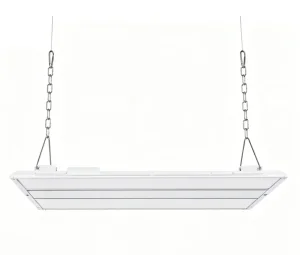
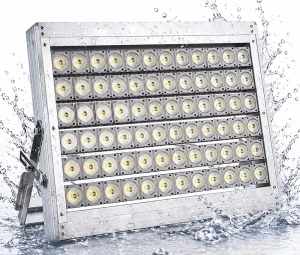
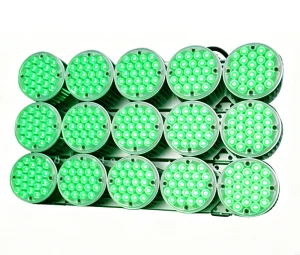
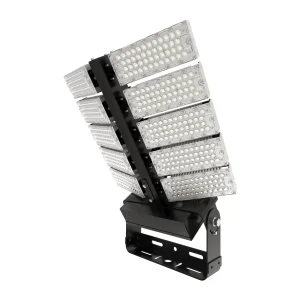
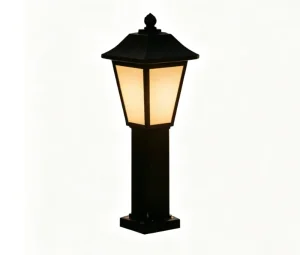
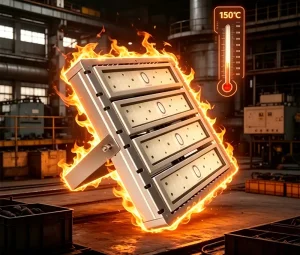
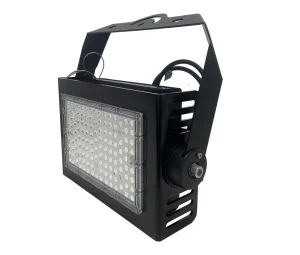
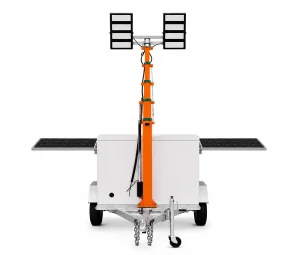
Explore our full lineup of specialized high-bay, marine, mobile light tower, and exterior architectural LED solutions.
Frequently Asked Questions (OEM & Engineering Procurement)
Essential guidance for electrical engineers, stadium developers, and B2B lighting distributors.