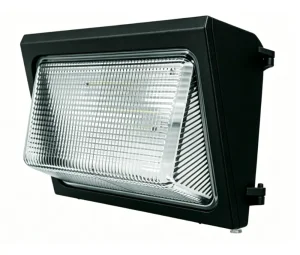
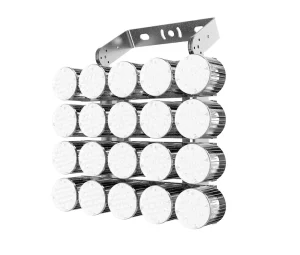
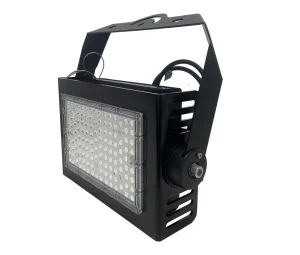
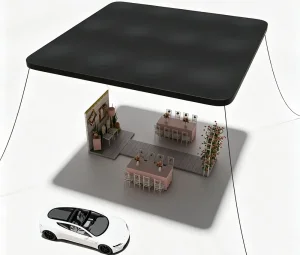
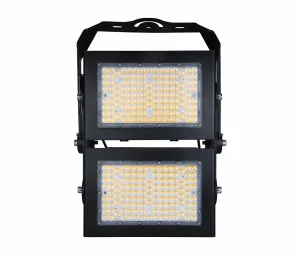
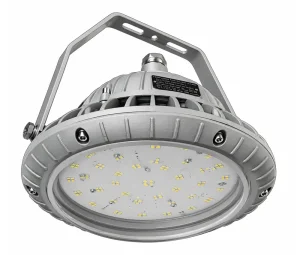
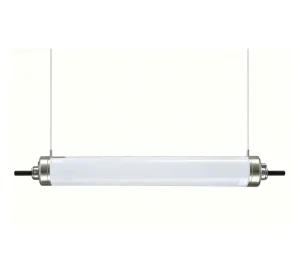
Featured Industrial Flicker-Free Fixtures
Precision-tested under 1000+ fps high-speed digital capture and rigorous thermal chamber cycling. Explore our core OEM product series built for mission-critical industrial, marine, and commercial architectures.
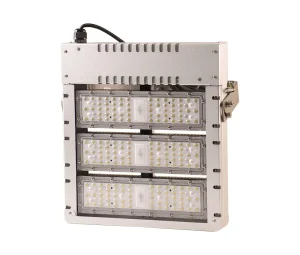
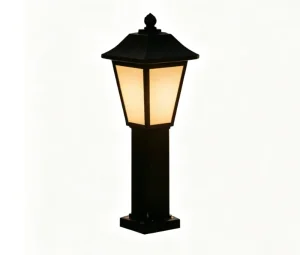
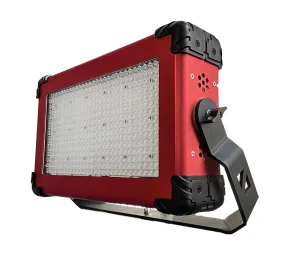
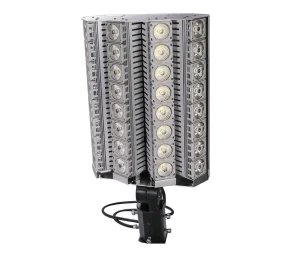
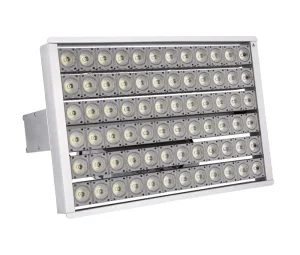
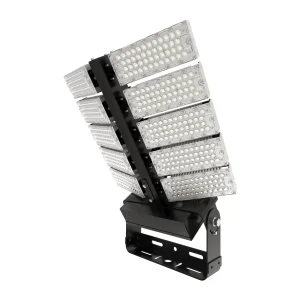
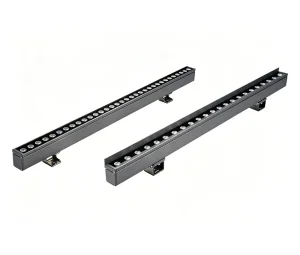
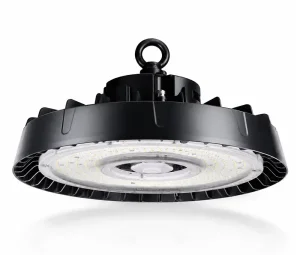
The Engineering Foundation of Flicker-Free Optical Output
Temporal Light Modulation (TLM) is an invisible engineering hazard. When alternating mains current (50Hz/60Hz) is rectified without high-grade active suppression, the remaining ripple induces stroboscopic visibility effects that compromise robotics, film capture, and human neural biology.
Suppression of Residual Ripple ($I_{ripple}$)
Standard LED drivers leave a double-line-frequency ripple (100Hz–120Hz). In broadcast and machine vision environments, this produces rolling dark bars. OEM flicker-free manufacturing utilizes two-stage LLC resonant topologies coupled with active linear current compensation, pulling output ripple under 0.2%.
This ensures that even when camera shutters cycle at 1/10,000s or phantom capture speeds exceed 1,500 fps, illumination maintains pure photometric flatness across continuous wave cycles.
IEEE 1789-2015 & CIE Metrics Compliance
Our factory lines engineer products to comfortably surpass IEEE 1789 "NO EFFECT" thresholds across the full operational dimming range. By prioritizing Stroboscopic Visibility Measure (SVM < 0.4) and Short-Term Flicker Severity ($P_{st}^{LM} < 1.0$), we safeguard humans and precision equipment.
Eliminating phantom array stroboscopic effects significantly reduces operator neurological fatigue, migraine induction, and automated optical inspection (AOI) false-negative rejection rates.
Continuous Constant Current Reduction (CCR)
Conventional pulse-width modulation (PWM) dimming cycles chips completely on and off, re-introducing high-contrast stroboscopic phenomena during low-output dimming. Lsledsus OEM drivers incorporate pure analog linear CCR circuitry.
By dynamically modulating DC forward amperage directly rather than chopping duty cycles, zero modulation flicker is guaranteed from 100% maximum lumen output down to sub-1% critical dimming levels.
Driver Architecture Benchmarking for Industrial OEM Buyers
Procurement teams frequently encounter premature component burnouts when cheap drivers are placed in demanding environmental conditions. Below is an engineering comparison of driver topologies implemented in industrial and broadcast sectors.
| Driver Topology Class | Current Ripple ($I_{p-p}$) | SVM / $P_{st}^{LM}$ Rating | High-Speed Camera Suitability | Capacitor Lifespan @ 85°C Ambient | Typical Industrial OEM Use Case |
|---|---|---|---|---|---|
| Standard Single-Stage Flyback | 15% – 35% | SVM > 1.6 / $P_{st}^{LM} > 1.5$ | Severe Black Bands > 250 fps | < 15,000 Hours (Electrolytic failure) | Low-cost residential & commodity retail |
| Low-Frequency PWM Direct Chop | Up to 100% (Modulated) | SVM 1.2 / $P_{st}^{LM} \approx 1.0$ | Strobe Artifacts on Motion Capture | 25,000 – 35,000 Hours | Commercial office troffers & decorative lights |
| Two-Stage Resonant with Active Ripple Killer | < 1.0% | SVM < 0.2 / $P_{st}^{LM} < 0.5$ | Flicker-Free to 2,000 fps | 60,000 – 85,000 Hours (Solid-state arrays) | Sports arenas, machine vision lines, high bays |
| Lsledsus Proprietary Isolated Ultra-CCR | < 0.2% | SVM < 0.05 / $P_{st}^{LM} < 0.1$ | Impervious Beyond 5,000 fps | > 100,000 Hours (Isolated cold-plate driver) | 300°C extreme heat, 30M depth cinema, stadium broadcasts |
Automated Vision Inspection
Eliminating microsecond-level luminance variance avoids edge-blur and pixel misreads on automated packaging, wafer sorting, and high-speed robotic pick-and-place lines.
4K/8K Broadcast Arenas
FIFA, FIBA, and IOC ultra-slow-motion broadcasting standards mandate flicker percentages strictly beneath 1% to prevent slow-motion playback degradation.
Metallurgical & Hot Foundries
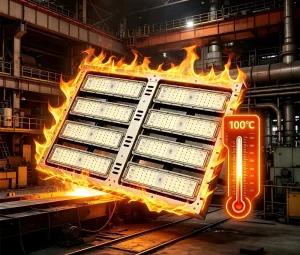
Standard capacitors dry out rapidly in 80°C–100°C ambient temperatures. Decoupled remote drivers and high-temp ceramic circuitry prevent thermal ripple amplification.
Precision Cinematography
Submersible film lights and helium balloon fixtures demand spectral fidelity alongside absolute zero stroboscopic effect when tracking high-speed cinematic action.
Solving the Thermal-Flicker Interdependence
A fundamental physical vulnerability of flicker-free lighting in heavy industry is temperature. As ambient heat rises, the Equivalent Series Resistance (ESR) of filter capacitors escalates, leading to sudden surge-ripple failures. Here is how our Shenzhen factory mitigates this dilemma.
Split-Chamber Thermal Decoupling
In fixtures like our 80°C, 90°C, and 100°C High-Temperature series, the electronic driver housing is physically and thermally isolated from the LED optical matrix. Utilizing thermodynamic chimneys and pure copper heat-pipe heat sinks, junction heat never spills into driver compartments.
This thermal isolation prevents heat-induced dielectric degradation, stabilizing filtering performance across 50,000+ continuous hours of heavy foundry operation.
Solid-State Ceramic Multistage Buffering
Standard drivers rely on liquid electrolyte capacitors that dry out rapidly according to the Arrhenius law (lifespan halves for every 10°C temperature increase). Our extreme-duty product configurations swap liquid capacitors for high-grade solid-state conductive polymer and multilayer ceramic capacitors (MLCC).
These solid components exhibit near-zero ESR variation from -40°C deep freeze environments up to +150°C engine and turbine rooms, maintaining absolute flicker suppression.
Remote-Rack Driver Enclosures (≤ 300°C)
For ultra-extreme installations such as continuous casting machines, annealing kilns, and glass production furnaces where operating temperatures reach 300°C, Lsledsus engineers custom split topologies.
The luminaire head houses high-purity inorganic optics and specialized ceramic phosphor LED packages, while the ripple-free intelligent driver modules reside up to 80 meters away in climate-controlled electrical rooms.
Technology Roadmap: 2025–2030 Industrial LED Architecture
Continuous innovation powers our product pipeline. As industrial lighting moves from passive fixtures toward intelligent solid-state nodes, our R&D team targets these fundamental breakthroughs.
Wide Bandgap Semiconductors
Integrating Gallium Nitride (GaN) and Silicon Carbide (SiC) switching MOSFETs into our OEM driver lines. Increasing switching frequencies from 65kHz to >500kHz shrinks driver inductive footprints by 60%, drastically curtails thermal dissipation, and pushes current ripple figures down toward zero.
Self-Compensating Optical Sensing
Embedding internal photodiode feedback within high-power fixtures. Onboard microcontrollers constantly analyze forward voltage drifts and chip lumen depreciation, modulating current in real time to guarantee consistent illumination uniformity and zero stroboscopic degradation across the complete product lifecycle.
Sub-Millisecond DALI-2 & DMX RDM
Architecting next-generation 16-bit logarithmic dimming processors compatible with intelligent building management systems. Fixtures synchronize their switching phases to grid fluctuations, eliminating multi-fixture harmonic resonance and phase-angle interference across massive sports stadiums and logistics terminals.
Shenzhen Manufacturing Rigor: From Lab to Global Delivery
Every custom OEM design undergoes an uncompromising validation matrix before volume assembly begins. We provide complete third-party traceable documentation for international industrial infrastructure contractors.
Advanced Photometric & Oscilloscope Testing
Our facility houses an industrial-grade darkroom with Type-C Goniophotometers and high-speed photodiode-coupled oscilloscopes. Every custom run generates full IES/LDT photometric files, chromaticity coordinates, CRI/TLCI reports, and frequency-domain ripple waveforms up to 200kHz.
Environmental & Ingress Stress Screening
Products are verified against real-world degradation in programmable thermal shock chambers (-40°C to +150°C), salt spray corrosion chambers for coastal shipyard operations, and multi-axis sine/random vibration tables matching high-vibration gantry cranes and mobile lighting towers.
Global Certification & Turnkey Export Support
Our industrial product configurations comply with CE (EMC/LVD), RoHS, UL 1598, UL 8750, DLC 5.1 Premium, ATEX Zone 1/21 explosion-proof standards, and IP67/IP68/IP69K sealing. We provide direct customs-cleared logistics and sea/air freight documentation worldwide.
Frequently Asked Engineering Questions
Essential clarifications for specification engineers, project procurement directors, and system integrators sourcing flicker-free luminaires directly from our factory.
How does Lsledsus define "true" flicker-free compared to generic commercial fixtures?
Standard commercial suppliers claim "flicker-free" simply because visible 100Hz modulation is imperceptible to the naked human eye. Lsledsus adheres to strict laboratory standards: total current ripple amplitude under 0.5%, SVM < 0.1, and zero rolling banding under digital high-speed video capture running at 1000 frames per second or higher.
Why is ambient temperature the most frequent cause of flicker-free driver failure?
Standard electrolytic ripple filter capacitors utilize liquid electrolytes that outgas and dry out when exposed to elevated temperatures. When their Equivalent Series Resistance (ESR) rises, ripple current escapes directly onto the LED circuit, turning a once-flicker-free fixture into a stroboscopic strobe. Our factory uses solid capacitors or decoupled thermal architectures to prevent this.
Can you customize beam angles and optical lenses for sports arenas and tall industrial bays?
Yes. We design and injection-mold proprietary PMMA/PC and silicone optical lenses ranging from ultra-narrow 10° spot beams for stadium towers to 120° wide flood spreads and specialized forward-throw asymmetric roadway/high-bay optics. We calculate full photometric DIALux layouts prior to sample production.
What is the standard lead time for OEM/ODM bespoke housing and electrical prototyping?
For customized wattages, optical distributions, and driver configurations utilizing our proven modular tooling, initial prototypes ship in 7 to 12 business days. Full custom casting mould creation and thermal verification cycle in 25 to 35 days, followed by scalable mass batch assembly.
Engineered Heavy-Duty Luminaires & Systems
Complete structural durability: IP68 waterproof underwater cinema units, explosion-proof industrial housings, stadium-scale flood units, and mobile DC light tower systems.