Engineered High-CRI & Industrial Lighting Fixtures
Precision luminaire architectures built for extreme environments, heavy industry, offshore rigs, and television-broadcast quality color rendition.
Engineering Metrics That Define OEM High CRI Manufacturing
Color fidelity is no longer restricted to photography studios. Modern industrial engineering demands strict compliance with full-spectrum CIE parameters and TM-30 metrics under punishing site conditions.
TM-30-20 Spectral Purity
Moving beyond archaic 8-color Ra metrics, our manufacturing line tests 99 color evaluation samples (CES), guaranteeing high Fidelity Index ($R_f \ge 94$) and balanced Gamut Index ($R_g \approx 100$) without violet-spiking or unnatural desaturation.
Phosphor Thermal Stability
Conventional high-CRI LEDs degrade rapidly in intense heat. Our proprietary ceramic-matrix and quantum dot phosphor bonding resists thermal degradation up to junction temperatures of $T_j = 125^\circ\text{C}$, preventing chromaticity drift.
Flicker-Free Driver Physics
Customized DC ripple suppression architectures lower flicker percentage to $<0.5\%$ across high-speed photographic frame rates ($>3000\text{ fps}$), enabling crystal-clear visual inspection in precision fabrication and professional 4K/8K sports broadcasting.
China Factory Supply Chain Dominance in High CRI LED Luminaire Production
Shenzhen and the Greater Bay Area represent the world's most consolidated optical-mechanical cluster. Here is why multinational EPC contractors and OEMs source custom high-CRI fixtures directly from our factory.
Turnkey Precision Die-Casting
From raw ADC12 and 6063 marine-grade aluminum ingots to CNC mold manufacturing and anti-corrosive powder electro-coating, our localized vertically integrated supply loop condenses custom tooling lead times from 12 weeks to just 21 days.
Tier-1 Component Partnerships
Through decades-long cooperative agreements with tier-1 LED semiconductor foundries (such as OSRAM, Nichia, and Bridgelux) and driver pioneers (Mean Well, Inventronics), we obtain top-tier bin selections ($<3\text{-step MacAdam Ellipses}$) at unmatchable economies of scale.
Rapid Prototyping & Photometric Validation
Our on-site testing laboratories house darkrooms equipped with goniophotometers and 2-meter integrating spheres. We run thermal simulations (ANSYS ICEPAK) and produce full DIALux / IES lighting layouts within 48 hours of initial procurement briefing.
Localized Technical Support, Compliance & Quality Verification
International tenders require uncompromising adherence to safety directives, electromagnetic compatibility, and regional environmental resilience.
North America (UL 1598, UL 844, DLC 5.1)
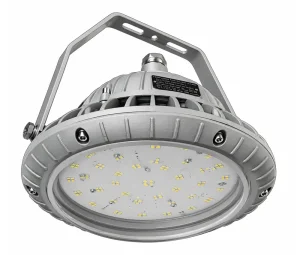
Engineered to comply with Class I Division 1 & 2 requirements for flammable vapor atmospheres, complete with LM-79, LM-80, and TM-21 degradation logs confirming lumen maintenance exceeding $L_{70} > 100,000\text{ hours}$.
European Union (CE, RoHS, ATEX & ENEC)
Full spectrum RoHS and WEEE compliance with ATEX Zone 1/21 certification. Engineered drivers maintain low total harmonic distortion ($\text{THD} < 10\%$) in conformity with EN 61000-3-2 and EN 55015 emission standards.
Marine & Offshore Salt-Spray Ratings
Subjected to 1,000-hour ASTM B117 salt fog testing and ISO 12944 C5-M extreme marine corrosive classification. Sealed with 316 stainless hardware and fluorocarbon O-rings to achieve IP68 submersible depth resilience.
Engineering Application Scenarios for High-CRI Solutions
When standard industrial LED illumination introduces chromatic errors, high-CRI architecture restores spectral truth in mission-critical applications.
In high-consequence facilities, light spectrum is an indispensable safety and operational variable. Low CRI lighting (typical 70 CRI) suppresses the red and amber spectrums, leading to visual fatigue, hazardous wiring color misidentifications, and poor surface defect recognition in manufacturing plants. As an experienced OEM High CRI lighting factory, our custom luminaires solve operational bottlenecks across four primary deployment verticals:
| Application Sector | Core Color Challenge | Target Optical Spec | Thermal & Mechanical Build |
|---|---|---|---|
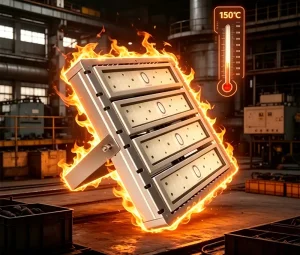
| Foundry & Steel Plants | Extreme radiant infrared; low visual discernment of molten slag | CRI ≥ 90, R9 > 60, 4000K–5000K | 80°C to 300°C ambient tolerance, remote drivers, finned pure cold-forged aluminum heatsinks |
| Cinematography & Underwater | Rapid red-wavelength water attenuation; camera color distortion | CRI ≥ 98, TLCI ≥ 98, Full TM-30 Purity | 30m pressure-submersible (IP68), housing-free hydrodynamic thermal heat conduction |
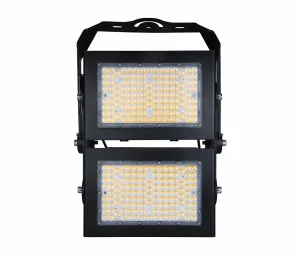
| Broadcast Stadium Venues | Slow-motion broadcast flicker, athlete glare, shadow casting | TLCI > 95, Ra > 90, High R9 & R13 | Custom optical TIR lenses (15°–60°), low UGR (<19), ultra-lightweight structural mounts |
| Automotive Finishing & QC | Micro-scratch and paint finish chromatic mismatch under daylight | Ra ≥ 97, Rg 99–102, 5700K D50/D65 match | Linear anti-glare micro-prismatic optics, non-flicker drivers, constant color consistency |
Automotive & Aerospace Surface Finishing
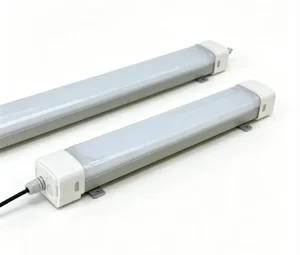
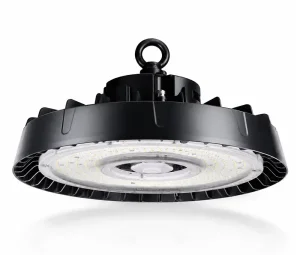
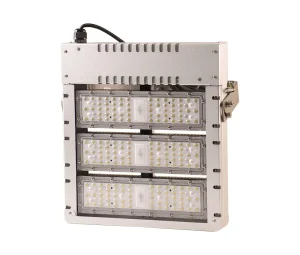
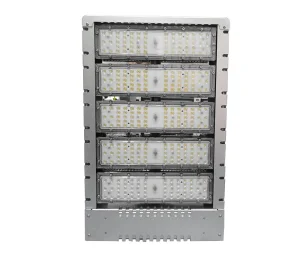
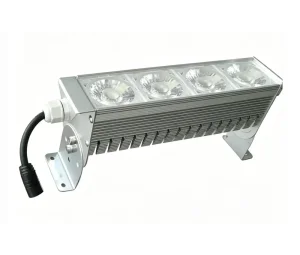
Automated robotics require precise camera sensory recognition, while manual paint inspection booths require true D65 solar replication. Our custom linear strip lights and high bays eliminate metamerism failures across varied substrate materials.
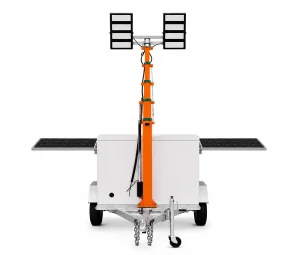
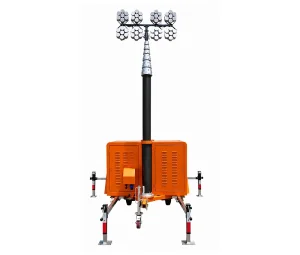
Mobile Mining & Disaster Relief Towers
Night excavation, drilling, and search-and-rescue teams work in chaotic conditions. Deploying our high-CRI mobile light towers improves geological layer identification, prevents worker eye fatigue, and enhances night worksite occupational safety.
Future Trends in OEM High CRI Industrial Illumination
Where the industry is heading: from CSP LED packaging and multi-channel spectral tuning to IoT-enabled proactive luminaire maintenance.
Chip-Scale Packaging (CSP) Integration
Eliminating traditional lead frames and gold wires, CSP provides thermal resistance reduction by up to 40%. This enables compact, high-density optical arrays that produce exceptional lumen output with uniform chromaticity over life.
Dynamic Tunable Full-Spectrum Output
B2B buyers are increasingly demanding multi-channel tunable white (2700K to 6500K) with constant Ra >95 throughout the dimming and tuning curve, managed via DMX512, DALI-2, or wireless mesh industrial networks.
Smart Predictive Thermal Feedback
Next-generation smart OEM drivers incorporate internal NTC sensors that communicate junction thermals to building management systems, automatically throttling current during temporary operational heat spikes to prevent catastrophic failure.
Frequently Asked Questions for Global OEM Buyers
Clear technical insights on minimum order quantities, customization parameters, phosphor durability, and certification pathways.
Why does high CRI lighting traditionally produce lower luminous efficacy (lm/W), and how does your factory overcome this?
Can your factory provide custom optical tooling and personalized OEM housing branding?
What ambient operating temperatures can your industrial high-CRI fixtures endure?
How do you verify color consistency between production batches?
What are typical OEM lead times for custom-engineered prototypes and container orders?
Specialized Heavy-Duty & Area Lighting Deployments
Certified luminaires designed for sports arenas, extreme high-temperature processing zones, municipal roadways, and offshore environments.