
Precision-Engineered Industrial & Outdoor Fixtures
Featured heavy-duty outdoor and extreme-environment luminaires manufactured to rigorous global engineering standards.
2026–2032 Global Trends in Outdoor Waterproof Illumination
How extreme climate events, smart city infrastructures, and industrial automation are reshaping engineering specifications for OEM suppliers worldwide.
Severe Environment Resilience
Modern outdoor installations no longer face standard rain and dust. Infrastructure managers now demand IP68 and IP69K ratings capable of enduring high-pressure washdowns, thermal cycling from -40°C to +300°C, and C5-M marine anti-corrosion finishes.
Smart IoT & DALI-2 Integration
OEM outdoor lighting is evolving into intelligent sensor nodes. Suppliers must incorporate DALI-2, Zigbee 3.0, Zhaga Book 18 sockets, and emergency autonomous controls into waterproof housings without compromising hermetic seals.
Micro-Lens Optical Efficiency
To eliminate light pollution (dark-sky compliance) and maximize ground lux per watt, advanced asymmetric optical distributions, TIR (Total Internal Reflection) lenses, and anti-glare louvers are standard OEM requirements.
What B2B Buying Decision-Makers Value Most
Synthesizing operational data from global EPC contractors, industrial plant directors, and OEM distributors to understand key risk mitigation factors.
When enterprise procurement officers query search engines for "OEM Waterproof Outdoor Light Suppliers", their search intent extends far beyond unit price comparison. Professional buyers seek long-term operational stability, reduced maintenance overhead, and verifiable technical compliance.
| Evaluation Matrix Parameter | Standard Commercial Grade | Industrial OEM High-Spec Standard | Operational Impact & ROI |
|---|---|---|---|
| Ingress Rating | IP65 (Water Jet Resistant) | IP67 / IP68 / IP69K (Submerged & High-Pressure) | Zero ingress failures during hurricanes, flooding, or intense power-washing cycles. |
| Thermal Range | -20°C to +45°C | -40°C to +80°C (Up to +300°C for foundry units) | Prevents thermal lumen degradation and extends driver electrolytic capacitor lifespan. |
| Lumen Maintenance | L70 @ 30,000 Hours | L90B10 > 100,000 Hours | Reduces relamping site labor costs by up to 75% in hazardous or elevated locations. |
| Corrosion Resistance | Standard Powder Coat (500h Salt Fog) | AkzoNobel C5-M Marine Coating (>2,000h Salt Fog) | Eliminates structural housing degradation in coastal ports, offshore platforms, and chemical plants. |
| Impact Resistance | IK07 to IK08 | IK10 Vandal-Proof Tempered Glass & Alloy Body | Resists mechanical shocks in heavy construction zones, mining rigs, and high-vibration sites. |
China Industry 4.0: Supply Chain Resilience & OEM Speed
How modern automated manufacturing hubs in Shenzhen and Guangdong deliver speed, custom engineering, and cost-to-performance superiority.
Vertical Integration Advantage
From precision die-casting molds and CNC machining to surface-mount technology (SMT) lines and in-house IPX8 pressure tanks, full vertical control guarantees rapid turnarounds for custom OEM/ODM requests.
Rigorous Quality Control Protocols
Every industrial product undergoes strict thermal shock simulation, 100% helium leak detection, vibration stress testing, and prolonged burn-in under heavy load before international shipping.
Agile Prototyping & Photometrics
Supply chain flexibility allows engineers to deliver bespoke Dialux photometric simulations within 24 hours and fully operational 3D-printed or machined OEM sample prototypes within days.
The Materials Science Behind Long-Term Waterproof Seals
Analyzing gasket physics, pressure-equalization vents, and thermal management mechanisms that prevent moisture accumulation in outdoor luminaires.
1. Gasket Elastomers: Fluororubber vs. Standard Silicone
In standard outdoor lighting, silicone seals frequently fail after 3–5 years due to UV degradation, ozone attack, and thermal expansion fatigue. Industrial OEM suppliers utilize FKM Fluororubber or cross-linked fluorosilicone gaskets. These advanced polymers retain permanent compression set resilience across continuous operating temperatures from -40°C up to +250°C, maintaining absolute seal integrity against rain, salt fog, and chemical exposure.
2. ePTFE Pressure Equalization Vents (Breather Valves)
When high-power LED outdoor lights are switched off, rapid cooling creates a internal vacuum inside the housing. Standard sealed fixtures draw ambient moisture through cable glands or micro-fissures, leading to internal glass condensation and board shorts. OEM-grade waterproof lights incorporate expanded Polytetrafluoroethylene (ePTFE) breathable membranes. These vents allow air molecules to pass freely for continuous pressure equalization while stopping liquid water droplets and microscopic dust cold.
3. Phase-Change & Cold-Forged Thermal Dissipation
Waterproof housings naturally trap heat due to thick sealed walls. To counteract this, leading OEM factories employ cold-forged 1070 pure aluminum heatsinks with integrated copper heatpipes. Cold-forged aluminum offers a thermal conductivity of ~226 W/m·K—nearly double that of traditional die-cast A380 aluminum (~96 W/m·K)—ensuring heat is rapidly drawn away from the LED junction to the outer cooling fins.
Tailored Solutions Across Specialized Operating Domains
Real-world deployment scenarios requiring customized optics, specialized mountings, and extreme ingress protection.
Deep-Sea Marine & Shipyards
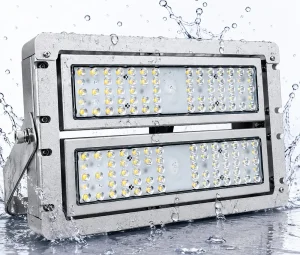
Offshore vessels, container ports, and dry docks require heavy-duty marine floodlights with IP68 ratings, 316 stainless steel brackets, and multi-stage C5-M anti-corrosion treatments to endure continuous salt spray and high-energy ocean surge.
Foundries & Steel Mills (+200°C zone)
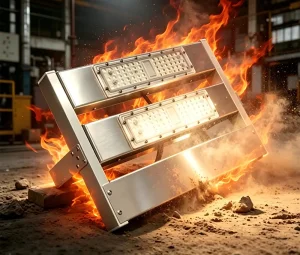
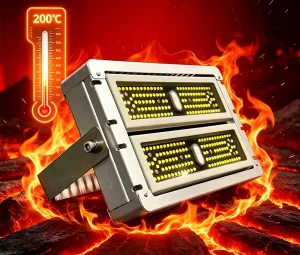
For lighting installed near blast furnaces, casting cranes, and glass kilns, ultra-high-temperature LED lights utilize remote power drivers, ceramic substrate LEDs, and phase-change cooling to operate reliably in ambient temperatures exceeding +200°C to +300°C.
Mobile Mining & Construction Towers
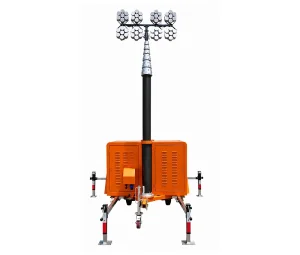
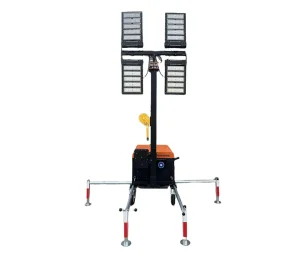
Mobile light towers demand high-lumen, vibration-resistant LED floodlights mounted on 6m to 12m telescoping masts. Fixtures must feature IK10 impact ratings, tight beam optics for deep excavation pit coverage, and generator-friendly wide voltage inputs.
Architectural RGB Facades & Bridges
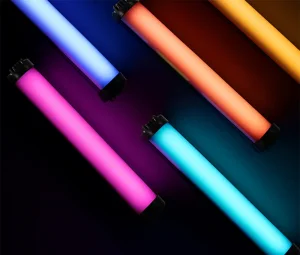
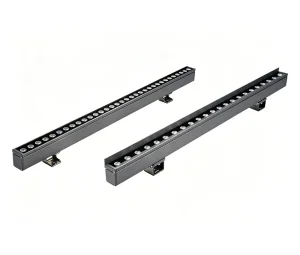
Linear RGB wall washers and high-power color-changing floodlights transform municipal bridges and commercial towers. Controlled via DMX512 or RDM protocols, these IP67 fixtures provide vibrant dynamic illumination with pixel-level precision.
Helium Balloon Aerial Lighting
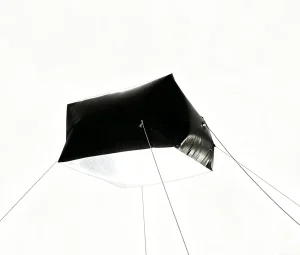
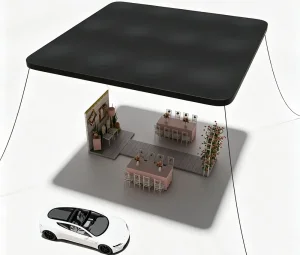
For cinema sets, disaster relief operations, and high-coverage outdoor events, truss-free helium balloon LED lights provide soft, 360-degree glare-free shadowless illumination, combining light weight with efficient helium gas retention.
Submersible Underwater Video Lighting
Engineered for commercial photography, film shoots, and aquatic research, specialized submersible video lights maintain constant color rendering (CRI > 95, TLCI > 97) at depths down to 2 meters and beyond.
Technical & Procurement FAQ for B2B Buyers
Clear engineering answers regarding OEM customization, testing standards, warranties, and supply chain logistics.
What is the difference between IP65, IP67, and IP68 waterproof ratings for outdoor lights?
IP65 fixtures protect against low-pressure water jets from any angle, making them suitable for standard rain. IP67 fixtures can withstand temporary immersion in water up to 1 meter deep for 30 minutes. IP68 fixtures offer continuous underwater submersion under specified pressure conditions (e.g., 2 meters or deeper continuous depth), suitable for marine docks, sub-aquatic video shoots, and extreme storm-prone coastal areas.
How do OEM factories handle thermal dissipation in high-ambient temperature applications (+150°C to +300°C)?
For high-temperature environments like steel foundries or glass plants, thermal management involves three engineering strategies: separating the LED driver into a cooler remote housing, using cold-forged 1070 aluminum heatsinks with embedded copper heatpipes, and utilizing specialized high-temp Japanese ceramic LED chips coupled with fluororubber seals.
Can OEM outdoor lighting fixtures be customized for specific beam angles and optical distributions?
Yes. OEM suppliers provide interchangeable optical lenses ranging from ultra-narrow 10° spot beams for architectural accents, to asymmetric 30°x90° roadway distributions, and 120° wide flood optics. Photometric IES files and Dialux simulations are prepared prior to production to guarantee lighting uniformity.
What anti-corrosion standards are applied for marine and harbor outdoor lighting?
Marine-grade outdoor luminaires undergo ISO 9227 salt spray testing for over 2,000 hours. The housing process includes chromate conversion coating followed by thermosetting AkzoNobel C5-M marine powder coating, paired with 316 stainless steel mounting hardware to prevent galvanic corrosion.
What is the typical Minimum Order Quantity (MOQ) and production lead time for custom OEM projects?
Standard OEM modifications (such as custom branding, wire lengths, or specific CCTs) typically carry low MOQs starting from 20–50 units. Fully custom die-cast tooling projects require standard prototyping in 15–20 days, followed by mass production lead times of 3 to 4 weeks depending on batch volume.
Are international compliance certificates provided for enterprise projects?
Yes. Reputable industrial OEM suppliers maintain comprehensive certification portfolios, including UL 1598, CE, CB, RoHS, ATEX (for explosion-proof lines), and official IP68/IK10 test reports issued by accredited third-party laboratories such as TÜV or SGS.
High-Performance Commercial & Specialized Luminaires
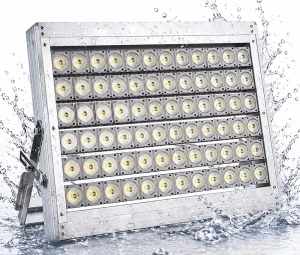
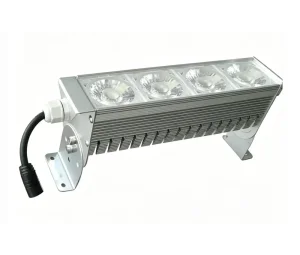
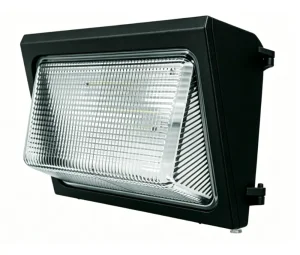
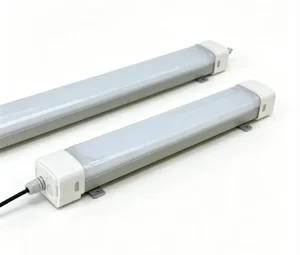
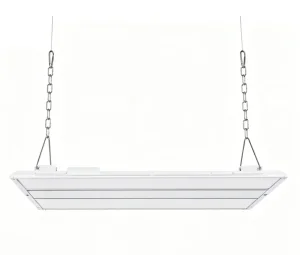
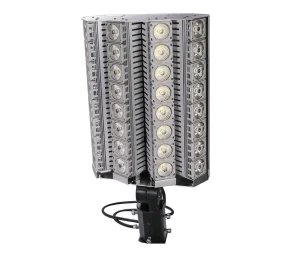
Explore additional high-efficiency OEM lighting solutions tailored for roadway, marine, high bay, and aerial applications.
Initiate Your OEM Custom Engineering Consultation
Send your project blueprints, environmental specifications, or photometric target levels to our senior engineering team for tailored OEM quotations within 24 hours.
Contact Senior Lighting Engineers