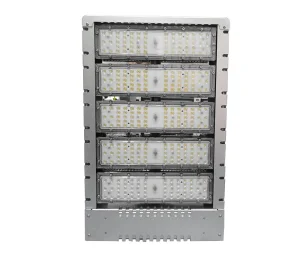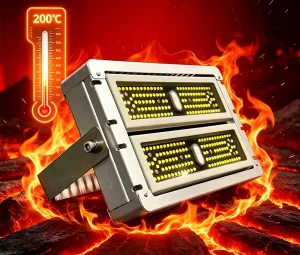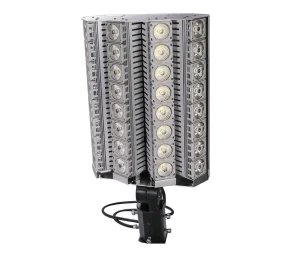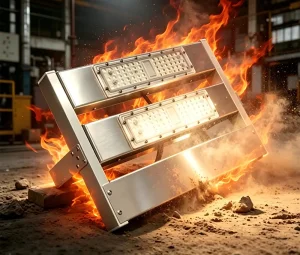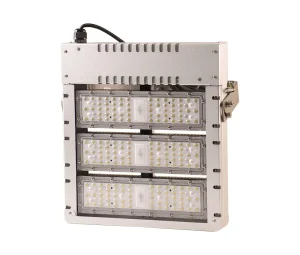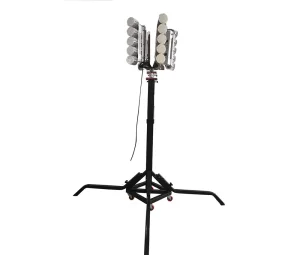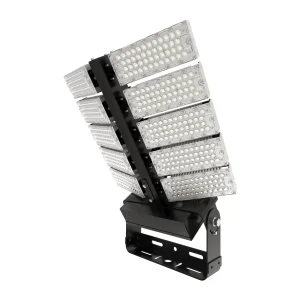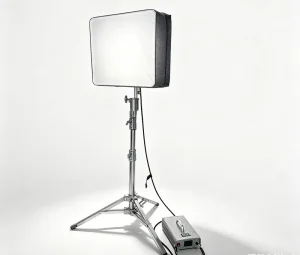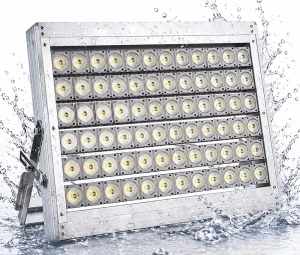
LS-FLN Titans Series LED Marine Light for Argentina Deep Sea Vessels
- Ingress Rating: IP68 Waterproof
- Impact Rating: IK10 Structural
- Salt Spray Test: ASTM B117 1,000h
- Application: South Atlantic Trawlers
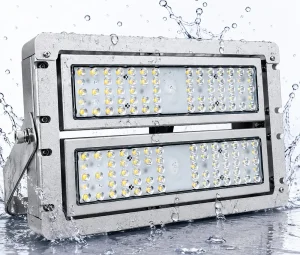
From the extreme sub-Antarctic salinity and relentless mechanical shock in Puerto Deseado to the high-density container traffic of Puerto Nuevo (Buenos Aires) and grain export hubs along the Paraná River, marine lighting requires specialized thermal dynamics and corrosion kinetics.
Operating out of Mar del Plata, Puerto Madryn, and Ushuaia, Argentine squid jiggers (poteros) and red shrimp trawlers face sub-zero gale force winds, freezing sea-spray icing, and continuous 5G harmonic hull vibration. Traditional high-pressure sodium (HPS) and metal halide fixtures suffer premature filament destruction and rapid ballast failure in these Patagonian environments.
The grain handling terminals of Rosario, San Lorenzo, and Santa Fe demand long-range asymmetric floodlighting that balances wide-area barge mooring with stringent combustible grain dust protections. Flammable particulate atmospheres in agricultural bulk terminals require sealed luminaire enclosures preventing electrical arcing.
Argentina's historic shipbuilders such as Astillero Río Santiago (ARS) and Tandanor (CINAR) require heavy-duty gantry, graving dock, and staging lighting. Fixtures must endure caustic sandblasting, high-pressure washing cycles, and aggressive electrochemical contact with salt residues.
High-performance marine fixtures customized for Argentine port authorities, commercial shipowners, and offshore installations.
Commercial marine luminaires in Argentina face severe environmental hazards: marine atmospheric chloride attack, galvanic electrochemical potentials between mismatched metals, and catastrophic thermal traps. Here is how our engineering tackles every failure mode.
When standard aluminum alloys contact ocean salt mist containing high NaCl concentrations, pit nucleation occurs within hours. Our specialized marine manufacturing implements low-copper A380 or 6063 aerospace-grade extruded aluminum.
The raw metal undergoes zirconium nanoceramic chemical conversion coating (chromate-free conversion) followed by an electrostatic application of AkzoNobel Interpon D2525 architectural-grade fluorocarbon powder coating. This creates an impermeable dielectric barrier preventing electron transfer and delivering verified resistance exceeding 1,000 hours in neutral salt spray testing under ASTM B117 and ISO 9227 standards.
Mounting a stainless steel bracket to an aluminum luminaire housing forms an active galvanic couple. If submerged or hit by heavy sea waves, the aluminum acts as a sacrificial anode and degrades rapidly.
Every fixture built for our Argentine procurement partners features Teflon (PTFE) and EPDM dielectric isolation washers. Furthermore, internal air volume expands and contracts during thermal switching, sucking in moist saline air past standard silicone seals. We integrate ePTFE GORE-Tex protective breather membranes (equalizing IP68/IP69K pressure vents) that permit vapor diffusion while physically blocking water droplets and salt particles.
| Critical Engineering Metric | Generic Commercial Luminaire | Lsledsus Argentine Marine Standard | Operational Advantage in Argentine Harbors |
|---|---|---|---|
| Housing Metallurgy | Recycled High-Copper Die-Cast Aluminum | Low-Copper (<0.1% Cu) Marine-Grade Alloy | Eliminates intergranular stress corrosion cracking in Puerto Deseado. |
| External Hardware | Zinc-Plated Steel or SS201 Fasteners | Austenitic A4 / AISI 316 Marine Stainless Steel | Zero fastener seizure; maintenance crew can adjust beam aiming after years. |
| Optical Seal & Lens | Standard Polycarbonate Lens with Rubber Gasket | UV-Stabilized IK10 Borosilicate Glass + Monolithic Silicone | Zero yellowing or thermal embrittlement under Patagonian UV-B radiation. |
| Surge Suppression | Internal Driver 2kV–4kV Only | Independent Secondary 10kV / 20kV SPD (IEEE C62.41) | Withstands crane regenerative feedback and vessel generator spikes. |
| Color Quality & CRI | CRI 70 with uncontrolled blue peak | CRI 80+ with Red Spectrum Retention (R9 > 20) | Accurate color distinction during night catch grading and search missions. |
Navigating customs regulations, electrical safety certifications, and maritime authority inspections in the Argentine Republic requires dedicated technical backing and audit-ready test reports.
Industrial luminaires entering Argentina must comply with Resolution 169/2018 governing low-voltage electrical safety. Our luminaires are engineered to adhere to IRAM 2006, IRAM 2444 (Ingress ratings), and IEC 60598-2-5. We provide full CB Scheme test reports, easing local S-Mark certification processes for Argentine importers.
Vessel modifications and dockside infrastructure under PNA maritime oversight require strict adherence to nautical navigation safety. Our luminaires feature precision beam cutoffs that suppress unwanted spill light into active navigation fairways, preventing pilot disorientation in dense shipping channels like the Canal de Acceso al Puerto de Buenos Aires.
Under the Common External Tariff (AEC) of MERCOSUR, our products are cataloged under precise NCM (Nomenclatura Común del MERCOSUR) tariff classifications (Heading 9405.42). Complete commercial invoices, packing lists with net weight specifications, and Certificates of Origin ensure predictable customs clearance at Puerto de Zárate and Ezeiza.
As an established industrial lighting manufacturer in Shenzhen with 20+ years of dedicated R&D, Lsledsus bridges cutting-edge automated production with bespoke OEM/ODM agility for Latin American contractors.
Equipped with state-of-the-art Yamaha surface-mount placement lines and Koh Young 3D SPI/AOI optical scanners, our printed circuit board assemblies (PCBAs) achieve zero-defect solder joint integrity. This eliminates micro-fractures caused by constant vessel vibrations.
Every design undergoes rigorous testing in our in-house test center: walk-in cyclic salt spray chambers (ASTM B117), thermal stress ovens up to 300°C, goniophotometer optical measurement suites, and high-frequency electrodynamic shake tables simulating severe sea conditions.
Unlike rigid multinational conglomerates offering fixed catalog SKUs, we configure beam angles (from 10° narrow pencil beams to 120° wide flood spreads), voltage ranges (100–277V AC, 347–480V AC, or 12V/24V/48V DC battery feeds), and bracket metallurgy to fit legacy retrofit bolt patterns directly.
Whether tendering for Consorcio de Gestión del Puerto de Bahía Blanca or outfitting a private oil service tugboat operating in San Antonio Este, our procurement process guarantees verified engineering metrics.
We do not sell luminaires based on raw lumens alone; we calculate delivered lux, uniformity ratios (Uo > 0.5), and Unified Glare Ratings (UGR < 22). Our in-house photometric engineering team provides comprehensive 3D DIALux / Relux lighting reports using authentic IES / LDT files. This verifies that your crane boom, vessel deck, or terminal berth meets OSHA and IESNA maritime safety levels before metal is cut.
Every critical component inside our marine luminaires carries documented provenance. We utilize Lumileds, Osram, or Cree high-density LED arrays driven by top-tier Mean Well, Inventronics, or Sosen drivers with total harmonic distortion (THD) under 10% and active Power Factor Correction (PFC > 0.98).
Engineered for extreme ambient temperatures, mobile off-grid mining, coastal roadway lighting, and dynamic heavy terminal applications across Argentina.
Direct engineering answers to technical, logistical, and environmental queries regarding marine lighting deployment across Argentina.
Send us your ship drawings, quayside terminal plans, or high-temperature mill specs. Our engineering team will return comprehensive DIALux photometric calculations, complete datasheets, and factory-direct pricing within 24 hours.
Send Inquiry Now