
High-Temperature Industrial Workhorses for Austria Operations
Engineered to replace failure-prone conventional metal-halide luminaires with robust thermal resistance and sealed IP68 enclosures.
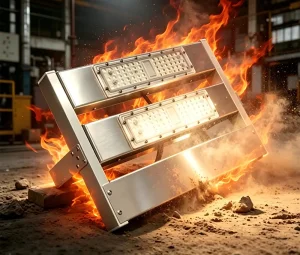
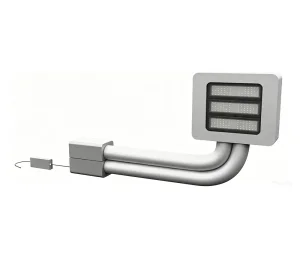
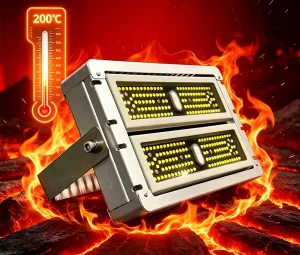
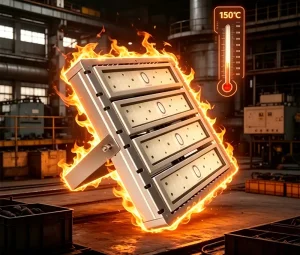
Thermal Demands in Austria's Core Manufacturing Clusters
From Linz's high-output steel lines to Styria's advanced automotive foundries, thermal management is key to preventing premature fixture breakdown.
Upper Austria Steel & Metallurgy
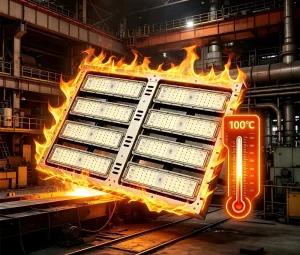
Plants in Linz and Steyr feature crane gantries where continuous heat soak drives ceiling ambients past 75°C to 110°C. Standard commercial fixtures encounter phosphor degredation, capacitor blowouts, and severe lumen degradation within months.
Styrian Heavy Casting & Automotive
Die-casting centers and foundries around Graz run continuous 3-shift schedules. Fixtures encounter sudden thermal transients, caustic lubricant vapors, and microscopic metal powders requiring IK10 impact resistance and IP68 sealing.
Austrian Paper, Pulp & Biomass
Paper mills in Carinthia and Lower Austria combine extreme ambient warmth from drying rolls with ambient moisture levels over 90%. Solid-state lighting requires silicone-sealed optical assemblies that resist moisture intrusion.
Comparative Thermal Topology: Conventional vs. OEM Spec
Specifiers in Vienna, Graz, and Linz demand measurable longevity. See how our thermal engineering compares to standard industrial-grade luminaires.
| Evaluation Parameter | Standard High Bay (Market Standard) | Our OEM High-Temperature Series (Austrian Spec) | Specifier Benefit |
|---|---|---|---|
| Driver Isolation | Internal monolithic mounting; driver shares LED board heat | Remote Gear-Box or 150mm stand-off air chimney | Decouples power electronics from LED junction thermal flux |
| Substrate Metallurgy | Standard 1.0mm FR4 or standard Aluminum PCB | 3.0mm Copper MCPCB with ceramic dielectrics (conductivity >380 W/mK) | Virtually eliminates junction hotspot degradation |
| Optical Material | Polycarbonate or PMMA lens (yellows >85°C) | Borosilicate 3.3 tempered optical glass with anti-glare etching | Maintains optical clarity across 10+ years without yellowing |
| Sealing Gaskets | EPDM or standard Nitrile (brittles under thermal cycles) | Fluorosilicone O-rings rated for continuous -40°C to +320°C | Zero vulcanization cracking in furnace-adjacent installations |
| Capacitor Grade | Standard 85°C/105°C rated electrolytics | Military/Aerospace-grade solid tantalum & Rubycon 125°C long-life capacitors | Eliminates the #1 failure mode in high-bay electronics |
Why Austrian Procurement Partners Source Direct from Shenzhen
Combining the agile manufacturing ecosystem of Shenzhen with the precise testing metrics demanded by Austrian engineers.
Full Turnkey Customization (OEM / ODM)
Unlike catalog distributors in Western Europe with fixed dimensional envelopes, we modify structural bracketry, heatsink fin density, mounting pivots, and ingress pathways to fit into existing Austrian factory ceiling conduits and crane tracks without hot work permits.
Rigorous Component Selection
Our luminaires pair genuine Tier-1 emitters (Nichia, Osram, Bridgelux) with specialized Mean Well, Inventronics, or bespoke thermal drivers. Every batch undergoes 100% burn-in chamber testing at full operating heat before crating and export.
Total Cost of Ownership (TCO) Optimization
Austrian labor costs make maintenance crane rentals and safety closures a substantial overhead cost. By extending MTBF beyond 100,000 hours in 80°C–120°C zones, our fixtures eliminate mid-lifecycle replacements, paying back their retrofit cost within months.
Photometric Precision via DIALux
Austrian workplaces strictly enforce EN 12464-1 lighting metrics for industrial workspaces. Our application engineering team delivers comprehensive DIALux simulations showing unified glare ratings (UGR <19 or <22) and target illuminance levels before manufacturing begins.
High Bay, Flood, Street & Utility Luminaires for Austrian Projects
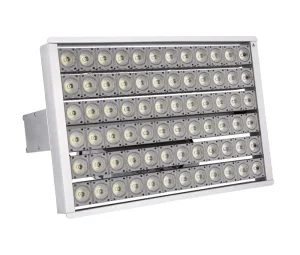
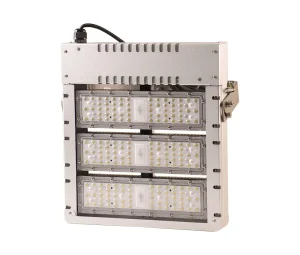
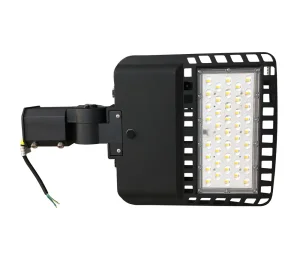
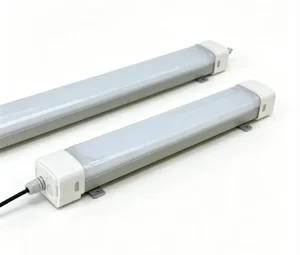
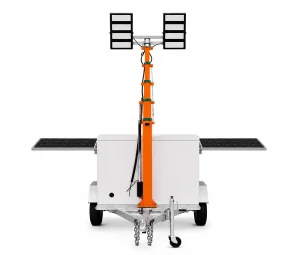
From 80°C furnace high-bays to perimeter yard illumination, explore our heavy-duty product families.
Require Custom DIALux Modeling for an Austrian Site?
Send our Shenzhen engineering headquarters your ceiling elevation drawings, operating temperatures, and mounting spacing for a turnkey quotation and photometric plan.
Send Inquiry NowEngineering Questions from European Specification Teams
Direct answers covering Austrian compliance, thermal physics, lead times, and customization capabilities.