
Premier Stadium Floodlighting Modules: Berlin Edition
Engineered for uncompromising atmospheric durability, zero up-light pollution, and precise lumen allocation. Our modular luminaires fulfill strict European transmission metrics (UGR < 19, TLCI > 90) across municipal arenas, district training pitches, and private sports hubs.
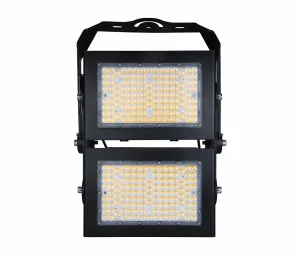
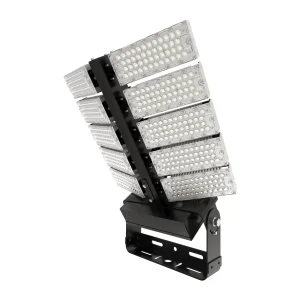
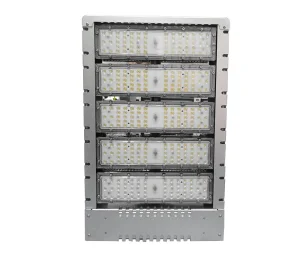
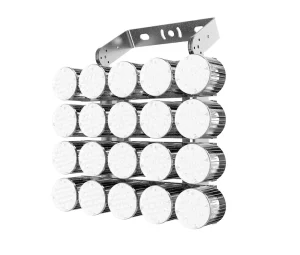
Berlin Sports Lighting Infrastructure: Commercial & Regulatory Reality
The Berlin metropolitan sports infrastructure is undergoing a generational shift. Spurred by the Senate Department for the Interior and Sports (Senatsverwaltung für Inneres und Sport) alongside Germany's federal Klimaschutzinitiative, municipal operators and club federations across the capital are phasing out legacy 2000W metal-halide luminaires. High utility tariffs, recurring maintenance downtime from aerial lifts on tall masts, and strict environmental restrictions on upward light leakage have elevated the technical thresholds for lighting manufacturers entering this regional arena.
In urbanized Berlin districts—such as Charlottenburg-Wilmersdorf, Friedrichshain-Kreuzberg, and Pankow—stadiums and district sports grounds (Sportplätze) operate directly contiguous to dense residential settlements. Hence, lighting designs must adhere rigorously to the technical guidelines set by the Bund/Länder-Arbeitsgemeinschaft für Immissionsschutz (LAI) concerning the reduction of obtrusive light (Lichtimmissionen). Fixture design is no longer just about pushing raw foot-candles or lux; it demands micro-targeted asymmetric beam controls, high cut-off angles, and integrated secondary visors to preserve neighborhood night-sky integrity while delivering uniform, competition-grade illuminance on the pitch.
Macro Industry Engineering: The Global Supply Chain Advantage
Modern stadium illumination has outgrown commodity production lines. Delivering high-output solid-state luminaires capable of sustaining 600W to 2400W in continuous multi-hour runs requires an end-to-end engineered ecosystem. As an industrial LED lighting manufacturer with two decades of heavy-duty thermal and optical fabrication history, we solve the structural challenges faced by international general contractors and German M&E engineering consultancies.
Structural Heat Pipe Dissipation
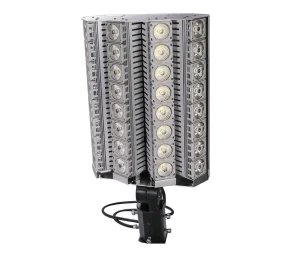
Unlike entry-level extruded aluminum brackets that suffocate LED junctions, our stadium series utilizes die-cast 6063 marine-grade aluminum coupled with sintered copper heat pipes. This pulls junction temperatures under 65°C even when high-powered luminaires operate at 100% capacity under humid summer peak loads.
Precision Optical Refraction
Optical trains employ non-yellowing Japanese polycarbonate and anti-glare tempered optics delivering razor-thin 10°, 15°, 30°, and customized 60°x100° asymmetric spreads. This achieves pitch uniformities (U1 and U2) exceeding 0.70 across Class I and Class II broadcast pitches.
Decoupled Driver Architecture
Drivers endure the highest electronic wear. By utilizing external, mast-base IP67 remote driver racks equipped with high-surge 10kV/20kV suppressors, stadium maintenance crews can service control hardware without requiring heavy cranes on delicate turf surfaces.
Localized German Engineering Compliance: DIN EN 12193 & DMX512 Integration
Deploying stadium lighting systems in Germany demands compliance beyond general CE labels. Projects overseen by Berlin municipal authorities (Bezirksämter) or independent architectural auditors must pass systematic photometric inspections prior to site acceptance.
| Regulatory Standard | Technical Threshold | Our Engineering Verification |
|---|---|---|
| DIN EN 12193 (Sports Lighting) | Class I (National/Pro): >500-750 lx, U0 >0.7 Class II (Regional): >200 lx, U0 >0.6 Class III (Local/Training): >75-100 lx, U0 >0.5 |
Certified DIALux simulation layouts verifying horizontal and vertical planes, observer points, and player visual comfort. |
| LAI Immission Guidelines | Restricts vertical illuminance (Ev) on bedroom windows to ≤ 3 lux during late night hours in residential zones. | Integrated visor shielding and forward-throw asymmetric distribution lenses that restrict back-spill light to 0.5% max. |
| Flicker Index (HDTV Broadcast) | Flicker Factor < 1% for high-speed digital capture up to 1000 frames per second without stroboscopic artifacts. | Constant current ripple-free drivers coupled with PWM > 20kHz modulation for clean FIFA/UEFA broadcast transmission. |
| Corrosion & Wind Resistance | Survives Central European freeze-thaw cycles, road de-icing salts, and wind shear up to Beaufort Scale 12 (130 km/h). | ISO 9227 salt spray testing > 1000 hours, aerodynamic fin geometries, and 304/316 stainless steel mounting brackets. |
Localized Application Scenarios in Berlin and Brandenburg
Every venue in the capital exhibits unique civil constraints. Below are specific architectural scenarios where our custom optics solve local lighting engineering problems:
Municipal Football Fields (Großspielfelder)
Modernizing traditional 4-pole or 6-pole high-mast systems (16m-22m). Our Flex and Vega series swap out high-wattage HID systems 1-to-1 without exceeding structural pole weight or wind-load restrictions, yielding 55% power savings while pushing pitch lux to 200lx uniform.
Indoor Sports Arenas & Velodromes
Facilities demanding dual-purpose illumination: high-intensity uniform light for fast-paced handball, basketball, or track cycling, combined with instant multi-scene dimming (DALI-2 / DMX-RDM) for entertainment shows and ceremonies without acoustic coil whine.
Tennis Clubs & Training Academies
Courts nestled within residential areas like Zehlendorf or Grunewald. Forward-throw asymmetric distributions project intense uniform coverage over baselines and service lines while maintaining strict sharp cut-offs past the baseline perimeter fence.
Smart Lighting Roadmaps: IoT & Sustainability Matrix
Future-proof stadium lighting must do more than simply turn on and off. Our technical roadmap aligns directly with the digital infrastructure standards championed across Germany and the broader European Union:
LoRaWAN & Zhaga-D4i Sensors
Standardizing luminaires with Zhaga Book 18 sockets allows seamless integration of radar motion sensors and ambient daylight harvesters. Municipal facilities can automatically dim light output to 20% security level during idle hours, transmitting real-time diagnostics via LoRaWAN.
Dynamic Circadian Spectrum Tuning
Multi-channel LED engines allow switching between 5700K (crisp daylight for professional sports matches) down to 3000K or 2700K with amber-heavy profiles after 22:00, safeguarding local nocturnal insect ecosystems around suburban pitches.
Circular Design & Modular Repair
In compliance with the EU Ecodesign Directive, our fixtures feature non-potted, solder-free modular sub-assemblies. Drivers, optical lenses, and LED puck boards can be individually replaced in under 10 minutes, eliminating full-fixture obsolescence.
Expanded Industrial & Specialized Venue Solutions
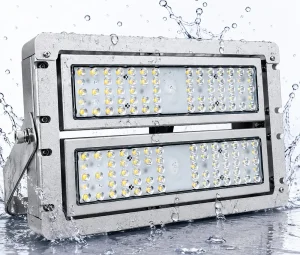
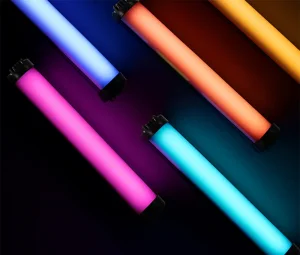
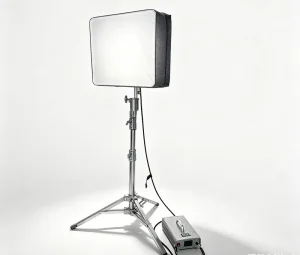
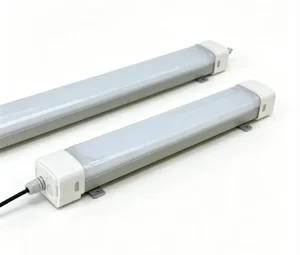
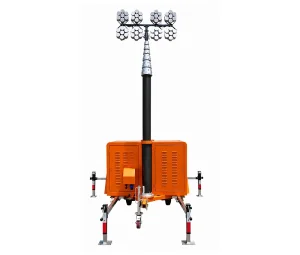
Beyond main competition stadium bowls, professional athletic complexes require specialized illumination: from moisture-dense aquatic training halls and broadcast staging to maintenance access roadways and deployable mobile lighting units.
Berlin Stadium & Sports Floodlighting: Frequently Asked Questions
Essential technical and commercial clarifications for German municipal planners, lighting designers, and installation contractors.
How do you verify compliance with German DIN EN 12193 standards?
What measures prevent light pollution in dense Berlin residential areas?
Can our existing lighting towers support your high-wattage LED fixtures?
Which control protocols are natively supported for dynamic sports staging?
Initiate Your Berlin Sports Lighting Project
Whether you are modernizing a district sports facility in Treptow-Köpenick or designing a premier multi-use arena in Brandenburg, our engineering specialists will configure tailored photometric simulations, structural wind calculations, and project quotation datasheets.
Send Inquiry Now